Key takeaways
- Social media goals should tie directly to business objectives like revenue, brand awareness, or customer retention.
- The SMART framework (Specific, Measurable, Achievable, Relevant, Time-bound) turns vague ambitions into goals you can actually track and report on.
- Every goal needs mapped KPIs, and the goals-to-metrics table in this post gives you a ready-made reference.
- The best social media teams review and adjust goals quarterly, not just annually, and align them across departments.
What are social media goals?
Social media goals are the desired outcomes you want your social media efforts to achieve. They give your strategy direction and help you measure whether your work is paying off.
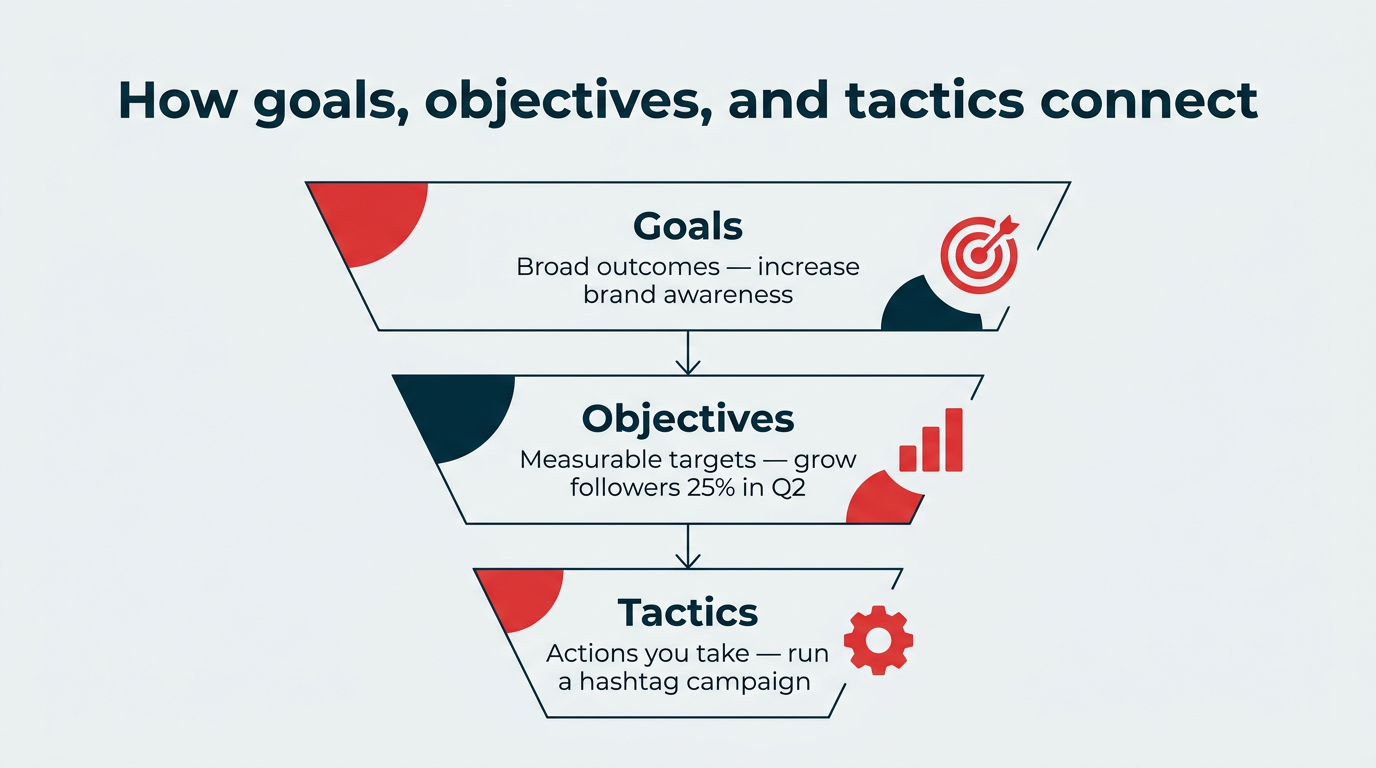
It helps to understand how goals, objectives, and tactics relate to each other.
- Goals are the broad outcomes you’re working toward (like “increase brand awareness”)
- Social media objectives are the specific, measurable targets within those goals (like “grow Instagram followers by 25% in Q2”)
- Tactics are the actions you take to get there (like running a branded hashtag campaign)
When all three are aligned, your team knows exactly what success looks like and how to get there.
Bonus: Get a free social media analytics report template that shows you the most important metrics to track for each network.
Why do social media goals matter?
Social media goals matter because they give your strategy focus and make it possible to measure results. Without them, it’s hard to know whether your efforts are contributing to the business or just generating activity.
For enterprise teams especially, clearly defined goals are the foundation of a scalable social strategy, making it easier to secure budget, align cross-functional stakeholders, and report performance to the C-suite. Shared social media strategy goals also give marketing, communications, and customer care teams a single definition of success to work from. They also help you:
- Manage your budget,
- Structure and streamline your workflow,
- Prove your marketing’s return on investment,
- Align your social media activity with your organization’s broader business objectives.
Goals can have added benefits like growing your social following, but that shouldn’t be your main motivator.
How do you set social media goals in 5 steps?
Setting effective social media goals doesn’t have to be a mystery. And social media goal setting is a skill you’ll use in many other facets of your career, like when you create a social media proposal.
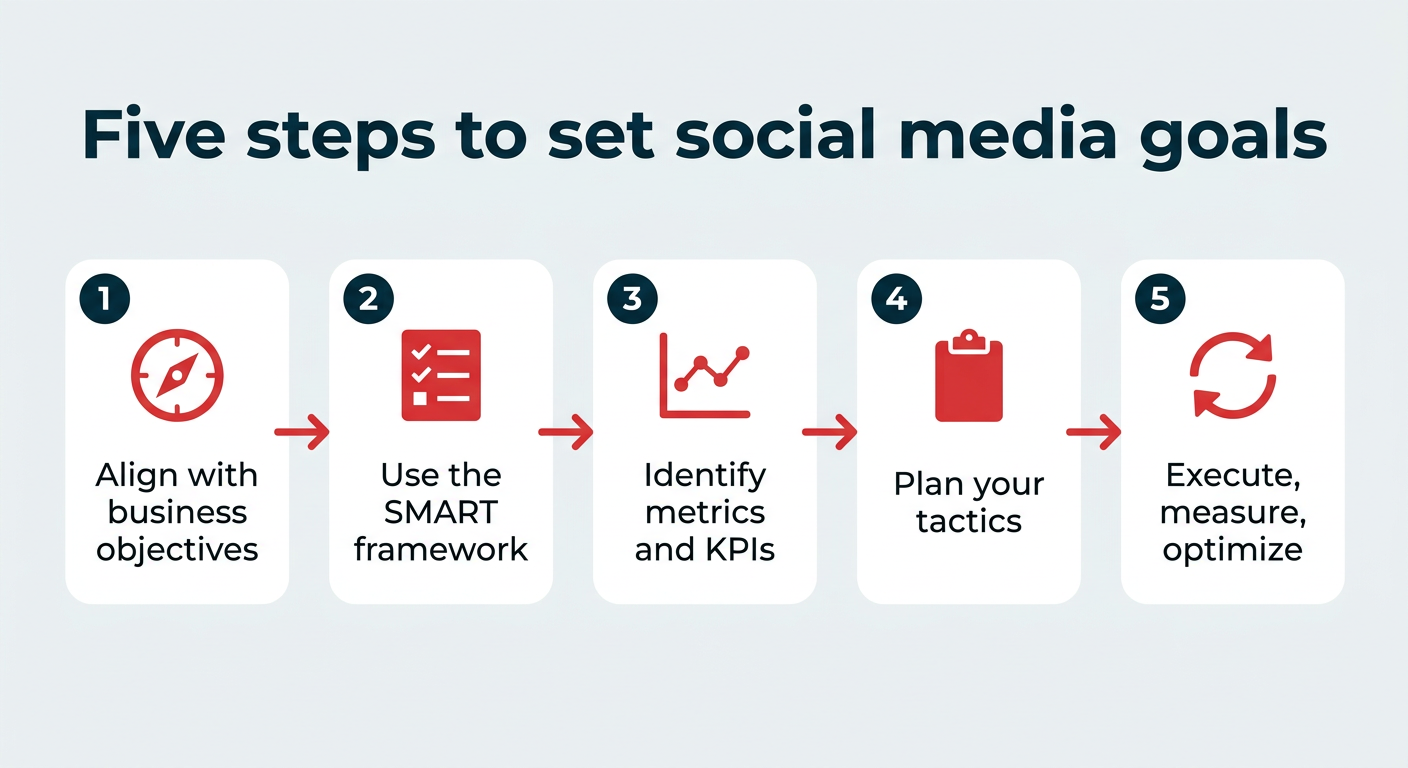
Here are the five steps at a glance:
- Align goals with your business objectives
- Use the SMART framework
- Identify your key metrics and KPIs
- Plan your tactics
- Execute, measure, and optimize
Now let’s break each one down. And once you’ve worked through the steps, it’s worth reviewing the common goal-setting mistakes later in this post before you lock anything in.
Step 1: Align goals with your business objectives
Before you start throwing ideas out there, ask yourself: What problems does our business need to solve? Or, what would most benefit the business in the next year?
Maybe the answer is, “Our business isn’t as recognizable as we would like.” Or “Our business could really use some more web conversions.” If your organization is expanding into a new region, your social goals might focus on building brand awareness in that market.
Your social media goals should be aligned with your business objectives. So, if your business is often confused with your competitors, you can use your social media pages to show people how you’re different and build up your brand’s reputation.
Let your business objectives inform your social media goals.
Step 2: Use the SMART framework
Once you’ve finished step one, make sure the goals you’ve set are attainable. You can do so using the SMART framework.
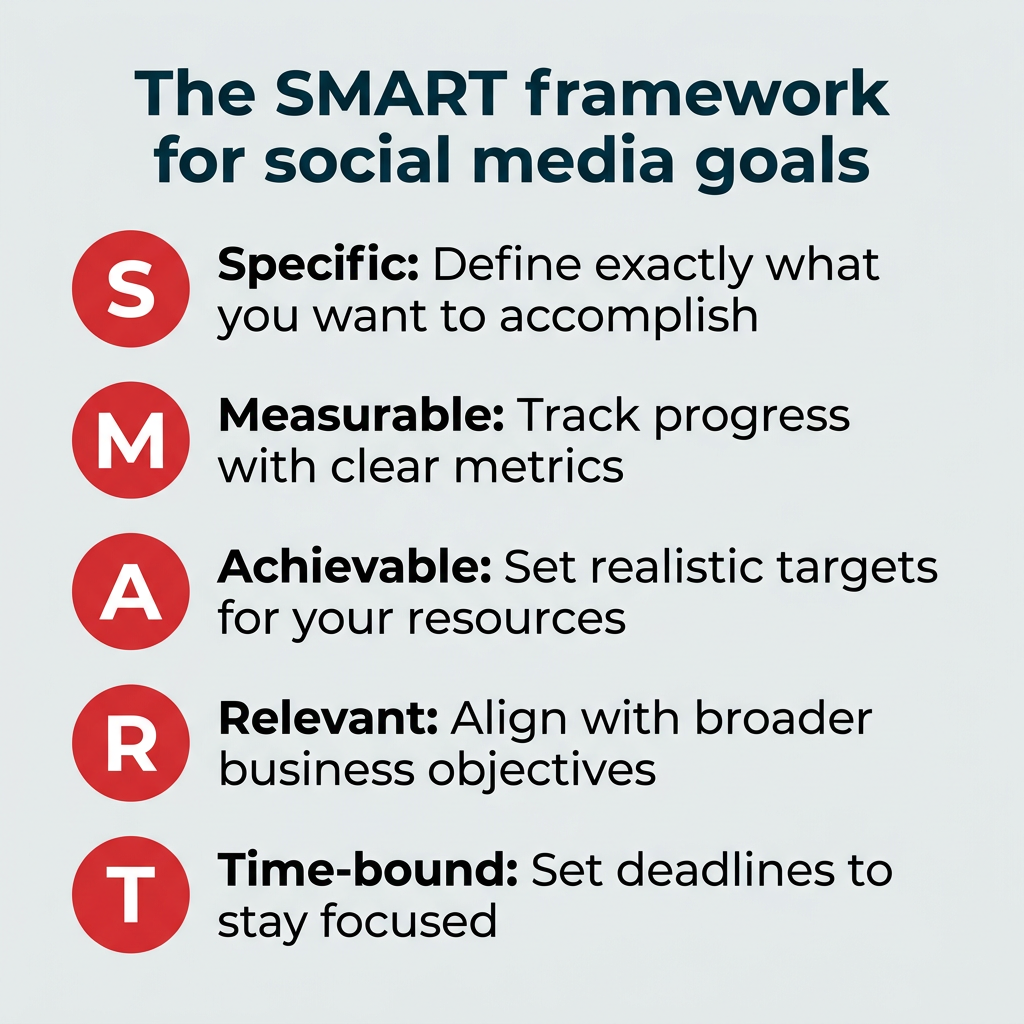
The SMART framework is a great litmus test for whether or not your goals can be reasonably achieved.
Make sure all of your social media goals are:
- Specific: Clearly define what you want to accomplish.
- Measurable: Ensure you can track progress with metrics.
- Achievable: Set realistic goals that can be attained with your resources.
- Relevant: Goals should contribute to your business’s broader objectives (see Step 1).
- Time-bound: Work towards deadlines to keep efforts focused.
What are 5 SMART social media goals examples?
Here are five SMART social media goals examples that cover the most common goal types, from awareness through to revenue:
- Awareness: Increase Instagram reach by 30% by the end of Q3 2026.
- Engagement: Increase audience shares of content by 15% on LinkedIn within the next six months.
- Customer service: Reduce customer wait time from 10 minutes to two minutes by leveraging Facebook Messenger by next quarter.
- Lead generation: Generate 500 qualified leads through LinkedIn lead gen forms in six months.
- Revenue: Increase social-attributed pipeline revenue by 20% across three regions by Q3 2026.
Notice that each one names a metric, a number, and a deadline. If any of those three pieces is missing, the goal isn’t SMART yet.
Step 3: Identify your key metrics and KPIs
Your key metrics and key performance indicators (KPIs) will depend on the goals you’ve set. For example, if your goal is to sell more products and services by funneling people from your social accounts to your website, then traffic and conversions will be important KPIs.
Common metrics include:
- Engagement: Likes, shares, comments, mentions.
- Reach: The number of people exposed to your post.
- Traffic: The number of visitors directed to your website via social media.
- Conversions: Actions taken, like newsletter signups or purchases.
If none of the above feels quite right, or you just want more options, try these social media metrics.
You’ll also find a summary table mapping each of the 10 goals below to its top social media KPIs later in this post, so you don’t have to build that mapping from scratch.
Step 4: Plan your tactics
Now that you know where you’re headed and how to tell if you’re on the right track, it’s time to map out what will get you there. A strategy template can help you organize goals, tactics, and KPIs in one view.
Brainstorm the kinds of things you can do to achieve your goals. This will likely take many forms, such as:
- Scheduling regular posts to maintain a consistent brand presence,
- Building a relationship with your community through engagement,
- Ideating and crafting the types of content your audience wants to see,
- Using AI writing tools to accelerate content creation and testing,
- A/B testing different content types and social platforms, and
- Getting as many eyes on your content as possible by boosting posts and running ads.
Step 5: Execute, measure, and optimize
Once you’ve set things in motion, keep checking your progress by using the metrics and KPIs you decided on in step 3. This way, you can see if you’re on track to meeting your goals, and if not, you can adjust the tactics you’re taking.
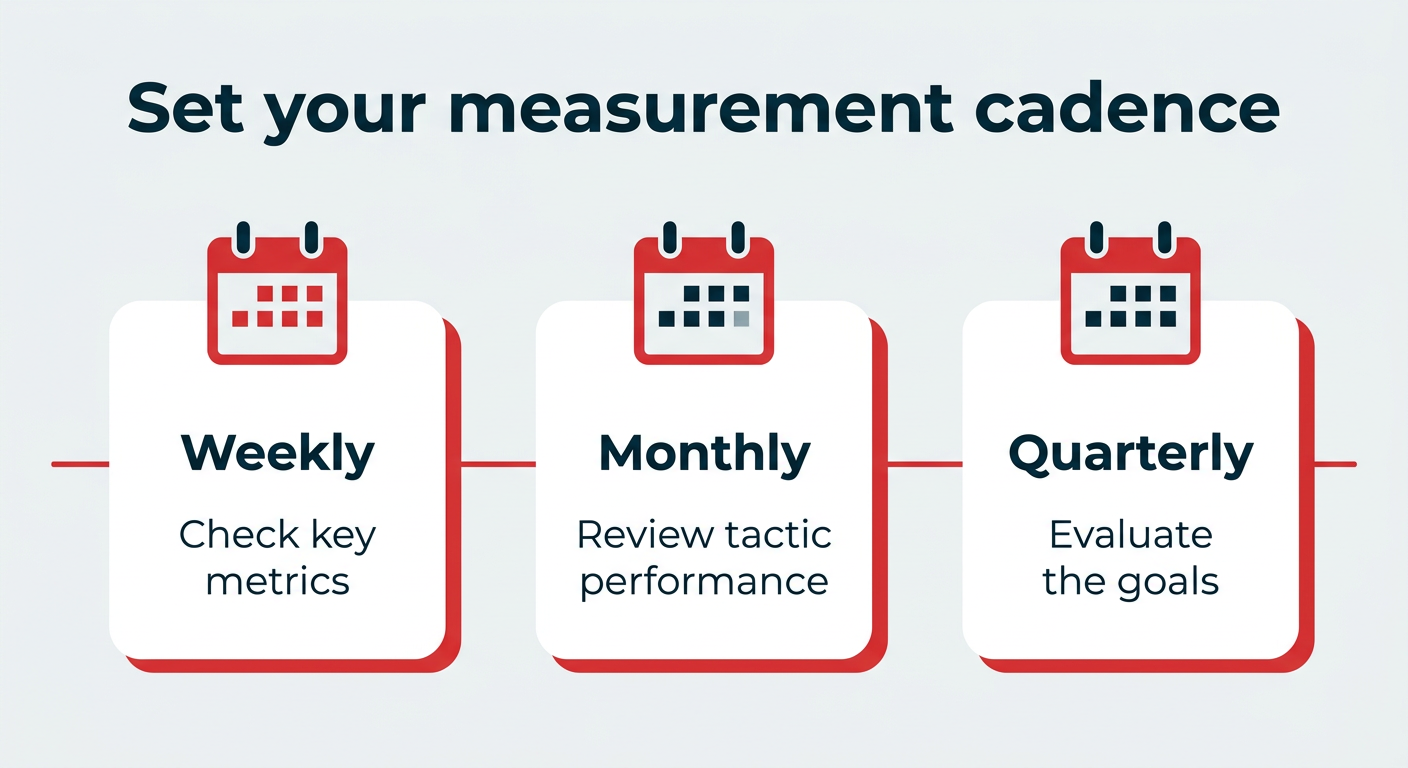
A good cadence is weekly check-ins on key metrics, monthly reviews of tactic performance, and quarterly evaluations of whether your goals themselves still make sense. If a goal isn’t being met, pivot your tactics first before changing the goal itself. Sometimes a content format swap or a shift in posting schedule is all it takes.
When reporting to stakeholders, tie your metrics back to the business objectives from step one. A structured OKR framework can help you show how social performance connects to revenue, pipeline, or brand health, making it much easier to maintain buy-in.
Regular evaluation and optimization help to make sure your efforts are working toward your goals. There’s a full walkthrough of dashboards, cadence, and stakeholder reporting near the end of this post.
What are the top 10 social media goals to set in 2026?
With nearly 5.75 billion social media users worldwide in 2026, the goals of social media marketing should always reflect your specific business needs and align with the latest social trends. But many goals can apply to almost any social media campaign, and some campaigns can contribute to several goals at once.
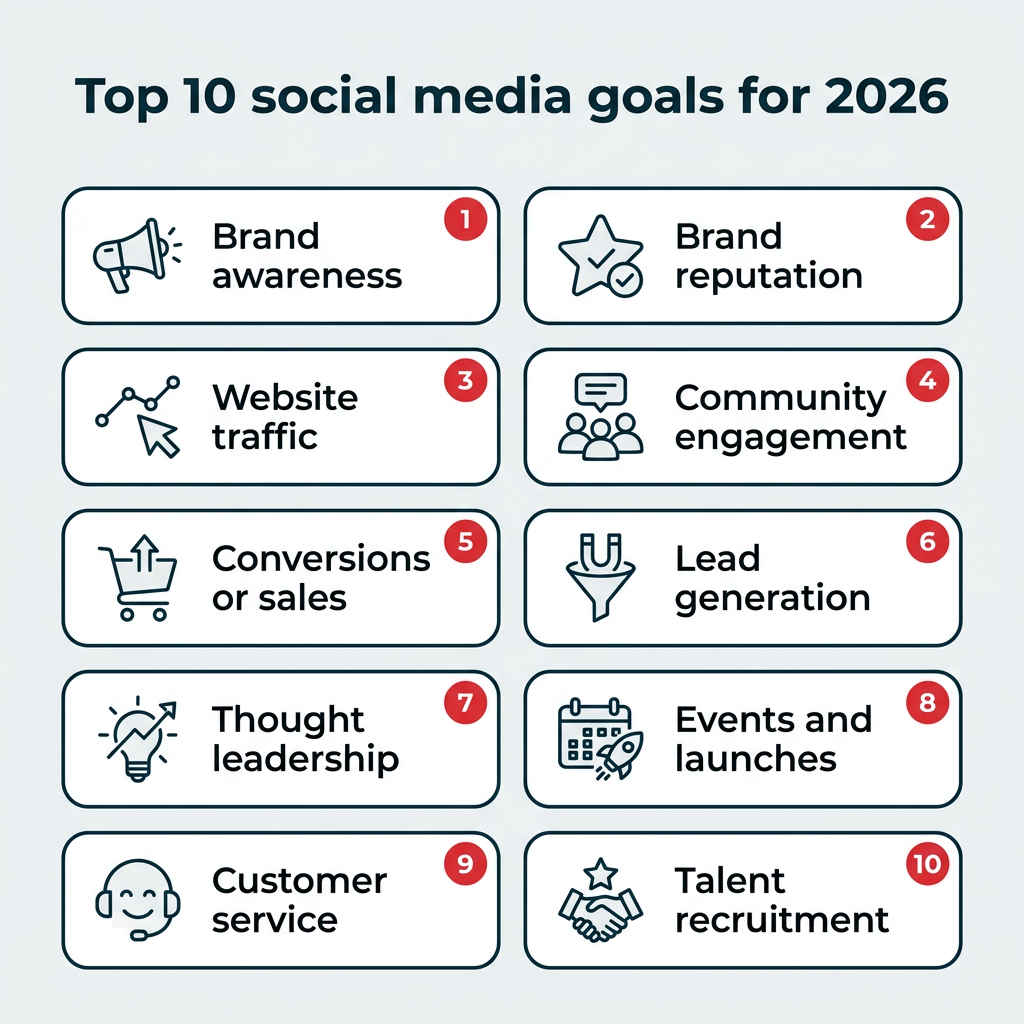
Here are 10 of the most common types of social media goals, along with the metrics you can use to measure success. Use these social media goals examples to frame your work in concrete, actionable terms.
1. Increase brand awareness
Building brand awareness means increasing the number of people who know your brand. This goal might be necessary if your brand or products are often confused with your competitors. Achieving this goal keeps your brand top of mind for consumers when they make purchasing decisions.
You can measure brand awareness on social media with specific metrics like:
- Post reach: The number of people who have seen a post since it went live.
- Audience growth rate: The rate at which you gain followers over time.
- Potential reach: The number of people who might see a post during a reporting period.
- Social share of voice: The number of people who mention your brand on social media compared to your competitors.
Need help tracking your brand awareness? Hootsuite makes it easy to measure and report on brand awareness metrics.
Hootsuite Analytics makes measuring brand awareness metrics easier by allowing you to track metrics from multiple social networks, all in one place. You can even export the information or create custom reports to share with colleagues and stakeholders. The tool collects data from Instagram, Facebook, TikTok, LinkedIn, and X (Twitter).
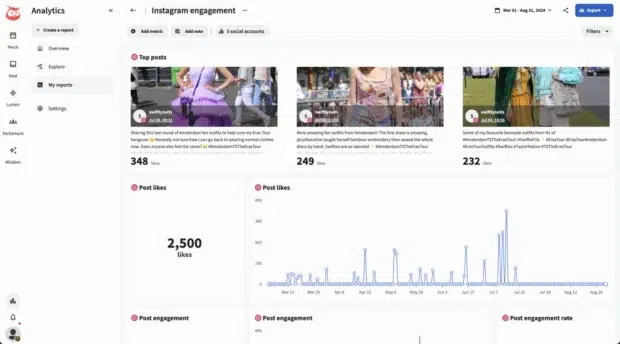
Track brand awareness metrics across all your social channels in one centralized dashboard.
If you want to go even further, Hootsuite can also help to show you your social share of voice through social listening capabilities.
2. Manage brand reputation
Social media marketing is one of the top ways you can build trust in your brand.
The metrics for measuring reputation are like those for brand awareness. Of course, you’ll track brand mentions and relevant hashtags. But you’ll also want to watch what people say about you even when they don’t tag you — including online reviews. That’s where social listening comes into play.
Every Hootsuite plan includes everything you need to get started with social listening.
Search tools let you discover trending hashtags, brands, and events anywhere in the world, or dive deeper for personalized insights on your brand.
You can track what people are saying about you, your top competitors, and your products.
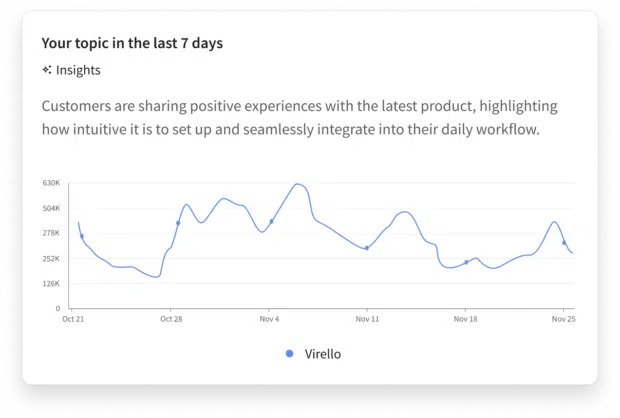
Monitor brand mentions and sentiment with Hootsuite’s search tools.
Plus, you can analyze things like:
- Key metrics: Are more people talking about you this week? What’s the vibe of their posts? Listening doesn’t just track what people are saying, it uses sentiment analysis to tell you how they really feel.
- Top themes: How are people talking about you? What are the most popular positive and negative posts about? Which other conversations are you showing up in?
- Results: Ready to get into specifics? The results view will show you a selection of popular posts related to your search terms, and you can filter by sentiment, social channel, and more.
Want to take social listening further? Lumen, the integrated insights and listening app inside Hootsuite Social OS, can show you sentiment over time, top influencers in your space, audience demographics, and much more.
Get deeper insights with listening tools that track sentiment trends and influencer activity.
3. Drive website traffic
Yes, increasing traffic to your website can be a social media goal! Social media marketing goals aren’t limited to actions that happen on social (though creating zero-click content is still a valid strategy).
Your digital strategies should all be working toward the same business objectives, so don’t let your social platforms become siloed from your website or any other online touch points. They can all work together to boost sales or move people down your social media marketing funnel.
Measuring website traffic in analytics is relatively simple. However, here are some of the top metrics you should keep an eye on:
- Traffic to your site: It’s obvious, but don’t forget to limit your reporting to the most relevant period. This can be daily, weekly or monthly. If you have a baseline number to compare traffic to, even better!
- Network referrals: Monitoring referrals can help you determine which platform is working best.
- Email sign-ups: Once your social traffic makes it to your website, are they signing up for more of your content?
For more on tracking social media ROI using Google Analytics, check out our guide.
4. Improve community engagement
Engagement is any type of visible social media interaction with your brand. For example, likes, comments and shares on your posts are all forms of engagement.
Engagement is sometimes considered a vanity metric, but that’s not always true.
These softer signals can help you track how well your content meets your target audience’s needs. Improving engagement often means better quantity or quality interactions with your audience.
View engagement metrics across all your social channels to understand how your audience interacts with your content.
There are several ways to calculate social media engagement rates. Here are a few examples:
- Engagement rate by reach (ERR): The percentage of people who chose to interact with your content after seeing it. You can calculate this by individual post or average it over time.
- Engagement rate by posts (ER post): Similar to ERR, but measures the rate at which your followers engage with your content.
- Daily engagement rate (Daily ER): Measures how often your followers engage with your account daily.
You’ll also want to keep an eye out for things like user-generated content and interactions in brand-hosted forums, like a live feed.
If calculations make your head spin, we’ve got you. Hootsuite’s free engagement calculator can do the work for you!
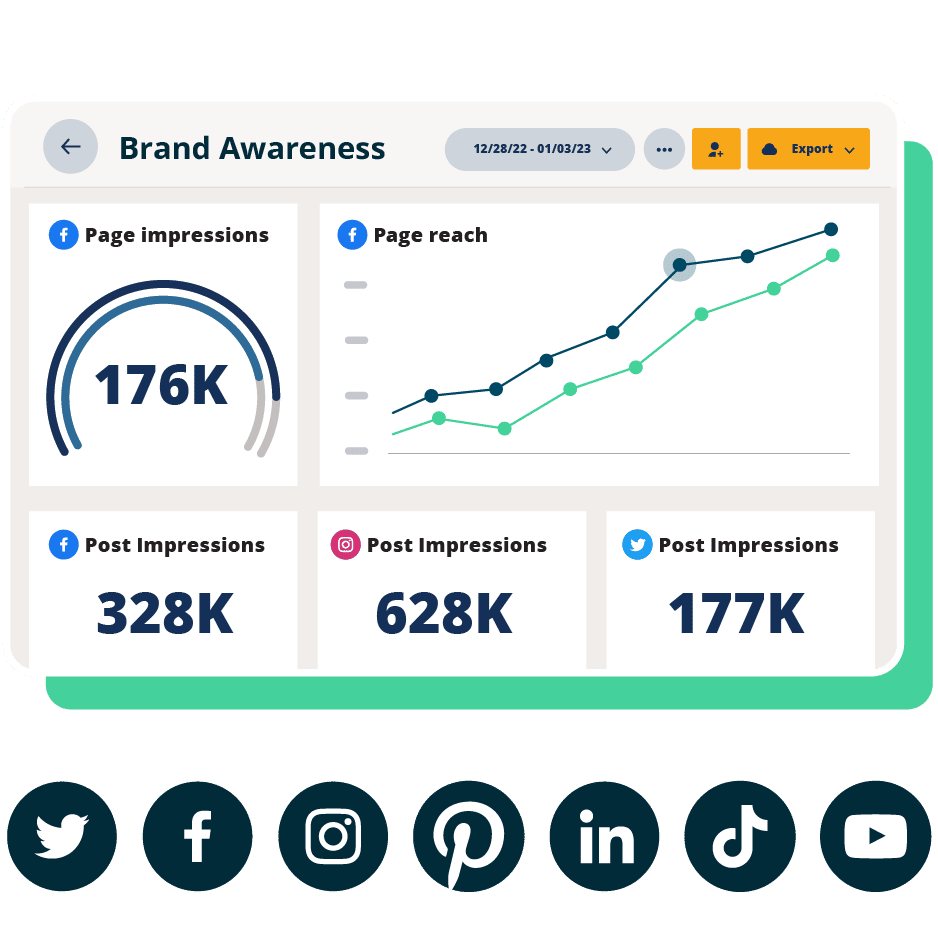
Beautiful reports. Clear data. Actionable insights to help you grow faster.
Start your free trial5. Boost conversions or sales
Do you want your social presence to translate into sales? Then try focusing on your conversions.
Depending on your specific business goals, you can measure conversion in several ways:
- Conversion rate: The number of visitors who, after clicking on a link in your post, take action on a page divided by that page’s total visitors.
- Click-through rate (CTR): How often people click on the call-to-action link in your post.
- Social media conversion rate: The percentage of total conversions from social media.
- Bounce rate: The percentage of users that click on one of your links only to leave without taking any action.
Social platforms and campaigns with integrated shopping tools are great for conversion goals. These include Pinterest Product Pins, Facebook Shops, Instagram Shopping, TikTok Shop, and YouTube Shopping. Social commerce is on track to surpass $100 billion in 2026, so it’s worth exploring which platforms align best with your audience and product catalog.
6. Generate leads
If you want to fill your funnel with potential customers, you might want to set a goal to generate more social leads.
Lead-generating campaigns yield any information that helps you follow up with a social media user. That includes names, email addresses, occupations, employers, or other information they share.
Common metrics to watch for are:
- Number of lead forms submitted,
- Downloads of gated content, and
- Sign-ups for webinars or newsletters.
To learn more about generating high-quality leads, we’ve put together a guide dedicated to social media leads.
7. Build thought leadership
If your organization wants to be seen as an authority in your industry, thought leadership should be a core social media goal. This means positioning your executives, subject matter experts, and brand voice as go-to sources for insights and expertise.
Thought leadership is especially valuable for B2B companies. 64% of hidden decision-makers trust thought leadership content more than marketing materials and product sheets when assessing capabilities and competencies, per the 2025 Edelman-LinkedIn B2B Thought Leadership Impact Report. It’s also a long-term play that compounds over time as your content gets shared, cited, and referenced.
Metrics to track for thought leadership include:
- Social share of voice: How often your brand is mentioned relative to competitors in industry conversations.
- Earned media mentions: Press coverage, podcast invitations, or conference speaking opportunities driven by your social presence.
- Content engagement on executive posts: Likes, comments, and shares on posts from your leadership team’s personal profiles.
- Follower growth on executive profiles: A growing audience for your leaders signals rising influence.
One effective tactic is employee advocacy, where team members share company content and industry insights from their own profiles. This extends your reach far beyond your brand accounts and adds a human, credible voice to your messaging.
8. Promote events or product launches
If you’ve got a new product ready to launch or are hosting an event, social media is the perfect place to build momentum.
Running a social media campaign dedicated to your pending product or event can help you find success. Consider building a content calendar in advance that maps out teaser posts, countdown content, launch-day assets, and follow-up recaps.
Here are the metrics to measure:
- Event registrations,
- Mentions of event hashtags or the name of your product,
- Product sales or traffic from social, and
- Engagement on promotional posts.
9. Deliver customer service
Your social presence isn’t just about attracting new customers. It’s also a place to keep the customers you already have. Goals to improve customer service on social media can take on a variety of forms, including:
- Establish a new customer support channel on social media
- Reduce wait times
- Increase customer satisfaction
Measuring the success of your social customer service will depend on your goal. Usually, you’ll use data from customer testimonials and customer satisfaction surveys.
Internal measurements like the number of service requests handled per customer service representative can also be useful.
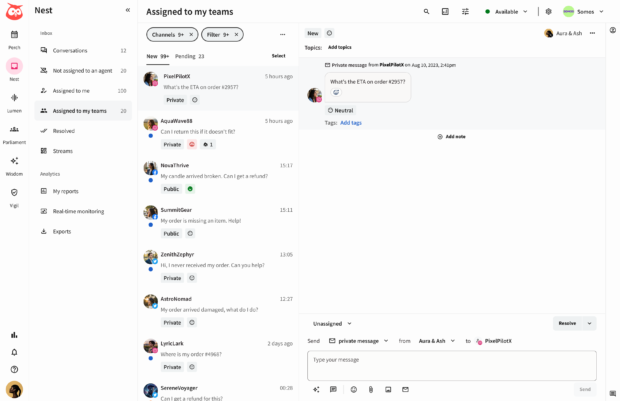
Platforms like X (formerly Twitter), Facebook Messenger, Instagram DMs, and WhatsApp are natural fits for customer service goals. Nest, the social customer care app inside Hootsuite Social OS, brings those conversations into one place with governed workflows so nothing gets missed. Many brands also use AI-powered chatbots on these channels to handle common questions and reduce response times.
10. Attract candidates for open positions
Using social media to fill open positions in your company is another kind of conversion. In this case, you’re targeting a particular type of user interaction: submitting a resume.
When recruiting for an open position, quality conversions are way more important than quantity. LinkedIn is usually (but not always!) your best bet for finding an engaged audience.
Beyond job postings, consider investing in employer branding content that showcases your company culture, values, and employee stories. This kind of content attracts passive candidates who aren’t actively job hunting but might be open to the right opportunity. Employee advocacy programs can amplify this reach by encouraging your team to share open roles and culture content from their own profiles.
When tracking social recruitment, keep an eye on metrics like these:
- Number of leads per platform: Is Instagram sending more candidates than LinkedIn?
- Source of hire: Once a hiring decision has been made, review where the candidate came from. Maybe that flood of Instagram-generated leads was mostly spam.
- Quality of applicants: Track how many social-sourced candidates make it past the initial screening stage.
How do social media goals map to key metrics?
Here’s a quick-reference table that ties each goal to its most important KPIs and how to measure them.
| Goal | Primary KPIs | How to measure |
|---|---|---|
| Increase brand awareness | Post reach, audience growth rate, social share of voice | Hootsuite Analytics, native platform insights |
| Manage brand reputation | Sentiment score, brand mentions, share of voice | Social listening tools (e.g., Lumen) |
| Drive website traffic | Referral traffic, network referrals, email sign-ups | Google Analytics, UTM parameters |
| Improve community engagement | Engagement rate (ERR), comments, shares | Hootsuite Analytics, engagement rate calculator |
| Boost conversions or sales | Conversion rate, CTR, bounce rate | Google Analytics, platform ad managers |
| Generate leads | Lead form submissions, gated content downloads, sign-ups | CRM, platform lead gen forms |
| Build thought leadership | Share of voice, earned media mentions, executive post engagement | Social listening, media monitoring tools |
| Promote events or product launches | Event registrations, hashtag mentions, promo post engagement | Event platform analytics, social monitoring |
| Deliver customer service | Response time, resolution rate, CSAT score | Nest, customer survey tools |
| Attract candidates | Leads per platform, source of hire, applicant quality | ATS (applicant tracking system), UTM parameters |
What are the most common social media goal-setting mistakes?
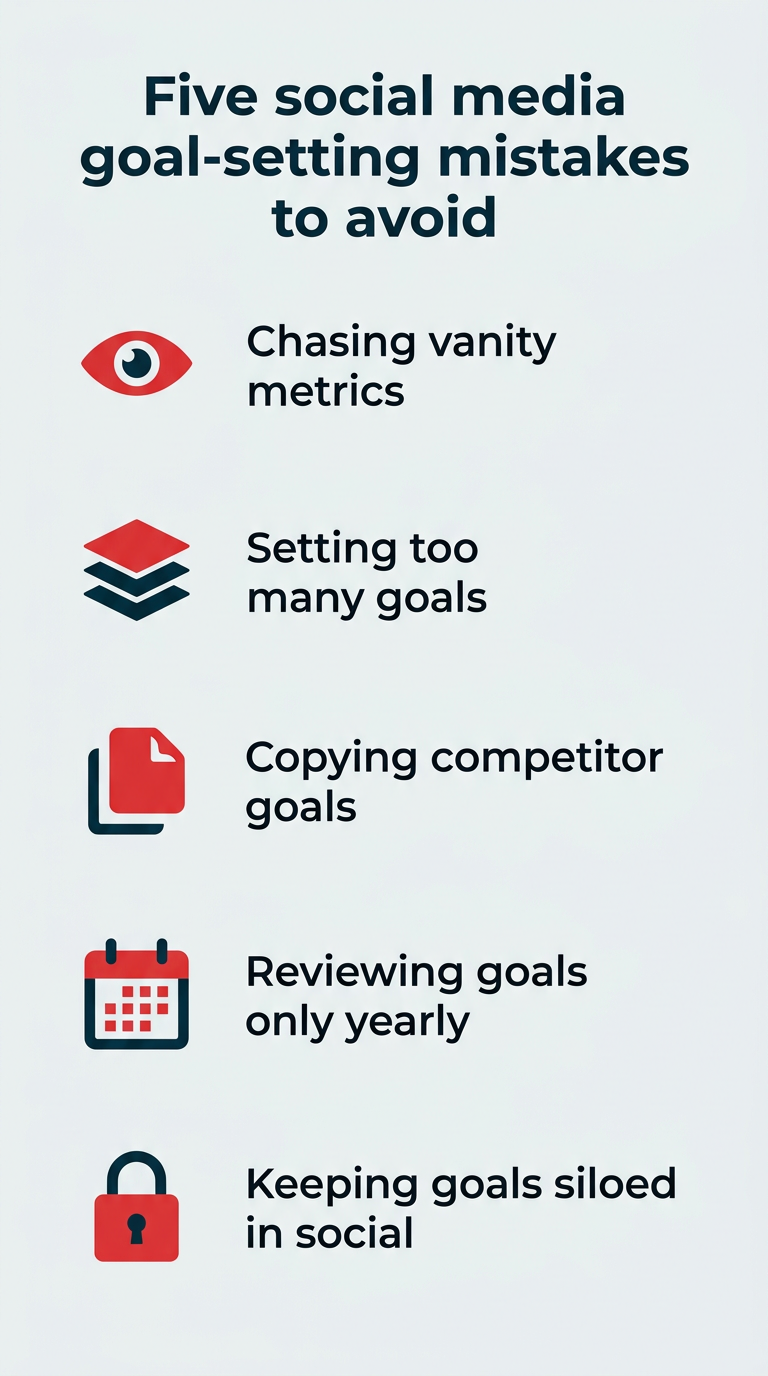
The most common social media goal-setting mistakes come down to measuring the wrong things, setting too many targets, or treating goals as a once-a-year exercise. Here’s what to watch for before you finalize your plan.
- Chasing vanity metrics: Follower counts and likes feel good in a deck, but on their own they don’t tell leadership much. Pair every soft metric with one that connects to revenue, pipeline, or retention.
- Setting too many goals at once: Three well-resourced goals will beat eight half-funded ones. If everything is a priority, your team ends up spreading effort thin and missing all of them.
- Copying a competitor’s goals: Their targets reflect their budget, team size, and audience, not yours. Use competitor benchmarks as context, then set numbers based on your own baseline.
- Reviewing goals only once a year: Platform algorithms, budgets, and business priorities shift far faster than that. Quarterly reviews give you time to course-correct while the number is still reachable.
- Keeping goals inside the social team: If customer service, sales, and comms don’t know what social is working toward, you lose the chance to support each other’s numbers. Share goals and progress in a forum other teams actually see.
Avoiding these five traps is often the difference between a goal you hit and a goal you quietly drop in month three.
How do social media goals differ by platform?
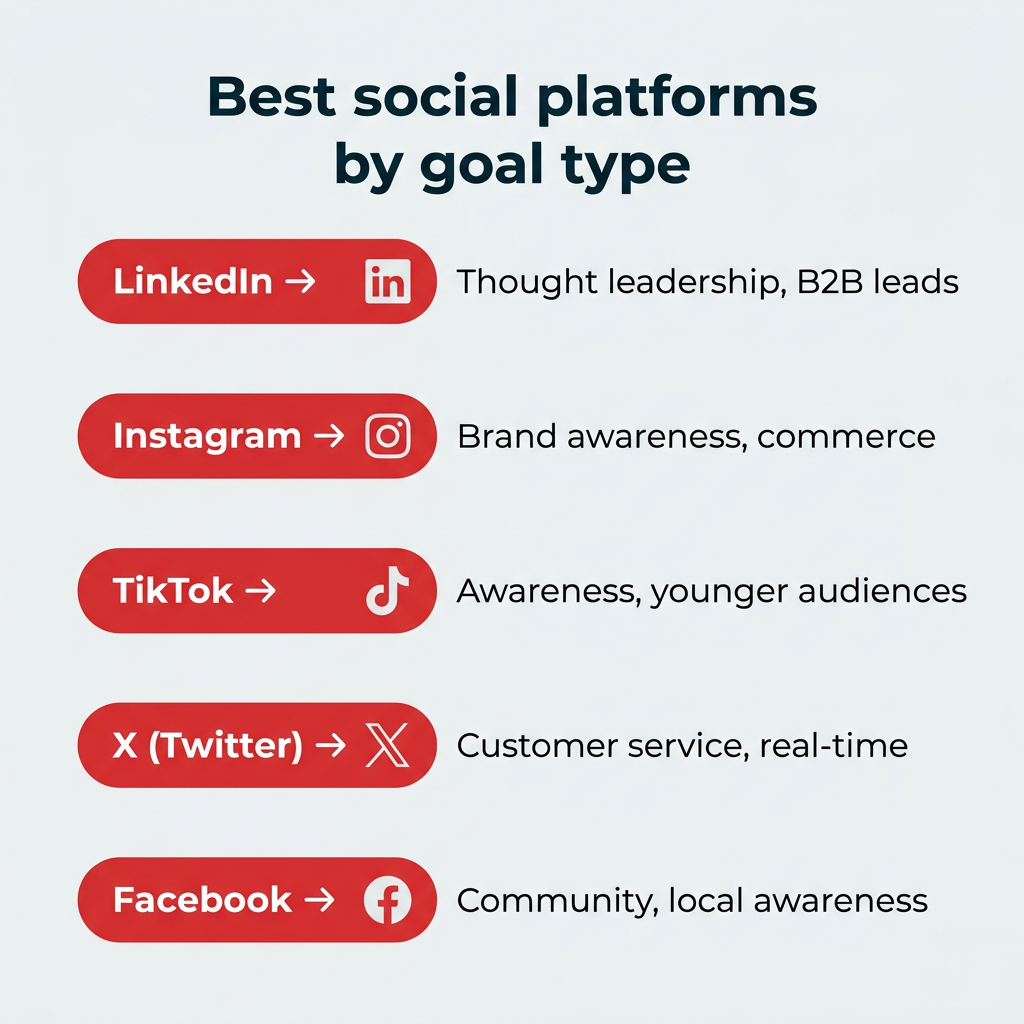
If your team manages multiple platforms, it’s worth tailoring your goals to each channel’s strengths rather than applying the same KPIs everywhere. Here’s a quick breakdown:
- LinkedIn: Best for thought leadership, B2B lead generation, recruiting, and employee advocacy. Focus on engagement from decision-makers and lead form completions.
- Instagram: Used by half of U.S. adults, it’s strong for brand awareness, community engagement, and social commerce. Track reach, engagement rate, and shopping activity.
- TikTok: Ideal for awareness, community building, and reaching younger audiences. Measure video views, shares, and follower growth.
- X (formerly Twitter): Well-suited for customer service, real-time engagement, and industry conversations. Monitor response times and mention volume.
- Facebook: Used by 71% of U.S. adults, it’s effective for community management, customer service, and local awareness. Track group engagement, Messenger response rates, and referral traffic.
How do you align social media goals across teams?
You align social media goals across teams by connecting them to shared business outcomes, then giving every stakeholder visibility into the same numbers.
Social touches marketing, communications, customer care, HR, and often sales — so goals work best as part of a unified strategic plan, not set in isolation where they tend to create duplicate work or conflicting priorities.
Four tactics make alignment stick:
- Shared OKRs: Tie social objectives to the same quarterly outcomes other departments are working toward, so a lift in social-sourced pipeline counts for both marketing and sales.
- A cross-functional reporting cadence: Set a recurring monthly review where social, care, and comms leads look at the same dashboard together instead of exchanging separate decks.
- One connected system: When publishing, listening, and customer care data live in different tools, teams argue about whose numbers are right. Connected systems remove that friction and speed up decisions.
- Executive sponsorship: An exec who reviews social media strategy goals alongside other channel goals makes it far easier to protect budget and headcount.
Hootsuite Social OS is built for this kind of operational coordination. Lumen handles insights and listening, publishing and scheduling sit alongside it, and Nest manages inbound customer conversations, all with governed workflows so approvals and permissions scale with your team. The practical benefit is that everyone reviews the same data, in the same place, on the same schedule.
How do you track and measure your social media goals?
You track social media goals by building dashboards around your KPIs, reviewing them on a fixed cadence, and reporting results in the language your stakeholders care about. Setting goals is only half the job. You also need a solid measurement system for tracking progress and reporting results.
Set a measurement cadence
Start by choosing how often you’ll look at each layer of data. Weekly check-ins help you catch issues early, monthly reviews let you assess tactic performance, and quarterly evaluations are the right time to decide whether your goals themselves need adjusting. Anything more frequent than weekly usually creates noise rather than insight.
Build dashboards around goals, not everything
Build dashboards that map directly to your goals and turn social data into actionable business intelligence. Rather than tracking every available metric, focus on the two or three social media KPIs that matter most for each goal. One dashboard per goal keeps reporting clean and makes it obvious when something is off track.
Hootsuite Analytics lets you track performance across Instagram, Facebook, TikTok, LinkedIn, and X from a single dashboard. You can build custom reports, export data for presentations, and benchmark against competitors, all without switching between platforms.
Report results in business terms
When you present to stakeholders, lead with the business objective, then show the social metric that moved it. A slide that says “social-attributed pipeline grew 18% this quarter” will land better than one that opens with impressions. Keep a short appendix of channel-level detail for anyone who wants to dig in.
Know when to pivot the tactic vs. the goal
If you’re behind on a target, change the tactic first. Swap a content format, shift posting times, or reallocate paid budget and give it a few weeks. Only change the goal itself if the underlying business objective has changed or the target was never realistic with the resources you have.
No matter your broader social media marketing objectives, SMART social media goals can help you succeed. At worst, you’ll learn from your mistakes!
FAQ: Social media goals
What are social media goals?
What are examples of social media goals?
What are the three main goals of social media?
What is the goal of social media?
What are the 5 SMART goals examples for social media?
What are some good social goals?
What are the 7 types of goals?
How often should you review social media goals?
How do you align social media goals with business objectives?
What is the difference between social media goals and social media objectives?
Save time managing your social media marketing strategy with Hootsuite. Publish and schedule posts, find relevant conversions, measure results, and more â all from one dashboard. Try it free today.
The post How to set social media goals in 2026 [10 examples] appeared first on Social Media Marketing & Management Dashboard.
* This article was originally published here


No comments:
Post a Comment