Friday, November 13, 2026

How to cross-post on social media without looking spammy in 2026

Key takeaways

  1. Cross-posting defined: Sharing adapted versions of the same content across multiple social platforms to save time and extend reach.
  2. Why identical posts backfire: Publishing the exact same copy and creative everywhere can read as spam to your audience and perform poorly against platform algorithms.
  3. What good cross-posting looks like: Tailoring captions, visuals, hashtags, and formatting to each platform’s specs and audience before you publish.
  4. How to do it at scale: Tools like Hootsuite Social OS let you customize, schedule, and measure cross-posted content from one workspace.

What is cross-posting on social media?

Cross-posting is the process of posting similar content across multiple social media channels. Social media managers use the tactic to help save time and resources. No more crafting a unique social media update for each channel every time you need to post.

The key word is similar, not identical. Cross-posting works when you start from one core message and then adapt it for each platform’s format, character limits, and audience.

It has also become harder to avoid, with social media platforms now reaching an estimated 5.75 billion users. Most brands now maintain a presence on five or more networks, and with people spending an average of two hours and 21 minutes a day on social media, there is real upside to getting your message in front of audiences wherever they spend their time.

Alongside saving time, cross-posting is a highly effective tactic for social managers because it helps streamline their posting strategy, allows them to repurpose content across multiple platforms, and continually keeps their social channels up to date. It is also easier to execute well than it used to be, since AI-assisted social media management tools can now draft platform-specific variations of a single post in seconds.

Bonus!!!

Get a free step-by-step social media strategy guide with pro tips on how to grow your social media presence.

Who is cross-posting good for?

  • Enterprise and mid-market social teams managing multi-brand, multi-region, or franchise accounts, where one campaign message needs to land consistently across dozens of profiles
  • Agency social media managers running publishing calendars for several clients at once
  • Companies with smaller budgets
  • Startups and founders who are running social alongside doing everything else
  • New brands that haven’t developed a lot of content yet
  • Time-conscious creators who want to free up hours to spend on delivering engaging, compelling posts

Cross-posting vs. content repurposing

Cross-posting and content repurposing get used interchangeably, but they are different jobs. Cross-posting takes one message and adapts it for multiple platforms, keeping the format mostly intact. Repurposing transforms content into an entirely new format for a new purpose.

A product launch graphic posted to Instagram, Facebook, and LinkedIn with tailored captions is cross-posting. Turning a webinar recording into six short vertical clips, a carousel, and a blog recap is repurposing.

Use cross-posting when the message is self-contained and travels well. Use repurposing when the original asset is too long, too dense, or wrong for the format you are targeting. Most strong content calendars use both.
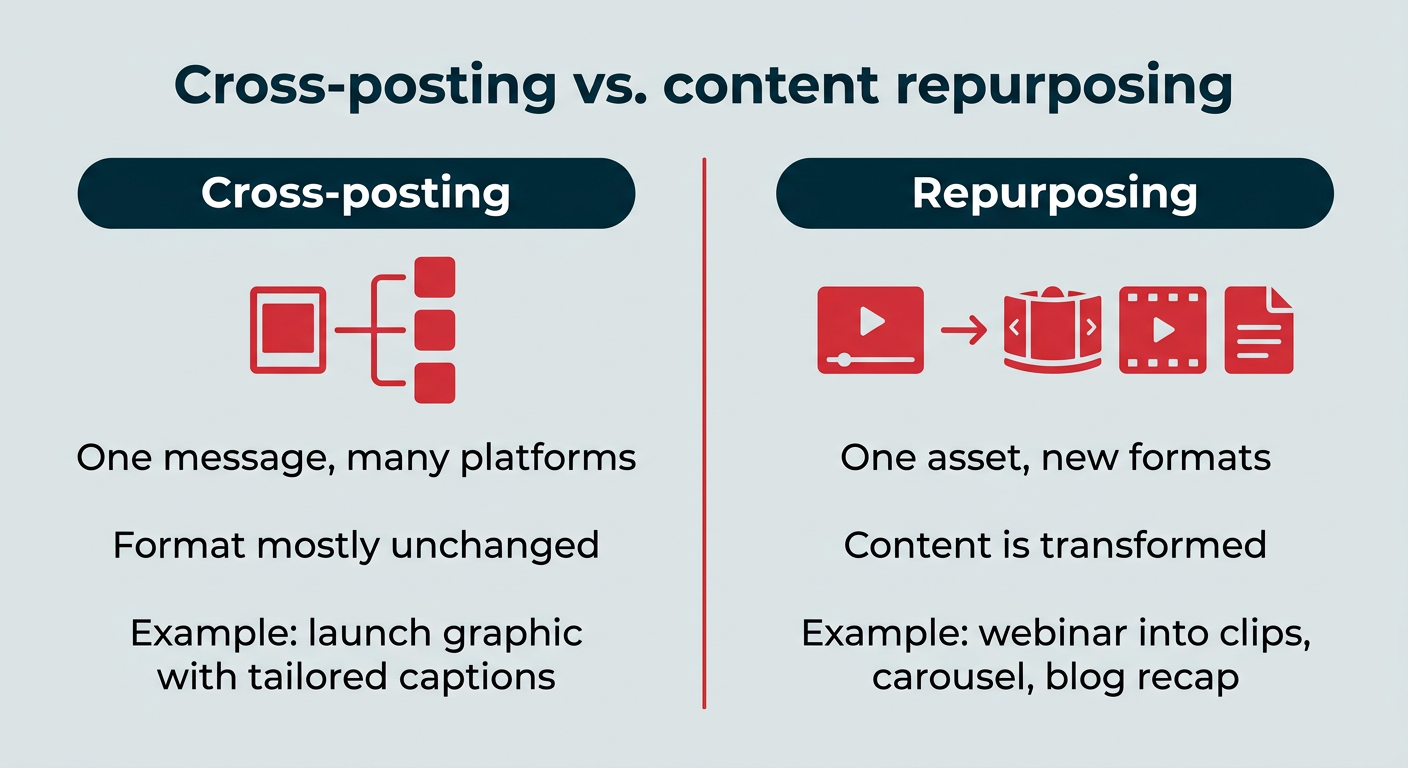
Cross-posting vs. content repurposing

What are the benefits of cross-posting?

The main benefit of cross-posting on social media is output: more presence across more channels without multiplying your production workload. A few more worth planning around:

  • Time savings: One brief, one creative asset, and a handful of caption edits replaces building each post from scratch.
  • Wider reach across different audiences: Platform demographics barely overlap. The same announcement can reach a LinkedIn audience in their 30s and 40s and an Instagram audience under 30, where 80% of adults 18 to 29 are active.
  • More consistent brand messaging: Starting from a single core message keeps campaign language aligned across channels, which matters most when several people publish on behalf of the brand.
  • Better use of your best content: Your top-performing posts deserve more than one shot at an audience.
  • Cleaner performance comparisons: Running the same message across platforms shows you where a given asset actually resonates, which sharpens future planning.
  • Always-on channels: Quieter platforms stay active instead of going dormant between dedicated campaigns.

What are the risks of cross-posting?

Cross-posting goes wrong when adaptation gets skipped. These are the failure points to watch:

  • Content fatigue: Followers who find you on three platforms and see the same post three times have a reason to unfollow two of them.
  • Weaker algorithmic performance: Platforms reward native formats. Reposted videos carrying another app’s watermark or logo tend to get less distribution.
  • Tone mismatches: Copy written for X often reads as flippant on LinkedIn, and LinkedIn copy reads as stiff on TikTok.
  • Broken mechanics: Dead handle tags, clickable links that are not clickable, cropped images, and truncated captions all signal carelessness.
  • Narrower discoverability: Reusing one hashtag set everywhere ignores how differently each platform surfaces and ranks tagged content.

How to build a cross-posting strategy

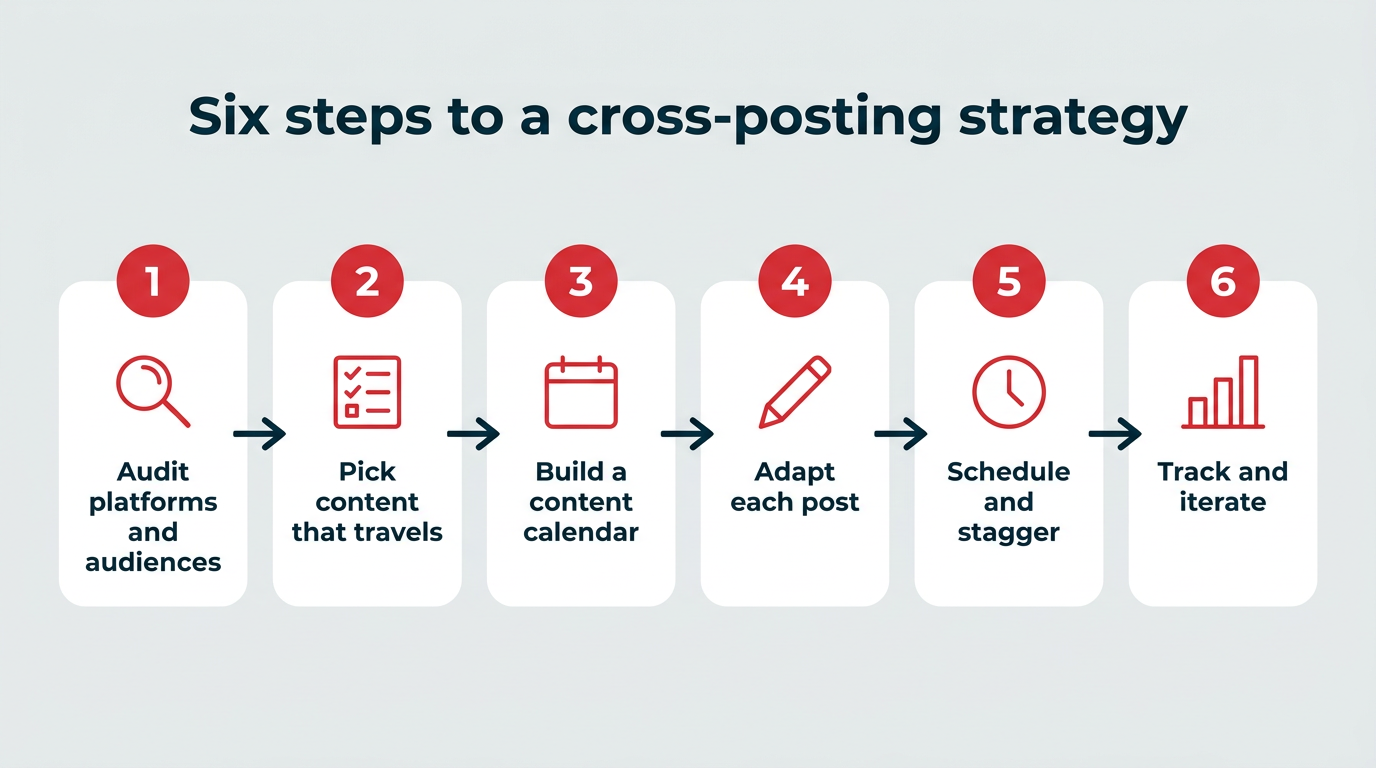
A cross-posting strategy is just a repeatable decision process: what gets cross-posted, where it goes, and how it changes along the way. Here are the six steps:

  1. Audit your platforms and audiences
  2. Identify content types that cross-post well
  3. Create a cross-posting content calendar
  4. Adapt each post for its platform
  5. Schedule and stagger your posts
  6. Track performance and iterate
Six steps to a cross-posting strategy

Start with the audit. List every active profile, who follows it, and how much audience overlap you have between channels. High overlap means you need more variation between versions, not less.

Identify which content types cross-post well

Not everything should travel. Evergreen educational content, brand and product announcements, strong standalone visuals, recruitment posts, and campaign messaging usually cross-post cleanly because the value does not depend on the format.

Content that should stay where it was made includes platform-native trends, TikTok audio-driven formats, LinkedIn long-form articles, community replies, and anything time-sensitive enough that a staggered posting schedule would make it stale.

Create a cross-posting content calendar

Map each core asset to the platforms it will appear on, then assign different publish times to each one. A simple grid with the asset in the left column and platforms across the top is enough to spot duplication problems before they go live.

Build the timing around each channel’s own peak windows rather than one universal slot. We recommend you familiarize yourself with the best times to post for each platform, then plan your calendar in Perch, the content planning and publishing app inside Hootsuite Social OS, which flags recommended publish times per account.

How to cross-post without looking spammy

Cross-posting sounds simple: you’re sharing your content on different networks. How tricky can it be? But, there are essential caveats to the cross-posting process that marketers need to understand.

Posting the exact same message to every network without editing it for the specific requirements and audience demands of those networks can make you look amateur or robotic at best and untrustworthy at worst. The four habits below prevent that.

Adapt your copy and captions for each platform

Start with your core message, then rewrite the caption for each destination. Every social media platform is different in length, tone, and convention, so when you’re cross-posting you need to be mindful of those differences and learn how to speak each platform’s language.

Let’s say you’re the newest coffee shop on the block and want to create a social post to reach your audience on Facebook, X, and Instagram. Each of these social networks has a unique set of parameters for posting, and your cross-posting strategy needs to take these into account.

For example, the character limit on X is 280 for Basic accounts, while the limits on Facebook and Instagram are higher (63,206 and 2,200 respectively), so make sure that you tailor your cross-posted content to fit these lengths.

Also check your tags before you publish. There’s no point in using a handle tag for a brand on X, cross-posting that post to Instagram, and realizing they don’t have an account on that platform.

Here’s a quick list of other parameters you’ll need to take into account when you’re crafting your content to cross-post:

  • Clickable links
  • Hashtag usage
  • Vocabulary
  • Audience
  • Messaging
  • CTA

Don’t post the exact same message across multiple platforms. Beyond the risk of boring followers who see you everywhere, an identical-everywhere approach makes your social media strategy look dull and flat. It also invites small errors, like asking Facebook followers to retweet you, losing part of a caption, or dropping your visual entirely.

If you’re short-changing your followers on one platform by sharing content optimized for another, they’re going to notice. The time you save isn’t worth losing your audience’s respect and attention. After all, if it looks like you don’t care about what you post on your account, why should they?

Stagger your posting times

Timing is everything on social media, and publishing the same message to every channel at the same minute is the clearest signal that a post was automated rather than written. Stagger your posting times by roughly one to three hours between platforms so anyone following you in more than one place does not get the same message twice in a row.
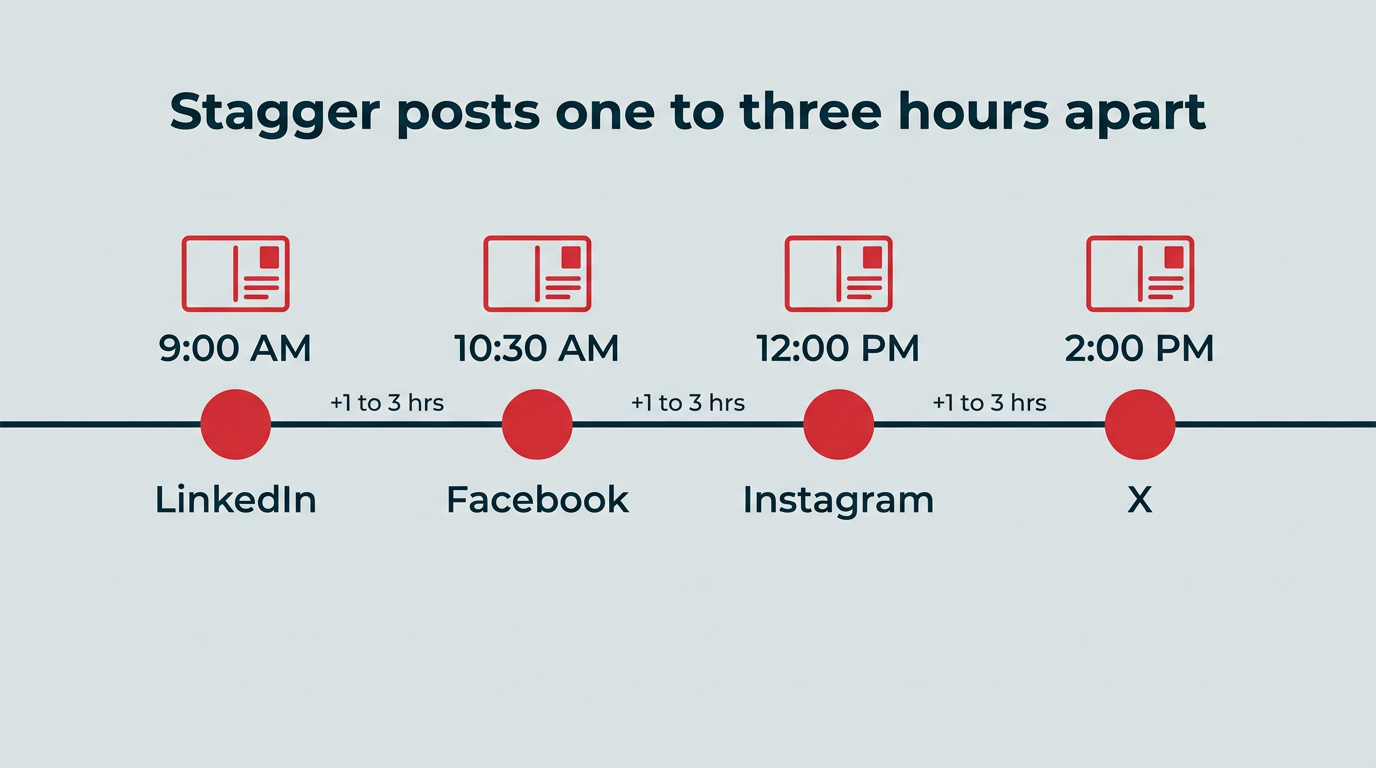
Stagger posts one to three hours apart

Perch includes a recommended best time to publish for each connected account, so you can schedule every version of a post in one sitting and still land in each platform’s strongest window. You can also bulk schedule social media posts, saving you even more time.

Optimize visuals for each platform

Suppose you plan on adding images and videos to your social media marketing (and we think you should). You’ll need to familiarize yourself with the image sizes for each channel before anything goes out, because a vertical video cropped into a square feed post loses text, faces, and framing.

Watermarks are the other common trap. A TikTok video downloaded with its watermark and uploaded to Reels or Shorts is visibly secondhand, and both platforms prioritize content made natively. Export clean files from your editing tool instead, then size them for their destination.

It is worth the extra step. Visual content consistently outperforms text-only posts, so a poorly cropped image or a missing photo costs you more than tidiness.

Follow each platform’s content policies

Repeating content can result in more than disengaged followers. Your followers aren’t the only ones who’ll notice when you post the same thing everywhere; the platforms are watching too.

X’s platform manipulation and spam policy tells users not to cross-post content across multiple accounts, and not to cross-post similar or duplicate content to the same trending topics or hashtags. Repeat violations can lead to reduced distribution or account suspension. Staying on the right side of anti-spam rules means taking the time to ensure each message you post is thoughtful and deliberate.

Platform-by-platform cross-posting specs

Platform

Caption limit

Recommended image size

Hashtag practice

Links

Audience note

Instagram

2,200 characters

1080 x 1350 (4:5)

3 to 5, relevant over broad

Not clickable in captions

Skews under 30, visual-first (Instagram demographics)

Facebook

63,206 characters

1200 x 630

Minimal, 1 to 2

Clickable, link previews render

Broad age range, strong for local and community posts

LinkedIn

3,000 characters

1200 x 627

3 to 5, professional topics

Clickable, previews render

Mostly over 30 and career-focused (LinkedIn demographics)

X

280 characters for Basic accounts

1600 x 900

1 to 2 maximum

Clickable

News, commentary, real-time reaction

TikTok

2,000 characters per video caption in Hootsuite

1080 x 1920 (9:16)

3 to 5, trend and niche tags

Clickable for business accounts

Native vertical video only, avoid watermarks

Pinterest

Up to 800 characters

1000 x 1500 (2:3)

Keywords matter more than tags

Clickable destination URL

Search and planning behavior, long content shelf life

Threads

500 characters

1080 x 1350

One topic tag

Clickable

Conversational, overlaps heavily with Instagram

Best cross-posting tools in 2026

  • Hootsuite Social OS: Built for teams managing several brands or regions. Perch handles planning, platform-by-platform customization, and scheduling across every major network, while Wisdom suggests caption variations tailored to each channel. Plans start at $99 per user per month on Standard, with unlimited social accounts on the Advanced plan.
  • Later: Visual-first planning with a drag-and-drop calendar, useful if Instagram, Pinterest, and TikTok carry most of your content.
  • SocialPilot: Bulk scheduling and client-level permissions, aimed at agencies publishing high volumes across many accounts.
  • Publer: Lightweight and inexpensive, with per-platform post customization and recycling options for evergreen assets.
  • CoSchedule: Strong fit if your social calendar needs to sit alongside blog, email, and campaign planning in one view.

How to cross-post with Hootsuite Social OS

Perch includes a built-in feature that lets you customize one post for multiple social networks on the same screen, so you never start from scratch for each channel.

Customizing a single post for several networks before scheduling.

  1. Log in to your Hootsuite account and navigate to Perch
  2. Select the accounts you want to publish your social post on
  3. Add your social copy in the Initial content box, or use Wisdom to generate a first draft
  4. Edit and refine your post for each channel by clicking the corresponding network icon next to Initial content (add or remove hashtags, tweak the copy, change tags and mentions, or swap in different links)
  5. Once you’re ready to publish, click Schedule for later or Post now, staggering the time for each network

How to measure your cross-posting results

How will you create a successful cross-posting strategy if you don’t analyze your results? Use your social media analytics as a springboard to see whether your campaigns are getting the desired results. For example, do you see more or less engagement when you cross-post?

Track these per platform rather than in aggregate, since the whole point is to find out where each asset works:

  • Engagement rate: The clearest signal of whether your adapted version landed with that audience
  • Reach and impressions: Shows whether a cross-posted asset is getting normal distribution or being suppressed
  • Click-through rate: Reveals which platforms actually drive traffic versus awareness
  • Follower growth and unfollows: Rising unfollows on your most overlapping channels is an early content fatigue warning

Hootsuite’s built-in analytics gives you a detailed overview of key social media performance metrics side by side, enabling you to make data-driven decisions about your cross-posting strategy.
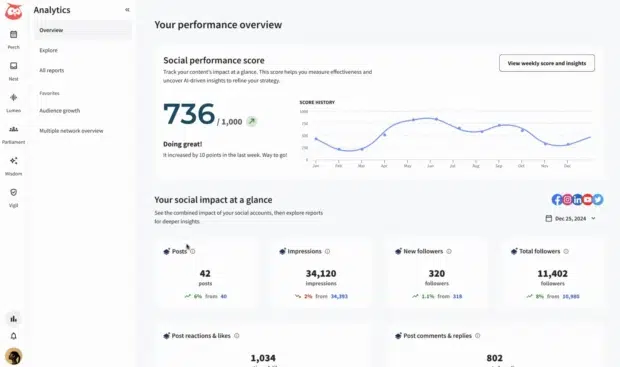
analytics dashboard

Comparing performance across networks to see which platforms respond best to cross-posted content.

You can also use Lumen, the integrated insights and listening app in Hootsuite Social OS, to gather sentiment on whether people feel like they hear from you too much. The goal is a cross-posting sweet spot: enough content to reach your goals, but not so much that audiences find you’re coming on too strong.

Cross-post on social media the right way

Cross-posting works when adaptation is built into the workflow, not bolted on afterward. With Hootsuite Social OS, you can customize one post for every network in Perch, draft platform-specific captions with Wisdom, stagger your publish times, and track what landed where.

FAQ: Cross-posting

Is cross-posting a good idea?

Cross-posting is a good idea when you adapt your content for each platform’s format, audience, and tone. It stops being a good idea when you publish identical copy and creative everywhere at the same time, which reads as automated and tends to underperform.

How do I cross-post a post?

To cross-post a post, start with your core message and then adjust the caption, visuals, hashtags, and formatting to fit each platform before publishing. A social media management tool lets you do all of that in one editor and schedule each version separately.

What is the 5-3-1 rule on Instagram?

The 5-3-1 rule is a content ratio guideline suggesting you share five pieces of curated content, three pieces of original content, and one promotional post for every nine posts. It is a planning heuristic rather than an Instagram policy, meant to keep feeds from tipping too far into self-promotion.

What is the 5 5 5 rule for social media?

The 5-5-5 rule is a social media engagement framework that suggests spending five minutes finding content to share, five minutes engaging with other people’s posts, and five minutes creating your own content. It is designed to keep daily activity balanced when time is tight.

Does cross-posting hurt engagement?

Cross-posting can hurt engagement if you share identical content without adapting it, because audiences and algorithms on each platform respond to different formats and tones. Adapted versions, published at staggered times, generally perform in line with native posts.

What is the best cross-posting app?

The best cross-posting app depends on your team size and needs, but Hootsuite Social OS is built for teams that need to adapt, schedule, and track content across every major platform from one workspace. Smaller teams on tighter budgets may find a lighter tool like Publer or Later sufficient.

Can I cross-post from Instagram to Facebook automatically?

Yes, Instagram allows you to share posts to Facebook automatically through its linked accounts settings, but the formatting and captions may not transfer cleanly. Hashtag blocks and Instagram-specific handle tags in particular tend to look out of place on Facebook.

Should I post at the same time on all platforms?

No, posting at the same time on every platform is not recommended, because followers who find you in multiple places will see duplicate content simultaneously. Leaving one to three hours between platforms also lets you publish in each channel’s own peak window.

What content works best for cross-posting?

Evergreen content, brand announcements, high-quality visual assets, and campaign messaging with broad relevance tend to cross-post most effectively. Platform-native trends, long-form LinkedIn articles, and community replies usually do not.

How often should I cross-post?

How often you cross-post depends on your content volume and audience overlap, but a good practice is to audit your cross-posting frequency quarterly and watch for signs of content fatigue like declining engagement or unfollows. The more overlap between your channel audiences, the more variation each version needs.

Save time managing your social media marketing strategy with Hootsuite. Publish and schedule posts, find relevant conversions, measure results, and more â all from one dashboard. Try it free today.

The post How to cross-post on social media without looking spammy in 2026 appeared first on Social Media Marketing & Management Dashboard.


* This article was originally published here

Thursday, November 12, 2026

Reddit marketing in 2026: Strategy, tips, and examples

Key takeaways

  1. Reddit marketing works best when brands participate authentically in niche communities instead of pushing promotional content.
  2. With more than 100,000 active subreddits and an audience that often isn’t reachable elsewhere (40% of Redditors aren’t on TikTok), Reddit gives brands access to communities they can’t find on other platforms.
  3. A successful Reddit marketing strategy combines organic community participation, social listening, and targeted Reddit ads to build trust and drive results.
  4. Tracking Reddit-specific metrics like karma growth, subreddit engagement, referral traffic, and ad conversions is how you prove ROI to leadership.

What is Reddit marketing?

Reddit marketing is the practice of using Reddit to reach an audience, either by participating organically in subreddit discussions or by running paid Reddit ads. Unlike feed-based platforms, Reddit is forum-driven and built around niche communities called subreddits, so success depends on how well you fit the culture of a specific community rather than how often you post.

And Redditors? They’re famously opinionated.

As a Redditor myself, that’s part of the charm. Reddit is humor-driven, deeply specific, and filled with real, down-to-earth people who definitely don’t respond well to obvious marketing.

But for brands that understand the culture, Reddit can be one of the most powerful platforms for building trust, credibility, and brand awareness.

For other organizations that are a bit more serious, like central banks or the World Health Organization, Reddit is probably not the top choice as a digital marketing channel.

Bonus!!!

Get our 2025 Social Media Trends report for the insights you need to reach your goals in what’s shaping up to be social’s best year yet.

What kind of brands succeed on Reddit?

Brands succeed on Reddit when their approach matches how the platform works. Reddit is built around conversation, so the brands that do well tend to be the ones that listen first and talk second. Reddit tends to work best for brands that:

  • Have a clear, niche audience
  • Can provide genuine value (insight, expertise, transparency)
  • Are comfortable with conversation, not just promotion
  • Don’t take themselves too seriously

For example, SaaS companies, creators, and startups often see strong results when they participate thoughtfully.

Audience fit matters, too. On Reddit, 37% of users are ages 18 to 34, which makes it a strong option for brands targeting younger demographics. The platform also skews male, so check that your audience matches before you invest.

What Reddit terms should marketers know?

Reddit has its own vocabulary, and using it correctly signals you’ve actually spent time on the platform. Here’s the lingo worth knowing before you post:

  • AMAs (Ask Me Anything): A Reddit-born format where experts, founders, and public figures answer questions. Even former U.S. President Barack Obama has hosted an AMA.
  • Karma: A score based on upvotes and downvotes across your posts and comments. This is a representation of how helpful/funny/probably cool you are. For brands, it can be a trust signal.
  • Original Poster (OP): The user who starts a discussion.
  • Thread: A chain of replies under a Reddit post.
  • Flair: A tag applied to a post or user that sorts content by category or identifies a role, such as a verified brand representative.
  • Crosspost: Sharing an existing post into another subreddit, which is allowed in some communities and banned in others.
  • Sidebar rules: The posting rules each subreddit lists in its sidebar or community info panel. Breaking them is the fastest way to get removed.
  • Novelty accounts: Accounts created for one specific joke or purpose, such as u/look_of_disapproval.

Why should brands invest in Reddit marketing in 2026?

Brands invest in Reddit because it’s where people go to ask for honest opinions before they buy, and because that audience, 26% of U.S. adults and growing, is hard to reach anywhere else. A few numbers explain the pull.

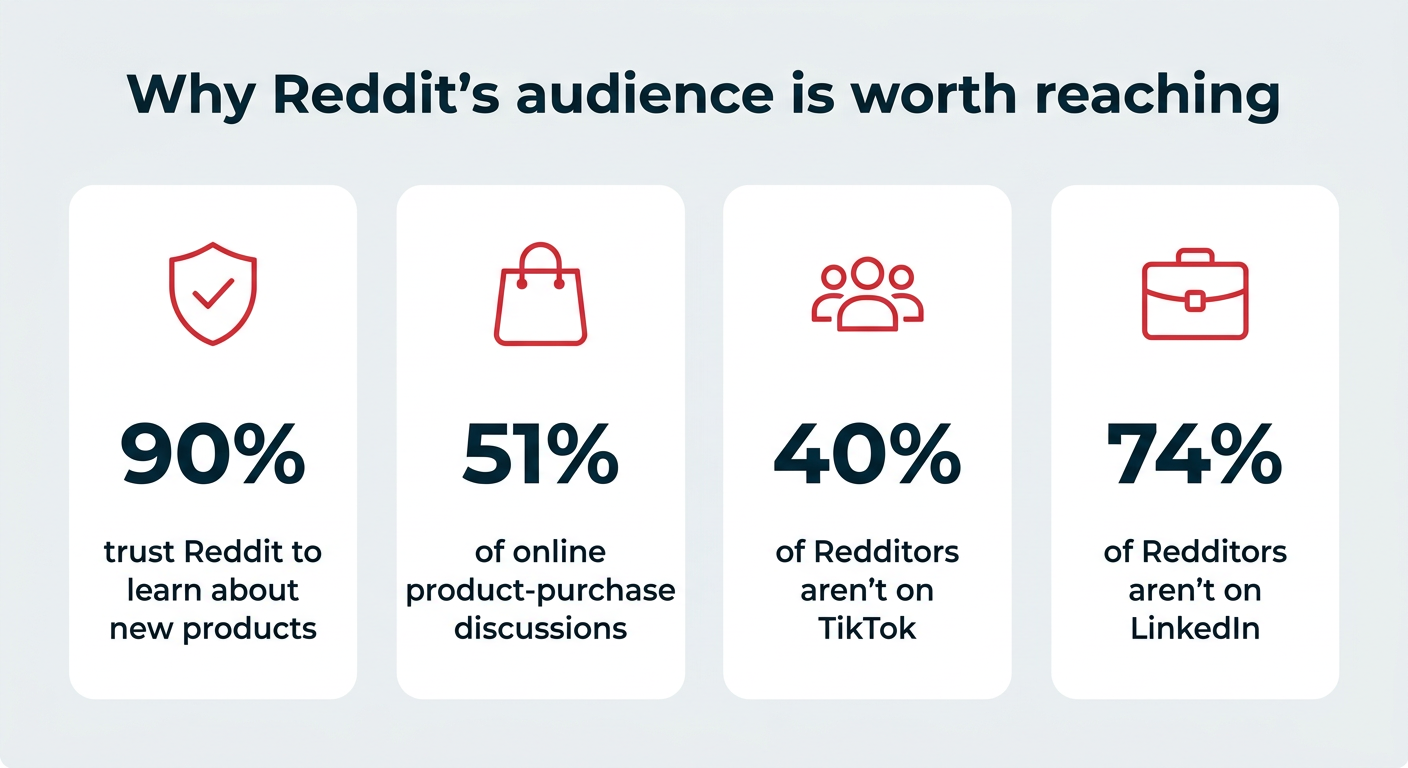
Trust is the headline. 90% of Redditors trust Reddit to learn about new products and brands, which outperforms platforms like Google and Instagram. That trust translates into commercial intent: Reddit reports that 51% of all online product-purchase discussions happen on the platform, which is why it dubs itself “the #1 platform for product conversations.” Redditors are also more likely to purchase after seeing a Reddit ad compared to other platforms.

Scale backs it up. Reddit’s most recent SEC filings report over half a billion weekly active users, ranking it among the most visited websites globally.

The reach is also hard to replicate. Many Redditors simply aren’t active elsewhere: 40% of Redditors aren’t on TikTok, and 74% aren’t on LinkedIn. If your campaigns live only on the big feeds, you’re missing them entirely.

Why Reddit's audience is worth reaching: 90% trust Reddit, 51% of product discussions, 40% not on TikTok, 74% not on LinkedIn

Search is the newer reason marketers are paying attention. After Reddit expanded its partnership with Google, Reddit threads began showing up far more often in traditional search results and AI-generated answers. A helpful comment you leave today can keep earning visibility long after it’s buried in a subreddit feed.

Put together: Reddit offers a trusted, purchase-minded, hard-to-reach audience, plus a long tail of search visibility. That’s a strong case for most brands with a niche.

How do you create a Reddit marketing strategy in 2026?

You create a Reddit marketing strategy by learning the culture first and then participating thoughtfully. Reddit requires a different playbook than other social media platforms. It works best when brands understand the culture, play by the rules, and participate thoughtfully.

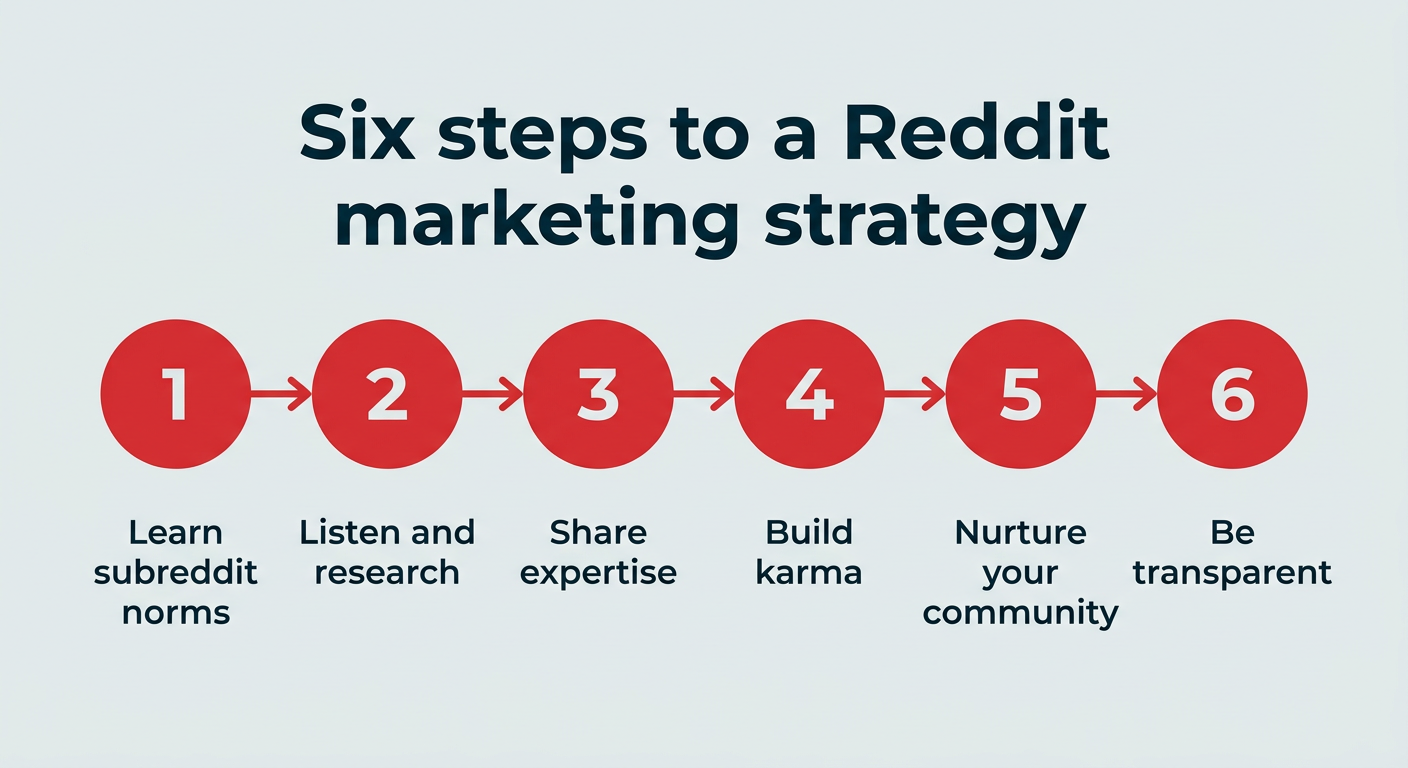
Here are the six steps of a reddit marketing strategy that communities won’t reject:

  1. Learn Reddit culture and subreddit norms before posting
  2. Use Reddit for social listening and audience research
  3. Share expertise and add genuine value
  4. Use a personal account and build karma
  5. Build and nurture your community
  6. Be transparent and respond to feedback
Six steps to a Reddit marketing strategy, from learning subreddit norms to being transparent

1. Learn Reddit culture and subreddit norms before posting

There are over 100,000 active subreddits on Reddit, so chances are one (or several) are relevant to your business.

But before you hit Post, you need to understand how they work first. Take a good look around. Lurking for a week or two before your first comment is time well spent.

How to do this well:

  • Join subreddits relevant to your industry or audience
  • Start with your city’s subreddit if you’re a local business
  • Look for niche communities tied closely to your product (e.g., tools for creators, founders, developers)
  • Read the sidebar rules, top posts, and comment styles before engaging
  • Note how active the moderators are and what they remove

Remember: Reddit norms are different from other social platforms, and each subreddit has its own culture, rules, and tolerance for marketing. What flies in one community might get removed instantly in another.

If you’re brand new to the platform, r/NewToReddit is a solid place to learn the ins and outs.

Subreddit

2. Use Reddit for social listening and audience research

Reddit is incredibly valuable for social listening, which is the practice of monitoring and analyzing conversations about your brand, competitors, and industry trends.

After all, people gravitate to the platform to:

  • Ask for recommendations
  • Share unfiltered opinions
  • Research (and sometimes complain about) products and brands

For marketers, Reddit threads can tell you what your target audience wants most, why past customers stopped using your product, and what made people buy from you in the first place.

Manually digging through posts can work, but it doesn’t scale. Social listening tools let you track conversations automatically across platforms, including Reddit, so you can spot patterns, pain points, and opportunities faster.

Lumen, the integrated insights and listening app inside Hootsuite Social OS, surfaces what people are saying about you and your competitors, scanning billions of sources including Reddit.

Use the data you gather from social listening to inform and adjust your social media marketing strategy, including how you show up and market your business on Reddit. Subreddit language is also a gift for ad copy and landing pages, because it’s how your buyers actually describe the problem.

You can also install the Reddit Hootsuite app to manually search keywords, or expand Hootsuite’s native Streams functionality with the Synapview app to monitor hashtags and competitors across Reddit, Pinterest, Instagram, and YouTube.

3. Share expertise and add genuine value

If your content feels salesy, Redditors will call it out immediately. The fix is to lead with help, not with a pitch.

Focus on genuine conversation. Encourage real customers to share their experiences. Ask questions, request feedback, and respond thoughtfully.

Peak Design is a great example of balancing self-promotion with authenticity and engaging customers without hard selling.

Peak Design Reddit marketing post about a tech pouch

Source: r/PeakDesign

People often go to product-specific subreddits to get advice. That’s why one of the most effective Reddit tactics is also the simplest: Show up, be helpful, and expect nothing in return. (Yes, that means deleting the call-to-action at the end of your post.)

Reddit marketing is a long-term game, not a place to blitz generic content and get quick leads. You need to be here because you want to be here, or because you’re already a Redditor at heart.

If you can be genuinely helpful, Reddit is a great place for driving brand loyalty and conversion over time.

As Redditor Perllitte advises, “Pick a niche, dig in, and you’ll find tactics.”

Comment in marketing subreddit about CNC machining and Reddit marketing

Source: r/marketing

Sharing high-quality content on Reddit also comes with mega SEO perks, thanks to the Google partnership mentioned earlier. Reddit discussions now surface more often in search results and AI overviews.

4. Use a personal account and build karma

Using a personal account can feel more natural and less promotional, especially if you already enjoy Reddit, know its lingo, and contribute to discussions.

It’s not that you can’t be successful using your company name. Many brands are, such as dbrand, Mint Mobile, and Nordstrom. But if you aren’t a well-known brand name already, personal may be the way to go.

You can still create a subreddit for your brand, and then use a personal account to interact with others in that subreddit and elsewhere on Reddit.

Redditor u/secretagentdad does this well with their company, Keyword Sheeter. They regularly post in large, relevant subreddits like r/SEO, and contribute to the brand’s subreddit with the same personal account.

Sheeter SEO personal Reddit account used for Reddit marketing

Source: r/Sheeter

TL;DR: If you focus on being genuinely helpful, people will respond positively to you, whether you use a personal account or brand name.

5. Build and nurture your community

The biggest secret to building a strong community as a brand on Reddit is to be helpful, engaging, and consistent.

Dbrand is a standout example. Their community thrives because they’re responsive, consistent, and unapologetically on-brand, even when that means gently roasting their own customers (who love it).

Request for 20 to 50 percent off code in Dbrand community with roast reply, a Reddit marketing example

Source: r/dbrand

Encourage your employees who are already Redditors to respond to posts in your organization’s subreddit too. In some cases, they can even operate as moderators. This helps build community and shows your subreddit is active.

6. Be transparent and respond to feedback

Reddit is all about discussion. While you should aim to be open and honest across all your platforms, it’s critical on Reddit, where old threads stay searchable for years.

Being open and honest is an important building block of any community. By replying to every post and comment in your subreddit, and joining discussions on relevant threads, you demonstrate openness and highlight the personality behind your brand.

That includes how you respond to negative comments or feedback. Insta360 handles that well here by investigating, apologizing, and clarifying next steps.

Three rules for handling criticism on Reddit: Respond fast, never delete or hide legitimate complaints, and say what you’re actually doing about it. Deleted comments on Reddit get screenshotted and reposted.

Insta360 survey scam report with coupon code reply, a Reddit marketing example

Source: r/Insta360

What’s the difference between organic and paid Reddit marketing?

Organic Reddit marketing builds credibility through participation, while paid Reddit marketing buys reach and speed. Most brands need both, but they solve different problems, so it helps to know which lever you’re pulling.

Organic is how you earn the right to be there. Paid is how you scale once you know which messages and communities land, and with Reddit’s advertising revenue growing 54% year-over-year, more brands are doing exactly that.

Dimension

Organic Reddit marketing

Paid Reddit marketing

Cost

Time only, no media spend

Media budget plus creative time

Time to results

Weeks to months

Days

Trust building

High, because comments come from a real account with history

Lower on its own, higher when comments are enabled

Scalability

Limited by how many conversations your team can join

Scales with budget and audience size

Best for

Community building, product feedback, long-term search visibility

Launches, lead generation, reaching subreddits you can’t post in

Key metrics

Karma, subscriber growth, comment sentiment, referral traffic

CPM, CTR, cost per conversion via the Reddit Pixel

How do you advertise on Reddit?

You advertise on Reddit through Reddit Ads Manager, where you choose an objective, pick your audience, set a budget, and upload creative. The standout feature is that you can target specific subreddits, which is as close to interest targeting by intent as social advertising gets.

Reddit ads also fit seamlessly among organic posts. Besides the small “Promoted” text at the top, it’s really difficult to tell them apart.

BMO sponsored ad about EFTs, an example of how to advertise on Reddit

Source: r/Notion

What ad formats and targeting options does Reddit offer?

Reddit offers a range of ad placements, and each one suits a different stage of the funnel:

  • Promoted posts (text): The most native-looking format. Good for discussion-led messages and questions.
  • Image ads: A single visual with a headline. Best for a bold, simple claim.
  • Video ads: Autoplay in feed. Useful for product demos and launches.
  • Carousel ads: Multiple cards in one unit. Works for feature comparisons or multi-product retail.
  • Conversation ads: Placed inside comment threads, where attention is highest.
  • AMA ads: Promote a scheduled Ask Me Anything, which pairs paid reach with an organic moment.

What are Reddit ad best practices?

The ads that work on Reddit read like posts, not like billboards. A few habits make the difference:

  • Write conversationally: Headlines that sound like something a user would actually say outperform polished ad copy.
  • Leave comments open: It’s a risk, but replying to questions under your own ad builds brand trust faster than any creative tweak.
  • Match the subreddit: Tailor creative and copy to each community instead of running one asset everywhere.
  • Keep visuals simple: A bold graphic with a strong headline is your best bet for an image ad.
  • Test in pairs: Run two headlines against the same audience, then two audiences against the winning headline.
Captions.ai Reddit ad to edit your videos in one tap

Source: u/Official_Captions_AI

Which brands are getting Reddit marketing right?

Several brands show how to use Reddit to build community, earn trust, and connect with customers in a way that feels natural. Here are four real-life examples worth studying.

1. Mint Mobile’s customer-driven subreddit

Mint Mobile’s subreddit has tens of thousands of members, and it’s not even run by the brand. Customers built it themselves. Instead of trying to control the conversation, Mint Mobile leaned in: employees regularly jump into threads, post updates, and respond to comments.

Mint Mobile surprise in the mail coat, a Reddit marketing example

Source: r/MintMobile

2. Semrush’s educational subreddit

Semrush is actively involved in their official, branded subreddit, regularly answering questions from customers and prospects. But what makes their subreddit unique is the focus on education.

Semrush official subreddit, a Reddit marketing example

Source: r/Semrush

3. Patagonia’s cross-promotional AMAs

Sustainable clothing manufacturer Patagonia regularly posts content to educate consumers about environmental issues and outdoor sports. To promote these initiatives, Patagonia hosts AMAs (Ask Me Anything threads) with notable people.

Patagonia Stacy Peralta cross promotional Reddit marketing event with film director and entrepreneur

Source: r/Surfing

4. Procreate’s community-first approach

iPad art app Procreate goes to great lengths to engage their community of artists on the platform. Besides encouraging Reddit users to post their work, Procreate offers a tagging system (known as “flair” on Reddit) to browse by different types of art.

Procreate subreddit iPad art, a Reddit marketing example

Source: r/Procreate

What are the most common Reddit marketing mistakes?

Most Reddit marketing failures come down to treating the platform like a feed instead of a forum. These are the mistakes that get posts removed, accounts banned, or brands roasted:

  • Leading with promotion: If every comment links back to your product, moderators and users will flag it.
  • Ignoring subreddit rules: Many communities ban self-promotion or links outright.
  • Posting from a brand-new account: An account with zero karma and no history looks like spam.
  • Copy-pasting the same post across subreddits: Reddit’s spam filters catch this quickly.
  • Astroturfing with fake accounts: Using sock puppets to upvote or praise your own brand violates Reddit’s content policy.
  • Deleting negative feedback: Removing complaints in your own subreddit almost always escalates them.
  • Measuring Reddit like Instagram: Follower counts and reach don’t capture what Reddit does well.

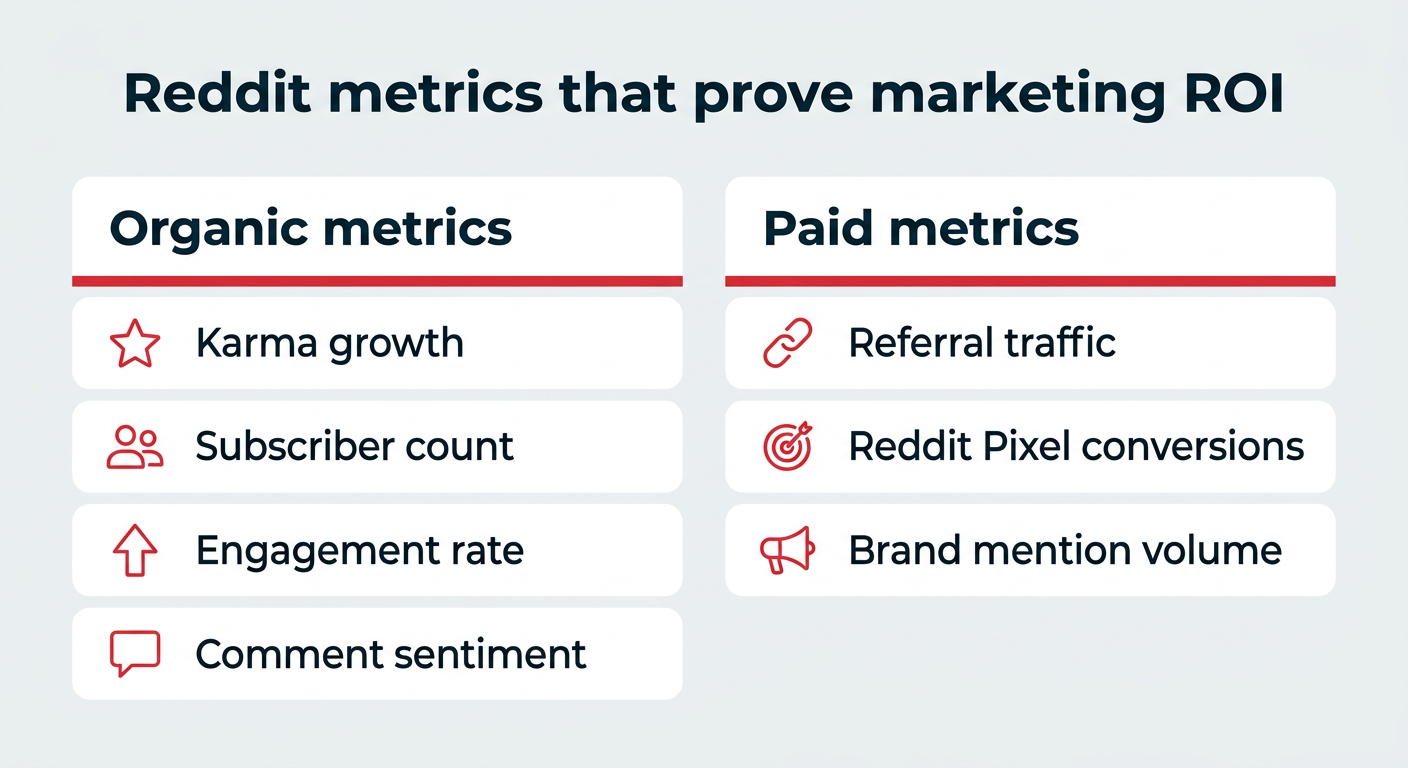
How do you measure Reddit marketing ROI?

You measure Reddit marketing ROI by mapping each goal to one or two specific metrics, then tracking them on a fixed cadence. Once you have your goals in mind, map them to the right metrics and keep track of them:

  • Karma growth: A simple proxy for whether your contributions are landing with communities.
  • Subreddit subscriber count: Tracks whether your owned community is actually growing.
  • Post and comment engagement rate: Upvote ratio and comment volume show which topics resonate.
  • Referral traffic: Tag links with UTM parameters so Reddit referral traffic shows up clearly in your analytics.
  • Reddit Pixel conversions: Signups, trials, and purchases attributed to paid campaigns.
  • Brand mention volume: How often your brand comes up across subreddits.
  • Comment sentiment: Whether those mentions are getting more positive or more negative over time.
Reddit metrics that prove marketing ROI, split into organic and paid metrics

What tools help streamline Reddit marketing?

A small stack covers most of what Reddit marketing requires: something to listen with, something to advertise with, and something to report with.

  • Hootsuite Social OS: Coordinate publishing, engagement, and reporting across your channels, with Lumen providing AI-powered insights from Reddit and billions of other sources.
  • Reddit Ads Manager: Build campaigns, apply subreddit targeting, and manage the Reddit Pixel for conversion tracking.
  • Reddit’s native post insights: Views, upvote ratio, and share data for individual posts and your subreddit.
  • Your web analytics platform: UTM-tagged links tie Reddit activity to traffic, signups, and revenue.

FAQ: Reddit marketing

What is Reddit marketing, and how does it work for brands?

Reddit marketing is when brands use Reddit to listen, join conversations, and share value with specific communities. It includes both organic participation and paid ads. Reddit marketing builds trust first, which leads to sales over time.

How can brands market on Reddit without breaking community rules?

Brands can market on Reddit without breaking community rules by reading each subreddit’s sidebar rules first, then focusing on being helpful instead of salesy. Pay attention to the lingo and how people talk and post.

What are the best Reddit marketing practices for businesses?

The best Reddit marketing practices follow the six steps in this guide: learn subreddit norms, use Reddit for social listening, share expertise, build karma with a credible account, nurture your community, and respond transparently to feedback.

Is Reddit marketing effective for B2B and B2C companies?

Yes, Reddit marketing is effective for both B2B and B2C companies. B2C brands often succeed in product and interest-based subreddits where people ask for recommendations. B2B companies see results by sharing expert advice in industry subreddits.

How do you measure success from Reddit marketing?

You measure success from Reddit marketing by tracking the goal you care about most, using metrics like karma growth, subreddit subscribers, UTM-tagged referral traffic, Reddit Pixel conversions, brand mention volume, and sentiment.

How much does it cost to advertise on Reddit?

Advertising on Reddit costs whatever you set as your budget, because Reddit Ads runs on an auction model with low daily minimums that make small tests practical.

What are the biggest Reddit marketing mistakes?

The biggest Reddit marketing mistakes include being overtly promotional, ignoring subreddit rules, posting from a brand-new account with no karma, copy-pasting identical content across subreddits, deleting negative feedback, and using fake accounts to upvote your own brand.

Can you use Reddit for social listening?

Yes, you can use Reddit for social listening, and it’s one of the most valuable platforms for it because users share unfiltered opinions, product recommendations, and brand complaints in public threads.

How does Reddit’s algorithm work for marketing content?

Reddit’s algorithm ranks content using a mix of upvotes, recency, and engagement velocity, so posts that attract early upvotes and comments surface faster in subreddit feeds.

Should brands use a personal account or brand account on Reddit?

Brands can succeed with either a personal account or a brand account on Reddit, but personal accounts often feel more natural and build trust faster, especially for lesser-known companies.

Save time managing your social media marketing strategy with Hootsuite. Publish and schedule posts, find relevant conversions, measure results, and more â all from one dashboard. Try it free today.

The post Reddit marketing in 2026: Strategy, tips, and examples appeared first on Social Media Marketing & Management Dashboard.


* This article was originally published here
Saturday, November 7, 2026

Why social-first AI wins where general AI fails in 2026

Key takeaways

  1. Social-first AI is AI designed specifically for social media, using real-time social data rather than static web content to power insights, content, and trend detection.
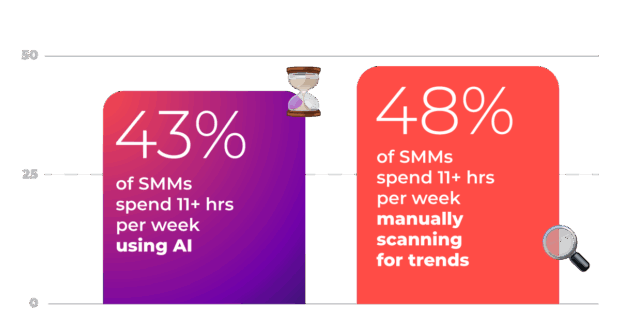
  2. Most general-purpose AI tools are adding work, not saving it, with 43% of social media managers spending 11+ hours a week on AI tools.
  3. Only 28% of social media managers are confident their tools reflect what’s happening on social right now, which forces constant oversight and edits.
  4. Hootsuite Social OS is built as a social-first AI system, connecting real-time intelligence (Lumen), content creation (Perch), and AI orchestration (Wisdom) in governed workflows.

What is social-first AI?

Social-first AI is artificial intelligence designed around social media data and social media workflows. Instead of drawing on general web crawls with a training cutoff, it works from live signals across social platforms, so the insights and content it produces reflect what people are talking about now.

The distinction matters because social moves differently from almost every other marketing channel. A trend can form and fade inside 48 hours. Tone shifts by platform, by audience, and sometimes by week. General-purpose AI for social media tends to flatten all of that into something safe, generic, and slightly out of date.

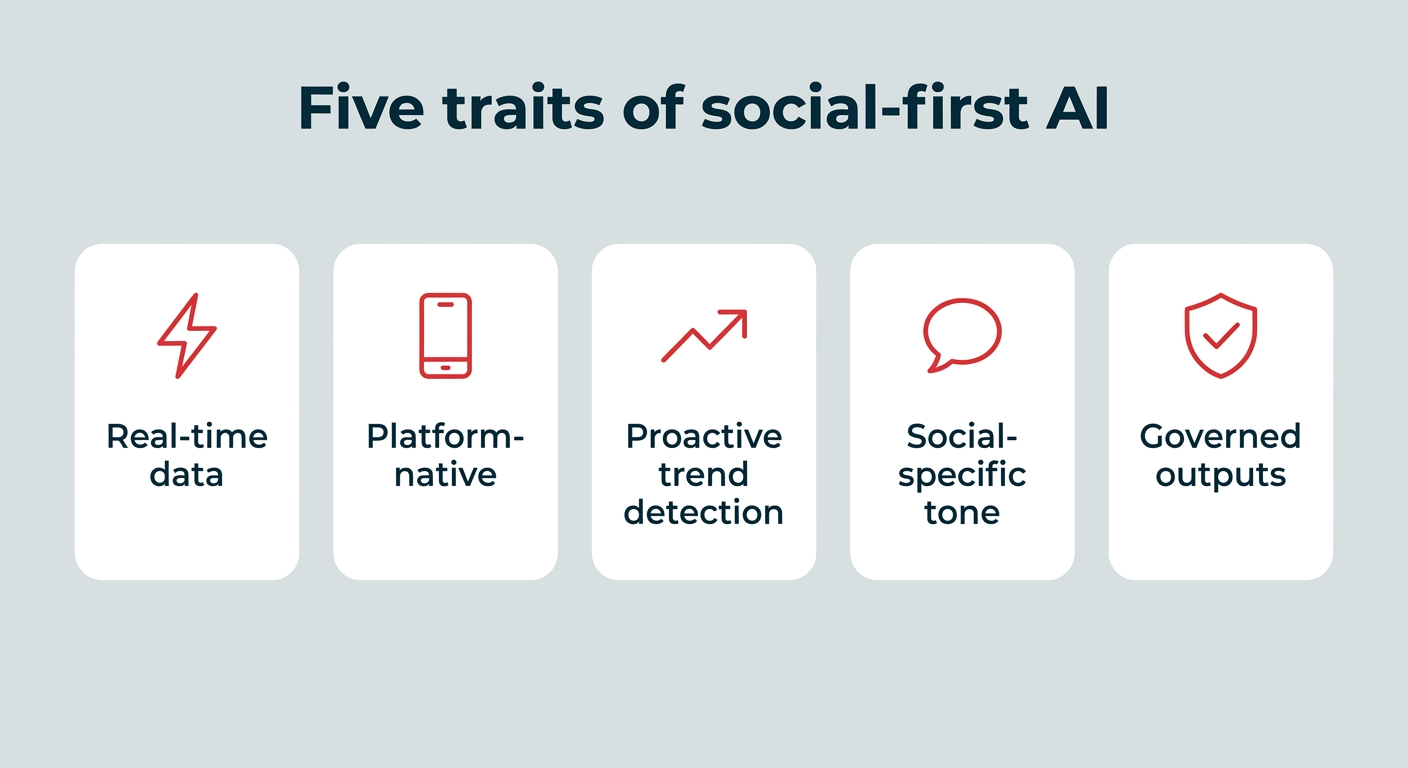
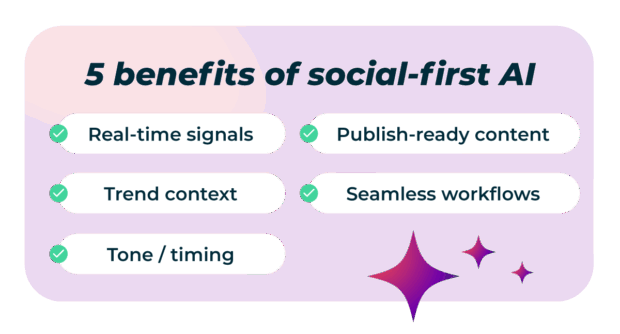
Most social-first AI systems share a few defining characteristics:

  • Real-time data foundation: Insights come from live social conversations, not static training data with a knowledge cutoff.
  • Platform-native understanding: It recognizes that a LinkedIn post, a TikTok hook, and an Instagram caption are different jobs with different norms.
  • Proactive trend detection: It surfaces emerging topics while there’s still time to act, rather than summarizing what already happened.
  • Social-specific tone and context: Outputs reflect how people actually talk online, including the references and formats native to each channel.
  • Governed outputs: Answers are traceable to sources, and content moves through approval workflows before it goes live.

Put simply, social-first AI treats social as the primary data source and the primary workflow, not an afterthought bolted onto a general marketing tool.

Five traits of social-first AI: real-time data, platform-native, proactive trend detection, social-specific tone, governed outputs
Bonus!!!

Download your free guide to social AI — 101 genius prompts to unlock real-time social insights with OwlyGPT.

How does social-first AI compare to general-purpose AI?

The clearest way to see the difference is side by side. Both approaches use large language models, but what they’re grounded in, and what they’re optimized for, diverges sharply.

Dimension

General-purpose AI

Social-first AI

Data source

Static web crawls and training data with knowledge cutoffs

Live social signals across platforms

Timeliness

Days to months behind

Real-time or near real-time

Content tone

Generic, often formal or blog-like

Platform-native, matches how people actually talk

Trend detection

Reactive or absent

Proactive, surfaces emerging trends

Platform understanding

Treats all channels the same

Understands platform-specific formats, audiences, and norms

Governance

Limited or bolt-on

Built-in compliance and approval workflows

The core difference comes down to grounding. General-purpose social media AI tools are strong at language and weak at timing. Social-first AI is built so that timing, tone, and platform context are part of the answer, not something your team has to add afterward.

Why does general-purpose AI fail social teams?

General-purpose AI fails social teams because it wasn’t designed for the pace or style of modern social. The problem isn’t that AI lacks potential, or that its underlying algorithms are flawed.

These tools promise automation but require micromanagement. This is unsurprising when only 16% of marketing work is currently AI-automated. They surface information but lack context, and they’re trained on data that rarely reflects what people care about right now.

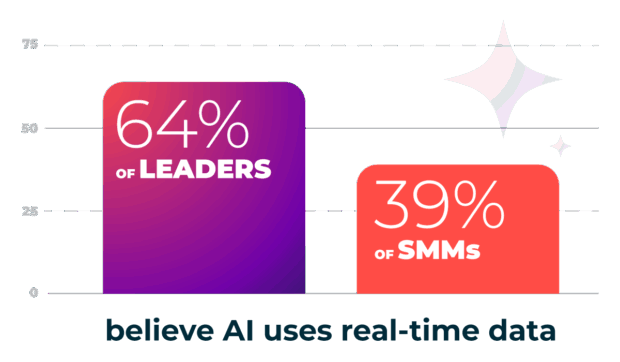
If we zoom out more, a clear disconnect emerges between how leaders think AI is performing and how it’s actually landing on the front lines. 64% of senior marketers believe their tools use real-time data, but only 39% of social media managers agree.

Chart showing the gap between senior marketers and social media managers on real-time AI data confidence

Marketing leaders are far more confident in their AI’s real-time data than the practitioners using it daily.

As AI budgets rise and expectations grow, the cracks are starting to show. The people closest to the work, closest to the platforms, the conversations, and the trends, know the truth: most AI-powered tools can’t keep up.

And when your tools can’t keep up, neither can your team. Instead of solving problems, most AI-driven tools are actually creating more work for already busy social teams. Here are three reasons AI is falling short, and what needs to change for social strategies to actually benefit.

Is AI actually saving social teams time?

For most teams, no. AI is adding hours rather than saving them. It was pitched as the time-saver social teams have been waiting for, but in practice, it’s become a big time sink.

43% of social media managers now spend more than 11 hours a week using AI tools. That’s a full third of their time spent coaxing content out of tools that were supposed to eliminate busywork.

Chart showing social media managers spending over 11 hours a week on AI tools

More than two in five social media managers now spend over 11 hours a week working inside AI tools.

All of this effort might be worthwhile if the outputs were dependable, but they’re not. Most tools don’t handle trend discovery either, so teams end up spinning their wheels on the exact problem proper AI trend detection is supposed to solve.

Instead of being freed up to focus on strategic decision-making, content strategy, or brainstorming, marketers are stuck justifying outputs or reverse-engineering performance from tools and chatbots that can’t explain themselves.

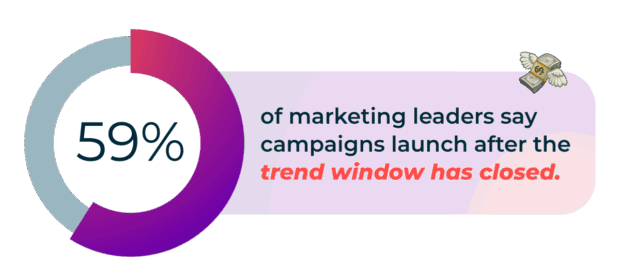
The impact climbs the ladder. 59% of senior marketers say their campaigns are launching after the trend window has closed. In other words, teams aren’t getting the right signals soon enough to act.

Chart showing nearly six in ten senior marketers say campaigns go live after the trend window closes

Nearly six in ten senior marketers say their campaigns go live after the moment has passed.

AI tools promise scale, but they just create more layers to manage. What’s supposed to be automation turns into another review cycle. Teams are trading one kind of work for another, often with less confidence and slower results.

If your team spends double-digit hours each week on AI but still misses the moment, you don’t have a workflow; you have a workaround.

Does your AI actually understand social media?

Often, it doesn’t. Most marketing AI tools, including popular options like ChatGPT, were never built for social. They pull from outdated, generic content that doesn’t reflect how people actually talk.

43% of social media managers say the content they get from AI seems based on general web data rather than social-specific sources. The language feels off, the insights are shallow, and it reads like it was written by someone who’s never scrolled through TikTok before.

When AI has a knowledge gap like this, teams have to compensate for that mismatch.

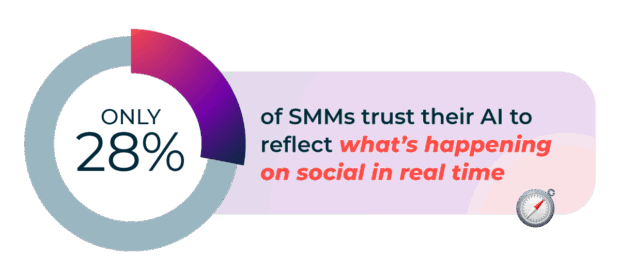
This disconnect erodes trust. Only 28% of social media managers trust their current tools to reflect what’s happening on social media in real time.

Chart showing just over a quarter of social media managers trust their AI to reflect what's happening on social right now

Just over a quarter of social media managers trust their AI to reflect what’s happening on social right now.

That’s staggeringly low, given that these tools are being used every single day by teams that know they can’t fully rely on them.

If your AI is drawing from stale sources, no amount of prompt engineering or internal upskilling will close the gap. You’re not working with bad AI. You’re working with blind spots. The fix is grounding outputs in real-time social data instead of generic web content.

This is where frustration starts to look like failure, especially for marketing teams under pressure to move fast, create social content at scale, and hit performance benchmarks.

The solution isn’t to pull back on AI. It’s to demand better from it.

Are rising AI budgets delivering results?

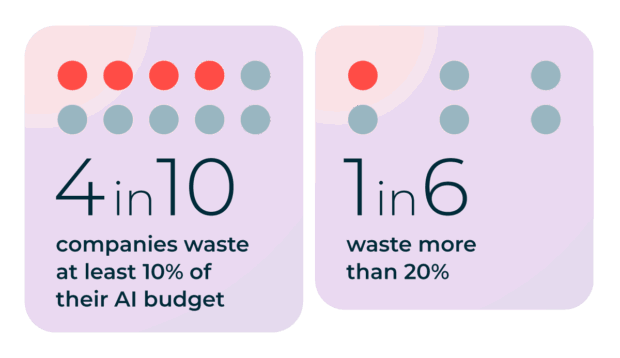
Not consistently. 40% of senior marketers say they’ve wasted over 10% of their AI marketing budget on tools that didn’t deliver.

That’s not just disappointing. It’s career-risking in a climate where CFOs are scrutinizing every line item.

Chart showing two in five senior marketers report wasting at least a tenth of their AI budget on underperforming tools

Two in five senior marketers report wasting at least a tenth of their AI budget on underperforming tools.

The risk here isn’t just a missed KPI. It’s the erosion of credibility. When executives can’t show clear wins from their AI investments, the perception shifts: not that the tools failed, but that their team did.

Teams were promised automation, scale, and speed. What they’re getting instead is a tangle of half-useful tools that often fail at the one thing they’re supposed to do: make social easier to execute and measure.

That’s why simply increasing AI spend won’t solve the problem. Only 30% of CMOs report the readiness capabilities to scale AI, even as budgets keep climbing.

If your AI doesn’t understand what makes content resonate on social, or can’t help you move fast enough to capitalize on a trend, then every additional dollar spent just adds pressure to prove ROI without giving you the tools to achieve it.

This is the inflection point.

Marketing leaders have invested. 83% of senior marketers say their AI budgets have increased. Nearly half now spend over 10% of their total marketing budget on AI tools, and one in five (20%) are spending more than 20%. Now they need tools that can deliver.

Chart showing AI budgets keep climbing, raising the bar for what social teams are expected to prove

AI budgets keep climbing, which raises the bar for what social teams are expected to prove.

What should social teams look for in AI tools?

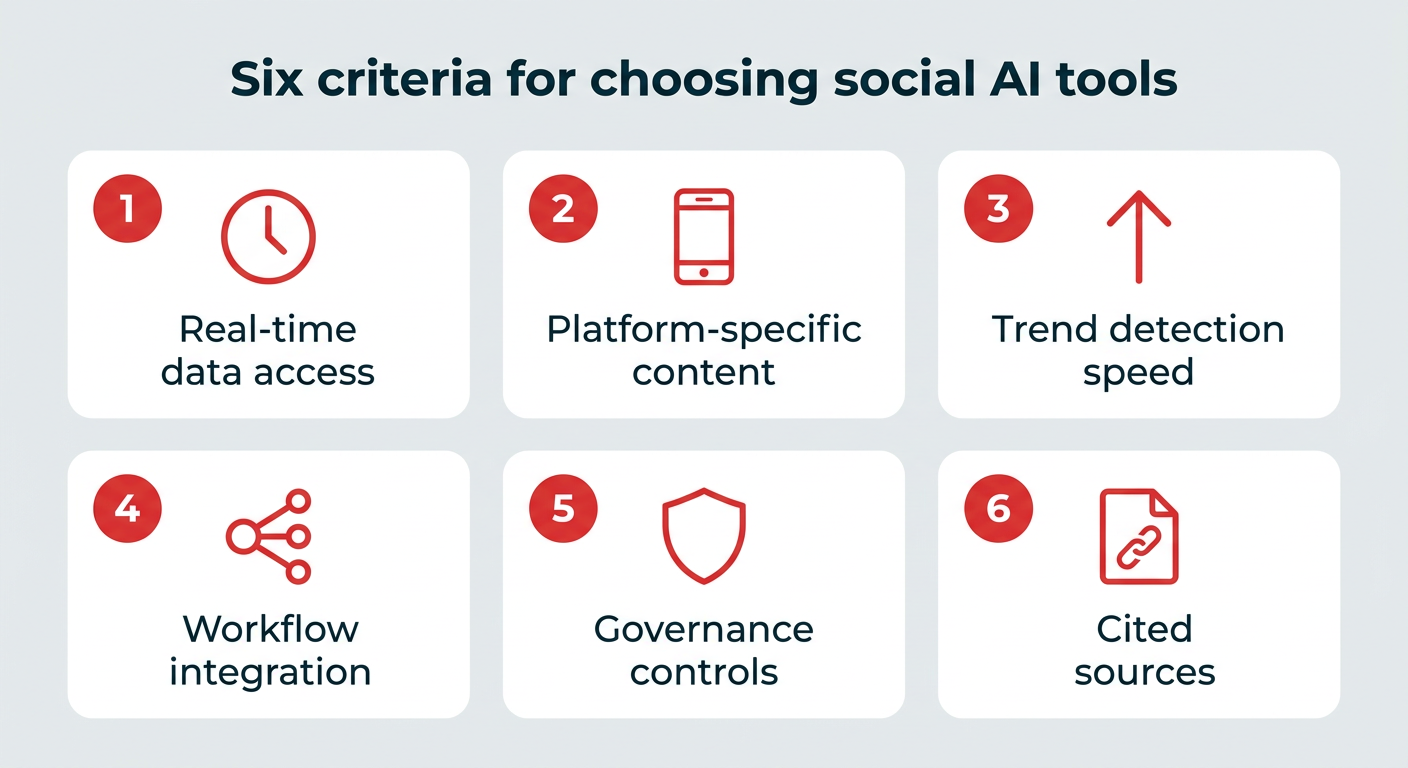
If the data above describes your experience, the answer isn’t fewer AI tools. It’s better criteria for choosing them. Here are six things worth checking before you sign anything.

  1. Real-time data access: Ask where the insights come from and how often the data refreshes. If the vendor can’t answer clearly, assume there’s a knowledge cutoff.
  2. Platform-specific content understanding: Test the same brief across three channels. If the outputs read identically, the tool doesn’t understand social.
  3. Trend detection speed: Look for tools that flag emerging conversations early, not ones that summarize last month’s performance.
  4. Workflow integration: The AI should live where you already plan, publish, and report. Every extra tab is another place work gets lost.
  5. Governance and compliance controls: Approval routing, permissions, and audit trails need to be built in, especially in regulated industries where an unapproved post carries legal exposure.
  6. Transparent, cited sources: You should be able to see what an answer is based on. Without citations, you can’t defend a decision to your leadership team.

Score any tool you’re evaluating against all six. The ones that fail on data freshness or governance are the ones most likely to end up in that wasted-budget statistic.

Six criteria for choosing social AI tools: real-time data access, platform-specific content, trend detection speed, workflow integration, governance controls, cited sources

How does social-first AI work in practice?

Social-first AI changes the workflow in a few specific, measurable ways. Here’s what that looks like day to day for a social team.

Catching trends before they peak

Social listening AI continuously monitors conversations across platforms and flags topics gaining momentum, rather than reporting on what already happened. That’s the direct counter to the finding that 59% of senior marketers see campaigns launch after the trend window closes.

In practice, it means a social team gets an alert about a rising conversation on day one instead of discovering it in a weekly report on day seven. The creative work stays human. The detection gets automated.

Creating content that matches the platform

Because outputs are grounded in live social conversations, social-first AI drafts copy that reflects current formats, references, and tone for each channel. This is the gap behind the 43% of social media managers who say AI content feels pulled from general web data.

The practical benefit is fewer edit cycles. Drafts arrive closer to publish-ready, so your time goes into judgment calls rather than rewriting robotic copy.

Monitoring brand health in real time

Real-time intelligence also works defensively. Sentiment shifts, spikes in mention volume, and competitor moves surface as they happen, which gives teams a head start on crisis response and competitive positioning.

For enterprise teams, this is often the clearest ROI case: the cost of noticing a problem 12 hours late is usually much higher than the cost of the tool.

How Hootsuite Social OS brings social-first AI to life

Most AI tools weren’t built for the social front lines. Hootsuite Social OS is. It’s an AI-first social operating system, which means intelligence, content creation, customer care, and governance are connected rather than stitched together from separate tools.

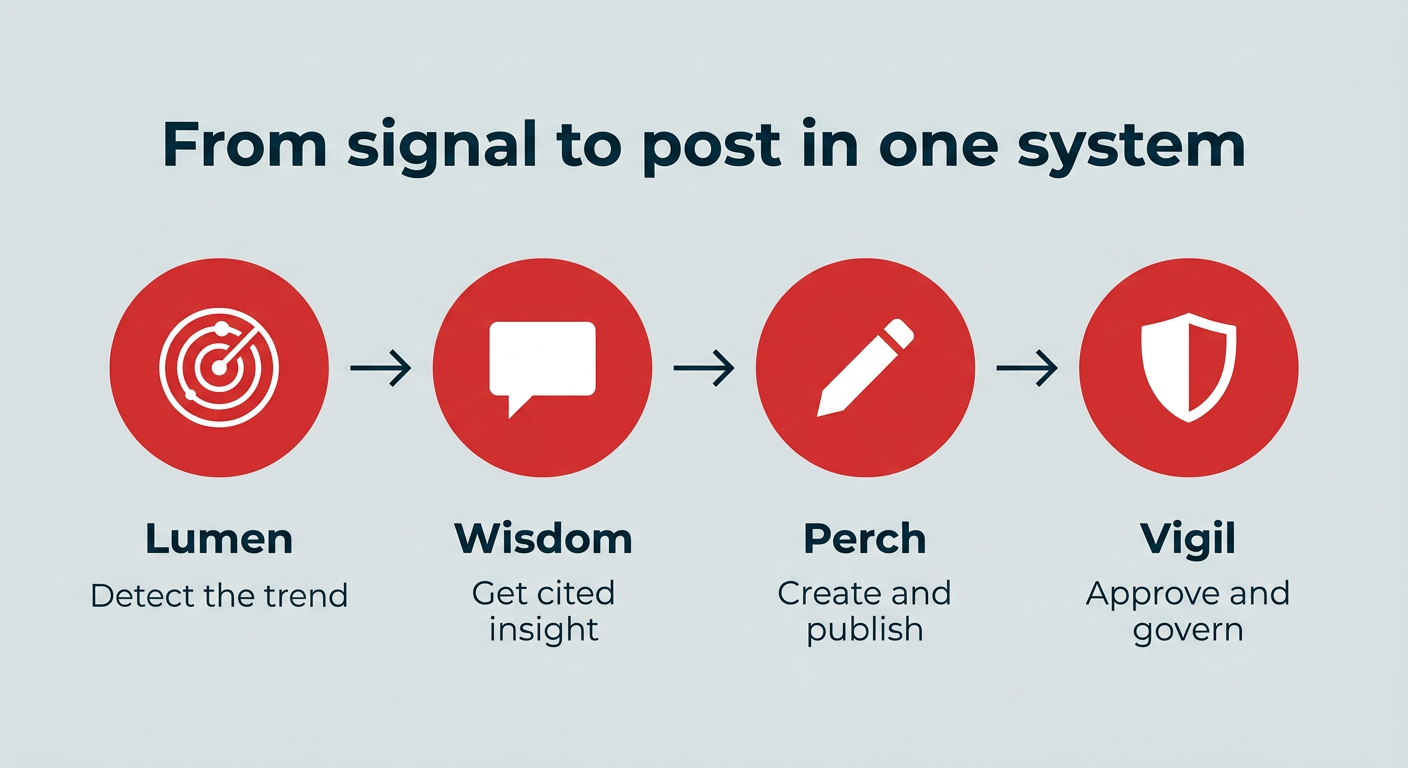
The apps inside Hootsuite Social OS each handle a different part of the social-first AI workflow:

  • Wisdom: The AI orchestration layer. Ask questions in plain language and get cited answers grounded in live social data.
  • Lumen: Real-time social intelligence and listening, covering trend detection, sentiment, and competitive insight.
  • Perch: Content creation and publishing, tuned to the formats and norms of each platform.
  • Nest: Customer care, bringing inbound messages and conversations into one place.
  • Vigil: Governance and compliance, including approval workflows and oversight controls.
  • Parliament: Collaboration and coordination across teams and stakeholders.

Together, they close the gap between intelligence and execution, which is where most social media management AI falls down. You spot the signal and act on it in the same system instead of exporting a report and starting over.

From signal to post in one system: Lumen detects the trend, Wisdom gives cited insight, Perch creates and publishes, Vigil approves and governs

Wisdom: AI orchestration that connects insight to action

Wisdom is the conversational AI layer inside Hootsuite Social OS, unifying what used to be two separate assistants (OwlyGPT and Yeti) into a single agent. You ask a question in plain language and get an answer grounded in live social data, with citations you can trace.

Wisdom Studio lets teams build custom agents for recurring tasks, and MCP connectors make it possible to bring social intelligence into other tools your organization already uses. The point isn’t novelty. It’s removing the friction between a question and a decision.

Lumen: Real-time social intelligence across millions of sources

Lumen is the integrated insights and listening app inside Hootsuite Social OS. It monitors conversations across more than 150 million sources in 187 languages, covering sentiment analysis, trend detection, and competitive intelligence.

Social-first AI pulling platform-native insights in real time

Social-first AI pulls platform-native insights in real time, like how your audience engages on Instagram or LinkedIn.

Lumen also includes LLM Insights, which tracks how your brand appears in AI search results. As more buyers start their research inside AI assistants, that visibility becomes part of the measurement picture. 49% of US adults now use AI chatbots.

How do you keep social-first AI governed and trustworthy?

You keep social-first AI trustworthy by pairing it with clear controls and human oversight. Speed without governance is how brands end up with an unapproved post, a compliance breach, or a statistic they can’t source.

Vigil is the governance layer inside Hootsuite Social OS, and it handles the controls enterprise teams need most. Whatever platform you use, these are the governance considerations worth getting right:

  • Cited, traceable sources: Every AI-generated insight should link back to the data behind it so decisions can be defended.
  • Approval workflows: Content routes through the right reviewers before publishing, with permissions set by role.
  • Compliance controls: Industry-specific rules are enforced inside the workflow, not in a separate document nobody reads.
  • Audit trails: A record of who approved what, and when, which matters in regulated sectors where posts can create legal exposure.
  • Human review on sensitive topics: Crisis, legal, and regulated content should always have a named human owner.

Governed workflows are what make social-first AI usable at enterprise scale. Without them, speed becomes a liability rather than an advantage.

What’s next for social-first AI?

The next phase is less about generating content and more about coordination. Early AI adoption focused on drafting captions and summarizing reports. The shift underway is toward systems that connect intelligence to action across teams, so a signal picked up by listening can trigger a brief, a draft, and an approval without a handoff getting lost.

Agentic workflows are part of that. Instead of prompting a tool every time, teams configure agents to handle recurring tasks like competitive monitoring or weekly performance synthesis, with humans reviewing the output.

MCP connectors are the other piece. They let social intelligence flow into the other systems your organization runs on, which means social data starts informing decisions outside the social team.

The direction is consistent: social-first AI is moving from a content tool to the connective layer between what’s happening on social and what your organization does about it.

FAQ: Social first AI

What is social-first AI and how is it used in social media marketing?

Social-first AI is artificial intelligence designed specifically for social media, built on real-time social data rather than static web content. Teams use it to monitor conversations, catch trends early, and create content that fits each platform. In Hootsuite Social OS, Wisdom handles the conversational layer, returning cited answers grounded in live social signals.

How is social-first AI different from general-purpose AI like ChatGPT?

Social-first AI differs from general-purpose AI by using real-time social data as its foundation rather than static web crawls with knowledge cutoffs. That changes the output in three ways: insights reflect current conversations, content matches how people actually talk on each platform, and trends surface while there’s still time to act.

How do brands use AI to create, optimize, and manage social content at scale?

Brands use AI to speed up content production and make better decisions at scale. Perch handles platform-native content creation and publishing, while Wisdom synthesizes performance data and identifies what’s working. The combination lets teams keep improving their social media strategy without adding headcount.

What are the benefits and risks of using AI in social media strategy?

The benefits of using AI in social media strategy include faster trend detection, deeper audience insight, and the ability to scale content production, while the risks include inaccurate outputs, missing cultural context, and brand misalignment. Governance tooling such as Vigil reduces those risks by routing content through approvals and keeping an audit trail.

How do companies implement social-first AI while maintaining brand voice and compliance?

Companies implement social-first AI by pairing it with clear guidelines and human oversight. That means defining brand voice, setting approval workflows, and reviewing content before it goes live. Governed workflows inside Vigil enforce those rules in the system rather than relying on people to remember them.

What tools support social-first AI workflows for enterprise teams?

Hootsuite Social OS supports social-first AI workflows for enterprise teams by connecting real-time intelligence (Lumen), AI orchestration (Wisdom), content creation (Perch), customer care (Nest), and governance (Vigil) in one system. Because the apps share the same data, insights move into action without exports or handoffs.

What is an AI-first social operating system?

An AI-first social operating system is a platform where AI is built into every layer of the social workflow, from intelligence and content creation to customer care and governance, rather than added as an afterthought. The practical difference is that insight, execution, and oversight happen in the same place.

Can AI replace social media managers?

AI cannot replace social media managers, but it can remove significant friction from their workflows. By handling trend detection, content drafting, and data synthesis, it frees practitioners to focus on strategy, creative judgment, and the community work that requires a human.

How do you measure ROI on AI tools for social media?

You measure ROI on AI tools for social media by tracking time saved on manual tasks, speed to publish on trending topics, content performance improvements, and reduction in wasted tool spend. That last metric matters: 40% of senior marketers say they’ve wasted over 10% of their AI budget on tools that didn’t deliver.

What should you look for when choosing AI tools for social media teams?

When choosing AI tools for social media teams, look for real-time data access, platform-specific content understanding, fast trend detection, integration with your existing workflow, built-in governance, and transparent, cited sources. Tools that fail on data freshness or governance are the ones most likely to go unused.

Save time managing your social media marketing strategy with Hootsuite. Publish and schedule posts, find relevant conversions, measure results, and more â all from one dashboard. Try it free today.

The post Why social-first AI wins where general AI fails in 2026 appeared first on Social Media Marketing & Management Dashboard.


* This article was originally published here
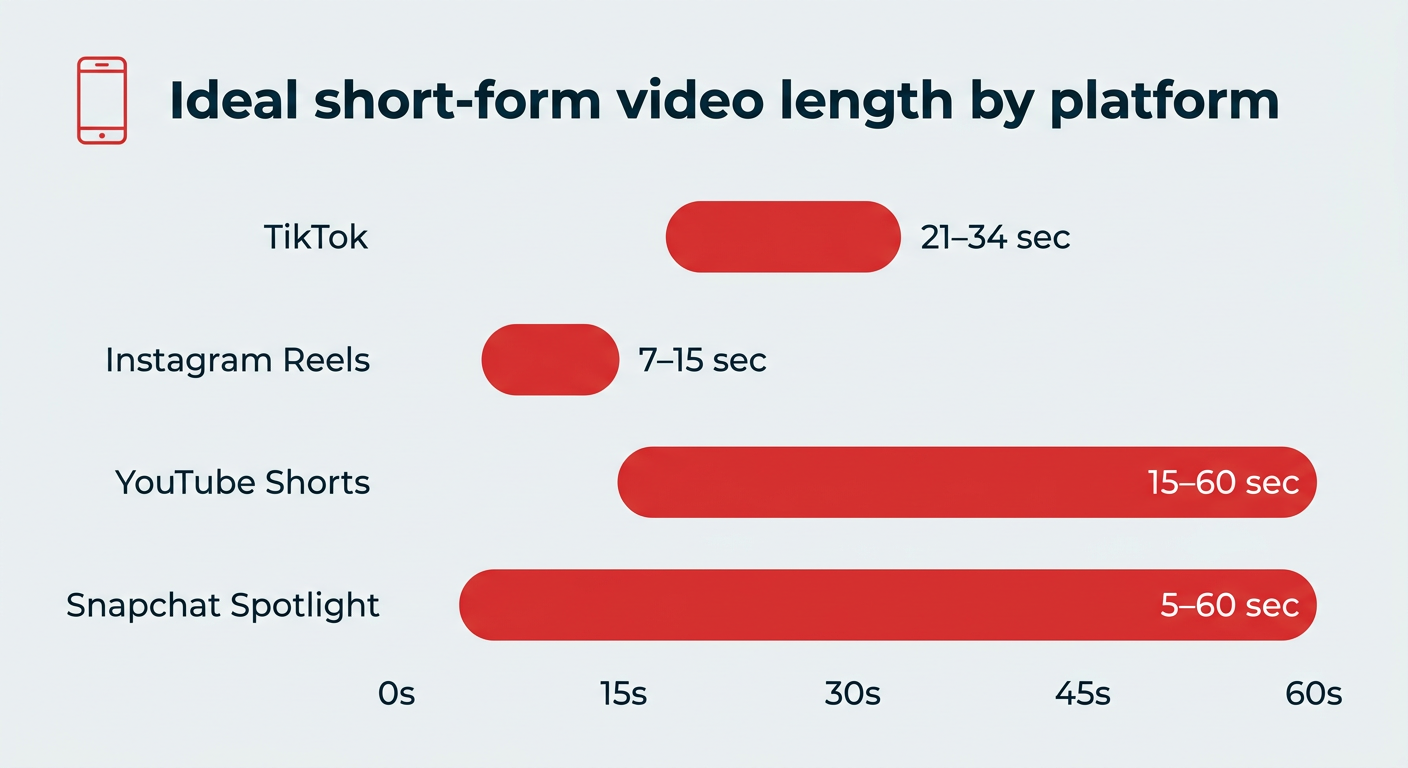
How to make short-form videos that stand out in 2026

Key takeaways Short-form video defined: Video content typically under 60 seconds, built for vertical, mobile-first platforms like TikTok, I...