Wednesday, July 22, 2026

Social media for financial services: 2026 guide

Key takeaways

  1. Gen Z and millennials increasingly turn to social media for financial advice. That makes social a critical channel for reaching new audiences early.
  2. Compliance is the foundation of any financial services social media strategy. It requires clear policies, approval workflows, and archiving.
  3. Each platform serves a different role. LinkedIn is best for thought leadership, TikTok and Instagram for awareness, YouTube for education, and X for real-time commentary.
  4. AI-powered tools are reshaping social media for financial services. They change how brands create content, monitor risk, and surface insights from social data.

What is social media marketing for financial services?

Social media marketing for financial services is the use of social platforms to educate audiences, build trust, generate leads, and support customers within a highly regulated industry.

It applies to a wide range of organizations, including banks, credit unions, insurance companies, wealth management firms, and fintech companies.

What sets it apart from other industries is the balancing act. Financial brands must stay engaging and human while meeting strict regulatory requirements, protecting sensitive customer data, and earning trust in an advisory relationship. Every post can carry compliance weight, so strategy and governance matter as much as creativity. When it works, social media becomes a way to reach people early in their financial journey and stay top of mind as their needs grow.

Bonus: Download a free bundle of social media tools designed specifically for financial services — including post ideas and templates for social media policies, strategies, and reports.

How do financial services use social media?

Financial services use social media for marketing, customer service, sales, and more.

In practice, social media shows up in a few core ways:

  • To educate: Financial brands can build credibility through thought leadership and helpful content, from bite-sized TikTok videos to longer LinkedIn posts.
  • To support marketing: Social media is an easy way to promote content, reach new audiences (like Gen Z), and connect with people at every stage in the customer journey.
  • To generate leads: Social media opens up new avenues to meet prospects. Brands can start conversations, build brand awareness, and turn connections into leads over time.
  • To provide customer support: Many financial companies use social media to offer real-time support. Customers can ask questions, raise issues, and get help across social media channels.
  • To listen: Through the power of social listening, teams can track trends, see what customers are talking about, and watch competitor activity.

For financial brands, social media is a cross-functional tool that helps marketing, sales, and customer experience teams all at once.

Why should financial services use social media?

Financial services should use social media because it plays a growing role in how people learn about finances and decide who to trust.

Here are the main benefits of using social media in financial services:

1. Reach new audiences

If you want to reach younger generations, social media matters. 80% of 18–29-year-olds use Instagram alone.

Gen Z already uses social platforms to learn about money, and they’re starting to hit major milestones that deserve financial advice.

In fact, 47% of Gen Z workers are on track for a successful retirement. And 99% of Gen Z use a mobile banking app to manage their money.

Social media is often the first place this audience goes for financial information. 72% of Gen Z use social media for financial advice, so it’s important to show up early.
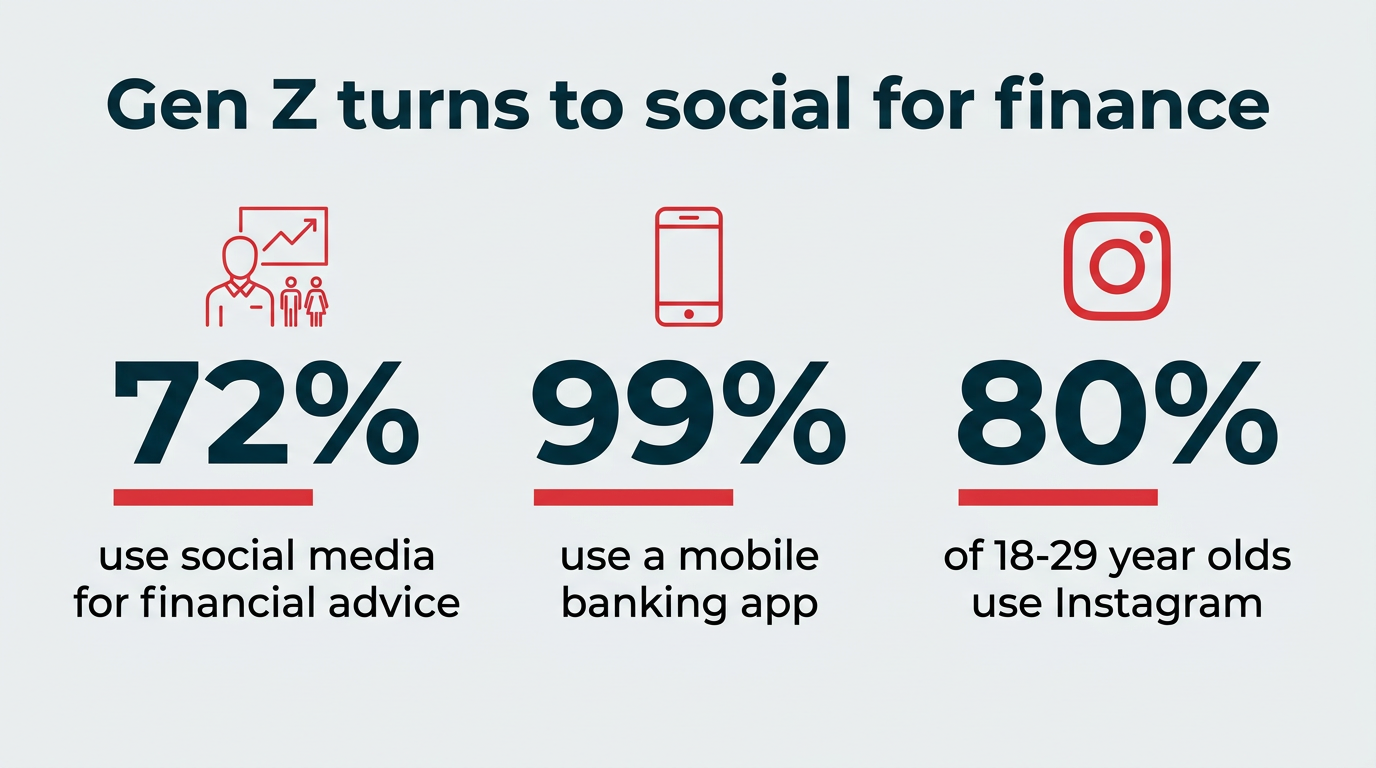
Gen Z turns to social for finance

2. Strengthen relationships

When it comes to finances, people want to work with someone they know and trust. Social media makes it easier to build those relationships over time.

This kind of relationship-building is known as social selling.

For instance, you might see when someone starts a new job, retires, or launches a business. (LinkedIn makes these moments easy to spot.)

If a connection shares good news, send a quick congratulations. If they post a question or concern, share a useful resource. Just don’t rush into a pitch.

Ultimately, social selling is about building relationships. Sales are a longer-term goal.

3. Build trust and highlight brand values

People aren’t just focused on returns anymore. They want to understand how their money is being invested and what it supports.

That’s why interest in sustainable investing is at an all-time high. According to a recent Morgan Stanley report, 99% of Gen Z and 97% of millennials say they’re interested in this type of investment.

When people understand a brand’s values, they feel more confident in who they’re working with.

Trust in financial services has improved over the past decade. Even so, it’s still one of the least trusted industries, according to the .
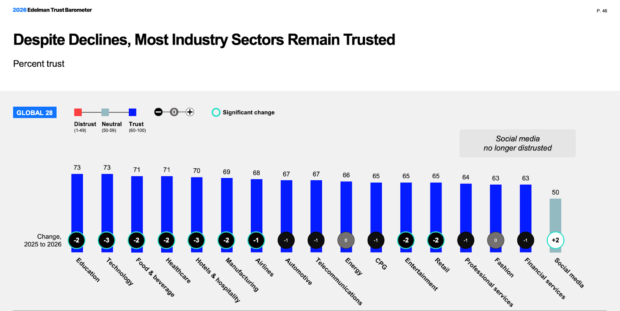
Trust barometer in financial services

Source: 2026 Edelman Trust Barometer

Social media gives financial brands a chance to close that gap. It’s a place to explain decisions, talk about values, and respond to real concerns in real time.

4. Humanize your brand

People want to deal with trusted financial experts, not brands that feel cold and distant. Social media offers the opportunity to sound more human.

Getting your company’s executives on social media can be a great place to start. In fact, 82% of people are more likely to trust a company when its senior executives are active on social media.

5. Gain industry and customer insights

Try using social media for financial services industry research. This is a good way to stay on top of what’s happening in your field.

Are competitors launching new financial products? Is a topic starting to pick up speed? Social media can act like an early warning system.

Social listening tools like Lumen, the integrated insights and listening app inside Hootsuite Social OS, can help you spot these trends faster. They surface what people are talking about, and where sentiment is shifting.

You can also use social listening to learn more about your target audience, including demographics, interests, and pain points. What do your customers care about? What are they confused by? What do they want more of?

Don’t forget your own data, either. Social media analytics show you what’s working and what’s not. Over time, those insights help you adjust your strategy and focus on what actually resonates.

6. Reduce effort and costs

Social media works best when everyone — teams, departments, and individual advisors — works from the same playbook.

That usually involves a shared social media management platform.

A shared content platform, like Parliament, the employee advocacy app within Hootsuite Social OS, gives employees access to pre-approved, compliant content that’s ready to post. For brands, that means peace of mind knowing messaging is on point and on brand. You can explore the employee advocacy tools available in one place.

With the right tools in place, social media becomes a lot less stressful.

7. Drive business results

Social media plays a real role in how people make financial decisions.

It starts with young adults. 42% of Americans under 30 say they get financial advice from social media, according to a new Gallup poll. And 23% follow a personal finance content creator (known as finfluencers).
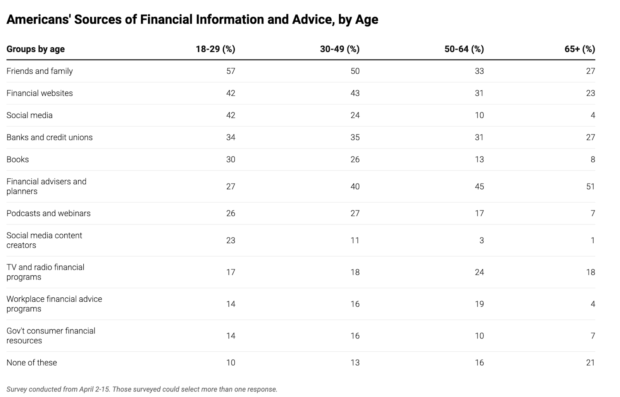
Americans' sources of information, showing social media as a leading source of information

Source: Gallup

Even people who already work with an advisor are turning to social. Roughly 45% of U.S. consumers who have a financial advisor use social media to learn more about financial planning.

For financial services, the opportunity isn’t just to show up on social media — it’s to show up with helpful content at every stage of the customer journey.

What are the best social media platforms for financial services?

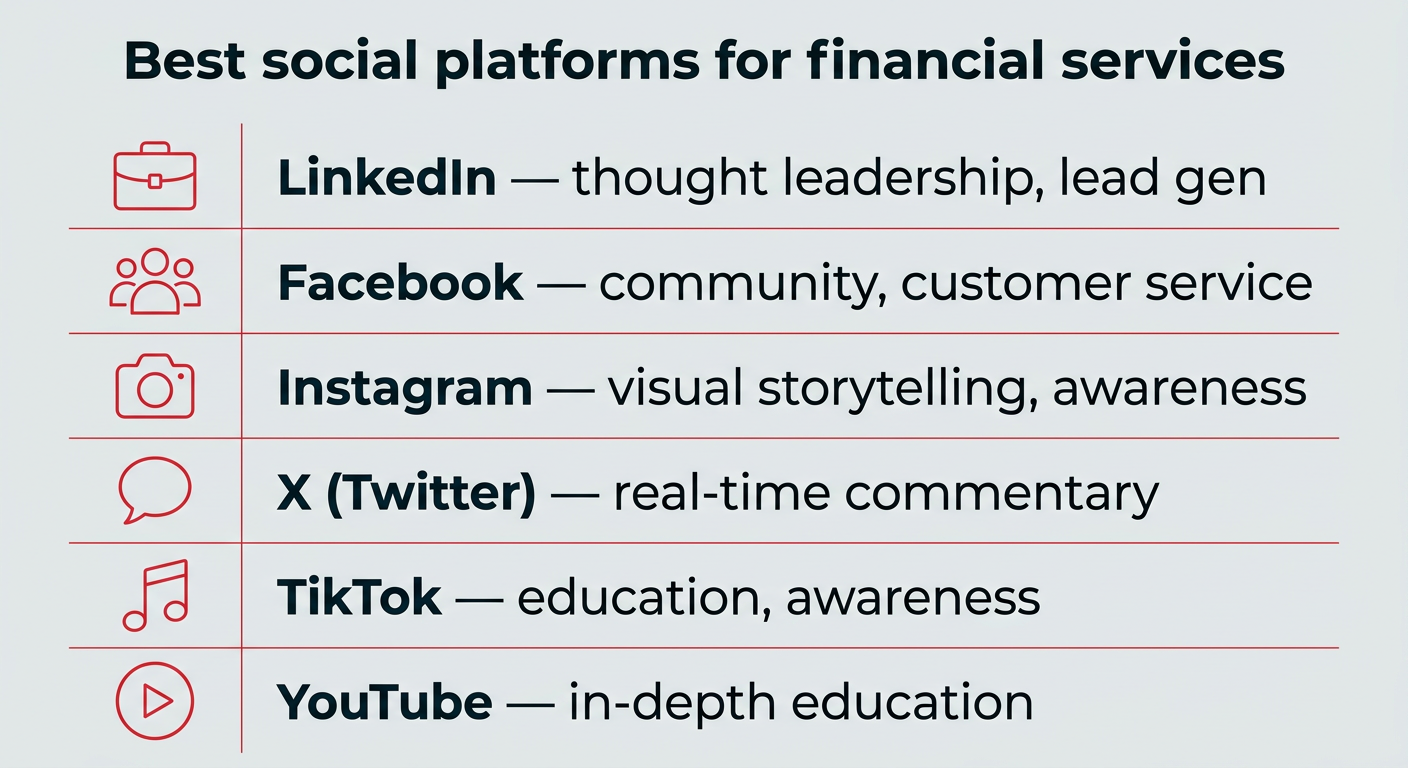
The best social media platforms for financial services include LinkedIn, Meta (Facebook and Instagram), X (Twitter), TikTok, and YouTube.

Each platform offers a different audience, content style, and conversation. So, picking the right platform will depend on your unique audience and goals.

Here’s a quick comparison before we break down each one.

PlatformBest forPrimary audienceContent typeKey strength for FinServ
LinkedInThought leadership, lead genProfessionals, decision-makersLong-form posts, articlesReaching business decision-makers
FacebookCommunity, customer serviceBroad, existing customersUpdates, links, videoLocal branch presence and support
InstagramVisual storytelling, awarenessYounger consumersReels, images, StoriesHighest engagement and follower growth
X (Twitter)Real-time commentaryNews-focused audiencesShort posts, threadsTimely reactions to news and trends
TikTokEducation, awarenessGen Z and younger millennialsShort-form videoExplaining topics in plain language
YouTubeIn-depth educationResearch-minded viewersLong-form videoLong content lifespan and SEO value

LinkedIn

LinkedIn has a large and active community of finance-minded professionals, with members 2x more likely to seek advice on the platform, making it one of the most valuable platforms for financial services brands looking to reach decision-makers.

LinkedIn is best for:

  • Amplifying executive voices
  • Sharing insights and longer perspectives
  • Reinforcing expertise and trust
  • Supporting lead generation
  • Recruiting

People come to LinkedIn to learn. That’s what makes the platform ideal for thought leadership and long-form educational content.

Leaders can take it one step further by linking out to a longer piece of marketing content (think: blog post or research report) to drive traffic — like in the example below:
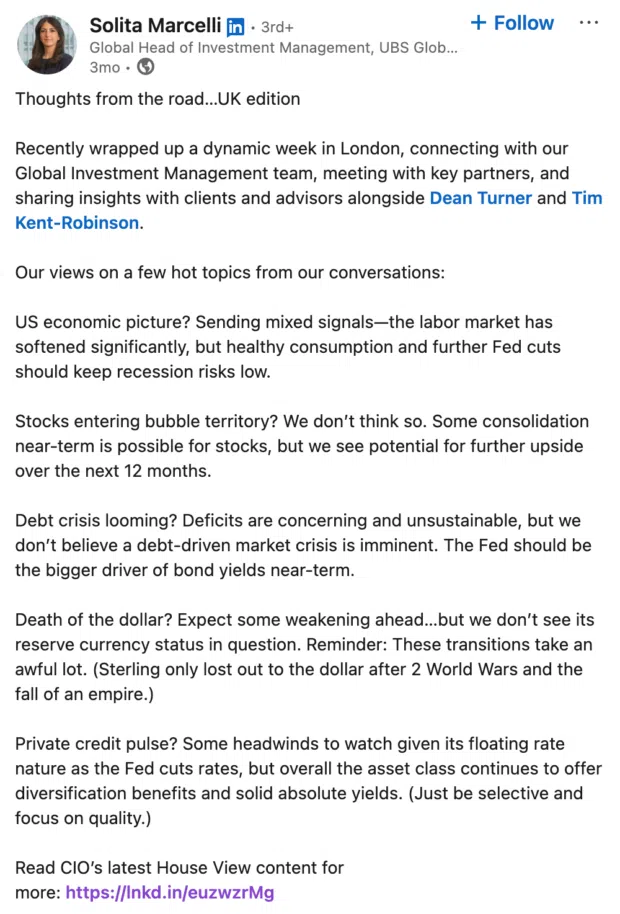
LinkedIn thought leadership example

Source: Solita Marcelli

Meta (Facebook and Instagram)

Meta’s two platforms cover a lot of ground for financial services, from community building to reaching younger consumers.

Facebook is the most-posted-to platform for financial institutions, and it’s well suited for community building, customer service, and giving local branches a presence. Many customers already use it to send messages and ask questions, so it doubles as a support channel.

Instagram, meanwhile, leads on results. It has the highest engagement rate (3.8%) and fastest follower growth (2.26%) of any platform in the financial services benchmarks below. It’s best for:

  • Visual storytelling and brand-building
  • Short-form video through Reels
  • Reaching younger demographics

Together, Facebook and Instagram let financial brands balance service and support with awareness and reach.

X (Twitter)

X is a fast-moving platform used for live conversations and real-time updates.

It’s best for:

  • Commenting on news and industry trends
  • Sharing observations from events and conferences
  • Sharing company updates

The platform rewards clear opinions and strong POVs. For example, when leaders share what they’re noticing in real time, they often spark bigger conversations (which = more engagement).

You can see this in action from Patrick Collison, CEO of Stripe, who drops a few observations on changes he’s seeing in the industry.
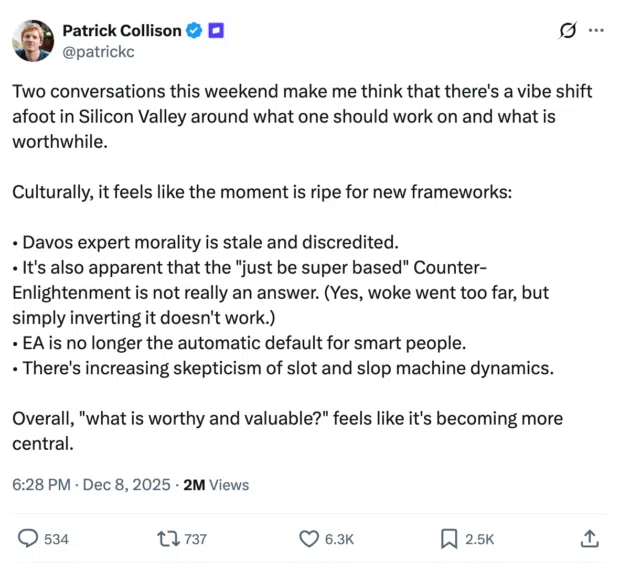
example of a CEO sharing observations on X (Twitter)

Source: Patrick Collison

TikTok

TikTok is becoming hard to ignore, especially for finance brands that want to reach younger audiences.

It’s best for:

  • Explaining topics in simple, everyday language
  • Increasing brand awareness with storytelling
  • Reaching new audiences via the algorithm

One note for planning: TikTok’s regulatory status in the U.S. has shifted in recent years, so it’s worth building a strategy that isn’t dependent on any single platform. Keep an eye on official guidance and have a backup plan for reaching the same audience elsewhere.

Quick disclaimer: TikTok content works best when it feels native to the platform. That means casual language and humor, like in this video from Cash App:
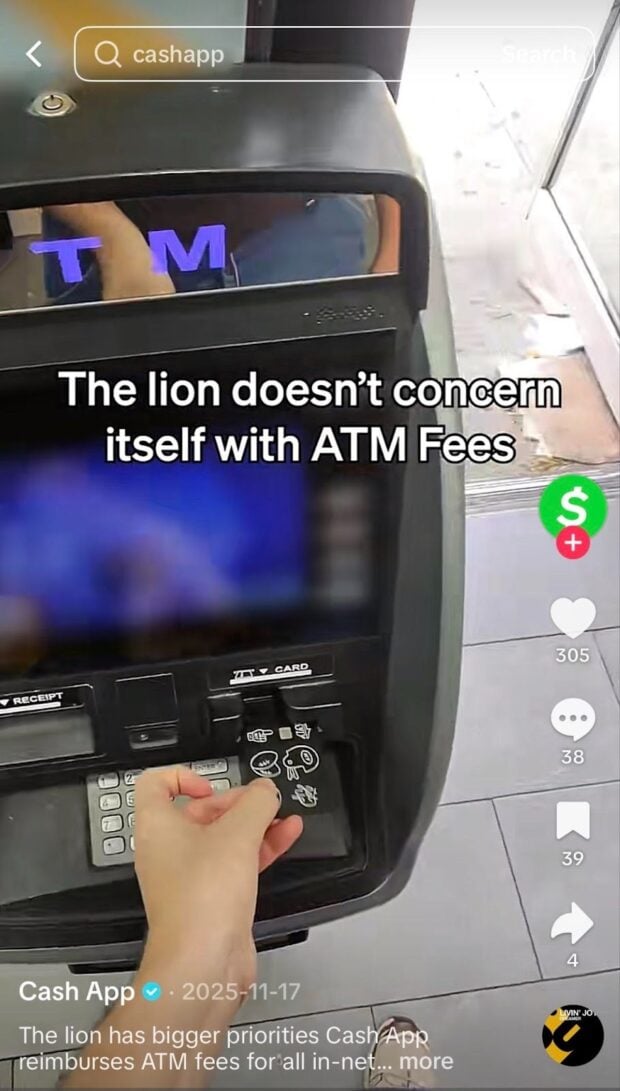
TikTok example from finance brand Cashapp

Source: Cash App

YouTube

YouTube is the leading platform for long-form videos, making it home base for content like podcasts, explainers, and more.

It’s best for:

  • Educational videos
  • Product walkthroughs and demos
  • Interviews, webinars, podcasts, and discussions

Because YouTube content has a longer lifespan than most social posts, it also plays an important role in SEO and trust-building.
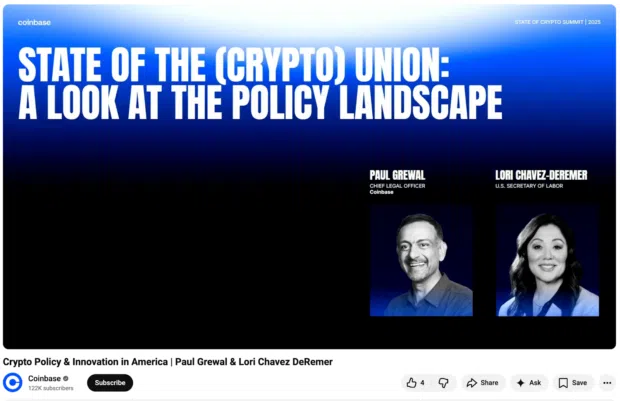
YouTube webinar from Coinbase

Source: Coinbase

Best social platforms for financial services

Social media benchmarks for financial services in 2026

Wondering how your numbers stack up? These financial services benchmarks give you a starting point for posting frequency, engagement, and follower growth. The data below is based on our research from early 2025.

How often should you post on social media in financial services?

Our research found that financial institutions post on Facebook more often than on other social platforms — an average of 5.9 times a week. Instagram and LinkedIn follow, with an average frequency of 5.6 and 5.3 posts per week.
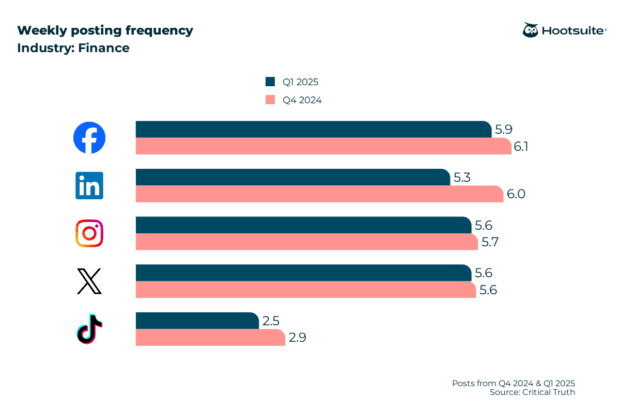
finance weekly posting frequency

That said, every financial institution’s ideal posting schedule is unique, and you should test different posting frequencies to find out what works best for your audience. Use these industry-specific stats as a starting point.

Average engagement rates and follower growth

Here’s how engagement rates and follower growth compare across the major platforms, based on financial services data from early 2025:

PlatformAverage engagement rateFollower growth rate
Instagram3.8%2.26%
LinkedIn3.2%0.51%
Instagram Reels3.1%
X (Twitter)2.1%0%
Facebook1.8%0.61%
TikTok1.6%0.98%

For more FinServ-specific research, including the best times to post, the most engaging content formats, and network-specific breakdowns of the stats above, check out our dedicated post on social media benchmarks for financial services.

How to build a social media strategy for financial services

Financial services teams can build an effective financial services social media strategy by following six core steps:

  1. Conduct a social media audit
  2. Implement a social media policy
  3. Establish clear objectives and define your target audience
  4. Create compliant, engaging content
  5. Engage and nurture relationships
  6. Measure, report, and optimize

1. Conduct a social media audit

In a social media audit, start by listing every social profile your team uses. That includes official brand accounts, team accounts, and any department-specific pages.

At the same time, hunt down any impostor or unofficial social media accounts so you can have those shut down.

While you’re at it, note the platforms where you don’t have a presence yet. Even if you’re not ready to post, it’s often smart to claim your brand handles early.

A free audit template can help keep all your research organized as you tackle this work.

2. Implement a social media policy

A social media policy guides social media use within your organization. That includes accounts for your advisors and agents.

To build a strong policy, loop in the right teams early. That usually includes:

  • Compliance
  • Legal
  • IT
  • Information security
  • Human resources
  • Public relations
  • Marketing

All these teams should have input. This will help you maintain a consistent brand identity while reducing compliance challenges.

Your policy should also spell out roles and approvals. Who can post? Who needs to review content? How does a post move from draft to published? Clear answers upfront help avoid confusion and slowdowns later.

Finally, don’t forget about security. Social media comes with real risks. Your policy should cover basics like password rules, access controls, and how often tools and software should be updated.

It may not be the most exciting part of social media, but it’s one of the most important.

3. Establish clear objectives and define your target audience

Before you post, decide what you want social media to achieve and who you’re trying to reach.

Set measurable goals tied to real business outcomes. That might be brand awareness, lead generation, or faster customer service response times. Clear goals make it much easier to prove value to leadership later.

Then define your audience segments. Retail banking customers, high-net-worth individuals, and B2B clients all have different needs and live on different platforms. Map each segment to the goals and channels that fit, so your effort goes where it counts.

4. Create compliant, engaging content

Great financial content balances education with engagement, and always keeps compliance in view.

Match your content to each platform’s strengths: long-form thinking on LinkedIn, short-form video on TikTok and Reels, and in-depth explainers on YouTube. Build a content calendar so you can plan ahead and keep a consistent cadence.

AI-powered tools can speed up drafting and ideation, and Perch, the content planning and publishing app in Hootsuite Social OS, helps you build posts and route them through approval workflows before anything goes live. That keeps messaging on brand and compliant without slowing your team down.

5. Engage and nurture relationships

Publishing is only half the job. The rest is showing up in the conversation.

Customers want to reach out on the platforms they already use, whether that’s Facebook, Instagram, or messaging apps like WhatsApp. When questions come up, they don’t want to jump between channels just to get help. Social customer service tools help you manage messages across all channels, and it’s smart to connect those conversations to your CRM for compliance, response times, and record-keeping.

Nest, the unified customer care app in Hootsuite Social OS, brings private messages, public comments, mentions, and reactions into one workspace. It integrates with Salesforce and Microsoft Dynamics, so your team has the context to personalize replies and manage messages together. You can explore the engagement tools in more detail.

6. Measure, report, and optimize

Finally, track what’s working and use it to improve.

Monitor performance against the goals you set in step three, and report results back to leadership in terms they care about, like reach, leads, and response times. The analytics in Hootsuite Social OS surface real-time insights across your accounts, so you can double down on what resonates and adjust what doesn’t. Treat your strategy as a loop, not a one-time plan.
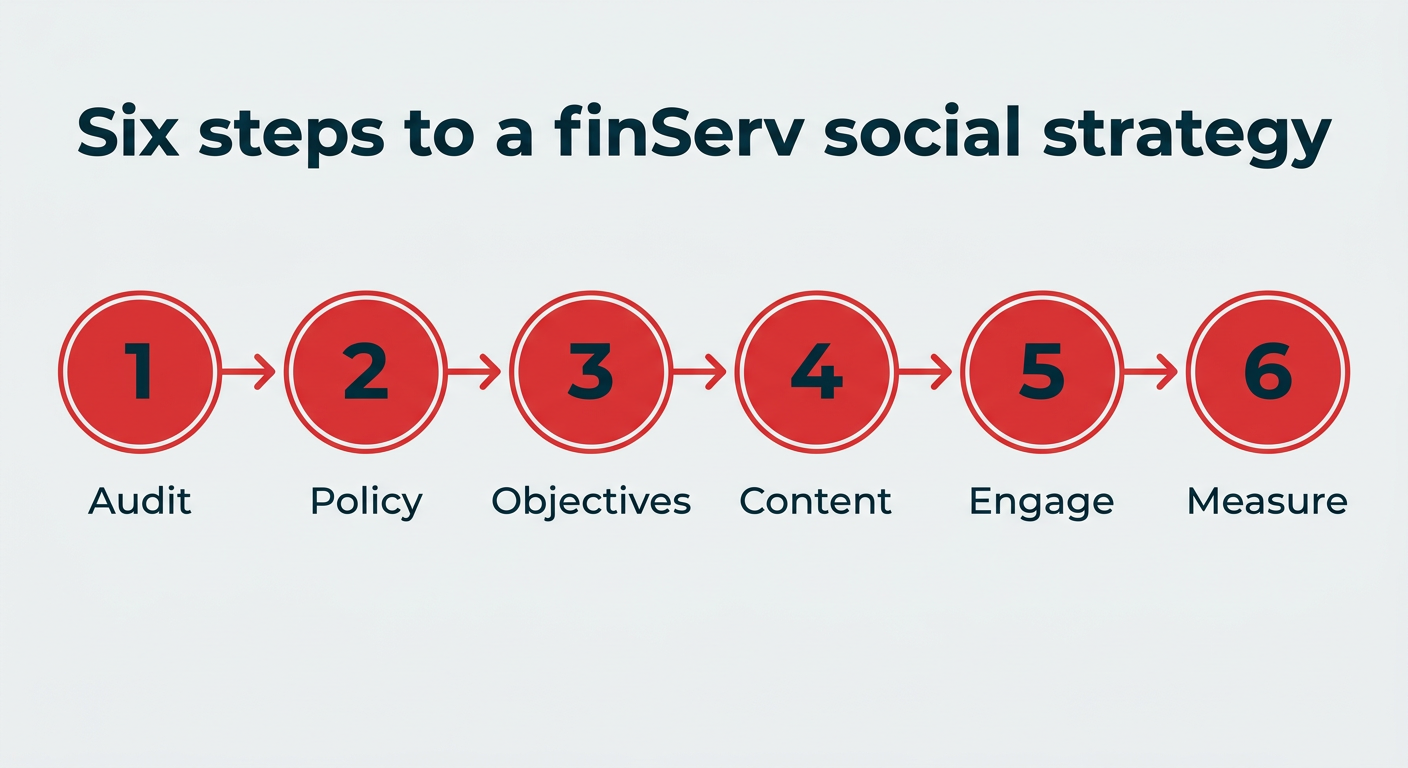
Six steps to a finServ social strategy

Compliance and risk management for financial services social media

Social media compliance in financial services means following the rules that govern how regulated firms communicate, keeping records of everything, and managing the risks that come with a public presence.

Regulatory requirements (FINRA, SEC, FCA, GDPR)

FINRA, FCA, FFIEC, IIROC, SEC, PCI, AMF, GDPR — all the compliance requirements can make your head spin. A few of the big ones:

  • FINRA: Requires principal review of social media used for business and record retention for firms and their representatives.
  • SEC: Governs how firms advertise and communicate with the public, including testimonials and endorsements on social channels.
  • FCA: Regulates financial promotions in the UK, requiring social posts to be fair, clear, and not misleading.
  • GDPR: Sets rules for handling the personal data of individuals in the EU, which affects targeting and customer interactions.

That’s why it’s critical to have compliance processes and tools in place, especially to guide independent advisors‘ use of social media. Vigil, the compliance and governance layer in Hootsuite Social OS, helps enforce approval chains and policies across teams.

Get your compliance team involved as you develop your strategy. They’ll have important guidance on the steps you need to take to protect your brand.

It’s also important to have the right chain of approvals in place for all social media posts. For example, FINRA states:

“A registered principal must review prior to using any social media site that an associated person intends to use for business.”
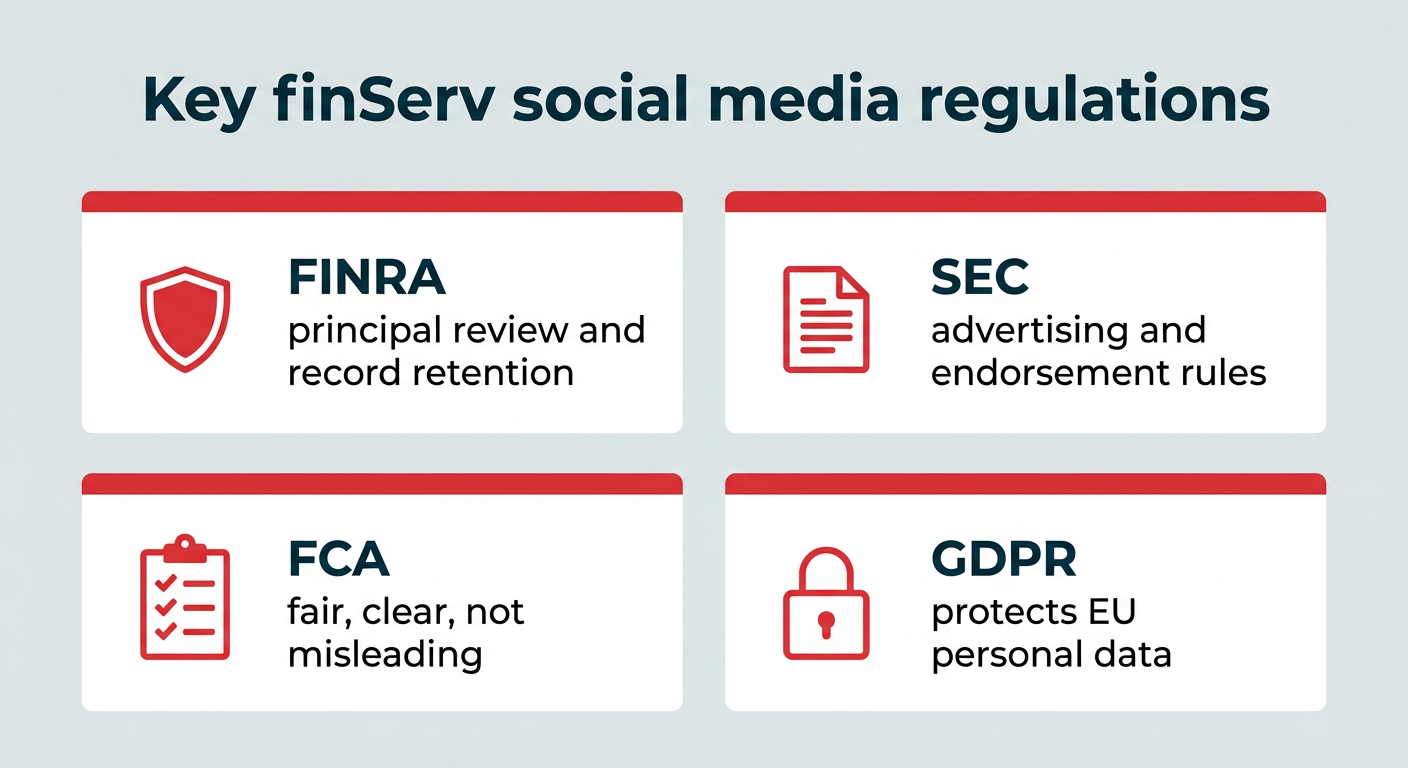
Key finServ social media regulations

Archiving and record-keeping

This falls under compliance, but it’s important enough that it’s worth calling out on its own.

Financial firms are required to keep records of communications related to their business. According to FINRA, those records need to be stored for at least three years.

Hootsuite’s integrations with compliance solutions like Brolly and Smarsh automatically archive all social media communications. You’ll have your social media content stored in a secure and searchable database, complete with the original context.

Social media risks and challenges in financial services

Beyond the rules themselves, social media carries real risks that financial services teams cannot afford to overlook.

Regulatory non-compliance is the most serious. A single non-compliant post can trigger fines, enforcement action, and legal consequences, not just embarrassment. Reputational damage is another concern. In a low-trust industry, a public misstep or poorly handled complaint can spread quickly and erode confidence.

Fraud and impersonation are ongoing threats too. Scammers create fake accounts that mimic legitimate brands to deceive customers, which can lead to real financial harm. And customer privacy is non-negotiable. Sharing or exposing personal financial information without proper consent can violate the law, not just internal policy. Strong governance, monitoring, and access controls are how you keep these risks in check.

Social media trends for financial services in 2026

The biggest financial services social media trends in 2026 center on AI, video, and authentic human voices. Here’s what’s shaping the year:

  • AI-powered content and intelligence: Reshaping how brands create, monitor, and analyze social activity.
  • Short-form video and creator partnerships: Driving reach and awareness with younger audiences.
  • Employee advocacy: Turning advisors and executives into trusted, scalable voices.

AI-powered content creation and social intelligence

AI is changing how financial brands work on social, from drafting content faster to surfacing real-time insights.

Tools like Lumen bring contextual intelligence to social listening, helping teams spot shifting sentiment and detect potential crises early. Wisdom, the AI orchestration layer in Hootsuite Social OS, connects those insights to action, keeping your intelligence in motion across the platform. For a regulated industry, that combination of speed and governed workflows is a real advantage.

Short-form video and creator partnerships

Short-form video keeps growing on TikTok, Reels, and Shorts, and financial brands are leaning in.

Finfluencers are a big part of the shift. As noted earlier, 23% of Americans under 30 follow a personal finance content creator. More financial services firms are partnering with these creators to explain products in plain language and reach audiences who tune out traditional advertising.

Employee advocacy as a growth channel

Financial services firms are increasingly using employee voices to extend reach and build trust.

Advisors and executives who share compliant, pre-approved content on their own profiles come across as more credible than a corporate account. Parliament makes this easy to scale, giving employees ready-to-post content while keeping messaging on brand. It’s one of the most effective ways to turn a large workforce into an authentic growth channel.

Social media campaign examples in financial services

The best social media marketing campaigns in financial services tend to focus on education, storytelling, and showing up consistently.

Here are a few examples to see what that looks like in practice.

1. Current x MrBeast

Current is a financial services company that primarily offers mobile banking services through an app. To build brand awareness, they partnered with high-profile influencers, including Hailey Bieber and Logan Paul.

In particular, they developed an ongoing collaboration with the influencer MrBeast.

The resulting social videos gained significant traction on YouTube, helping Current drive a major increase in app activity and visibility in the Apple App Store.

Why it worked: It met a young audience where they already are, using a trusted creator to make the brand feel relevant and shareable.

MrBeast YouTube video in collaboration with Current

Source: MrBeast

2. BNY Mellon #DoWellBetter

BNY Mellon created the #DoWellBetter campaign to spotlight the positive impact its clients are making.

Featuring beautiful portraits and video interviews, the campaign showed how smart investing and thoughtful wealth management helped clients create positive change.

Why it worked: It used real client stories to build an emotional, human connection that pure product messaging can’t match.
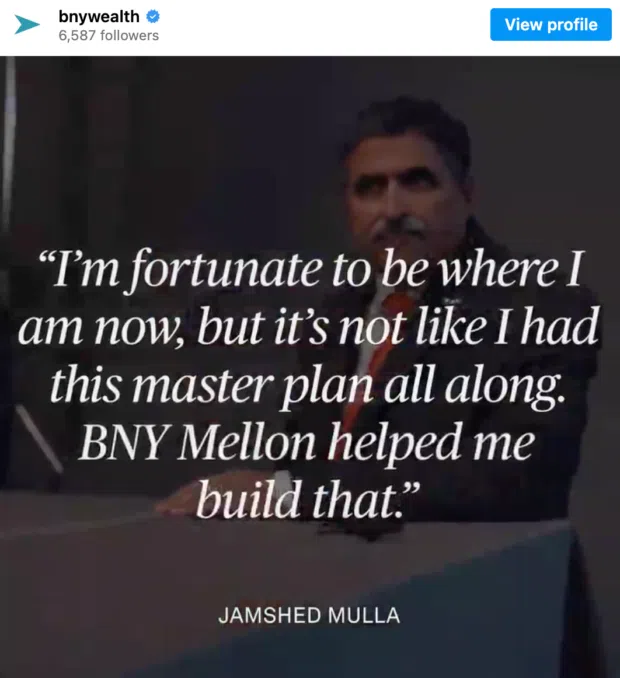
BNY Mellon's #DoWellBetter social media campaign

Source: bnywealth

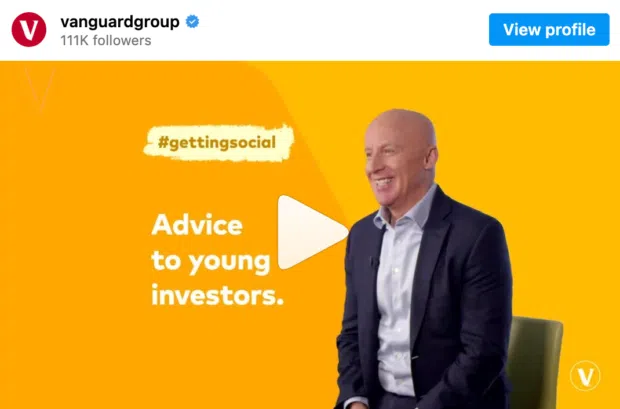
3. Vanguard Group #GettingSocial

Investment company Vanguard Group runs a weekly social video series to share clear, helpful insights on investing and other financial topics.

The consistency is a big part of why it works. Posting on a regular schedule helps followers know what to expect and gives them a reason to come back each week.

These short-form videos deliver useful takeaways without asking for a big time commitment — perfect for busy audiences.

Why it worked: A consistent, educational cadence built a habit with followers and positioned Vanguard as a reliable resource.
Vanguard Instagram Video

Source: Vanguard Group

Vanguard also supports this content with social ads on similar topics. That way, people see both educational and conversion-focused content working together.

How Hootsuite Social OS helps financial services teams

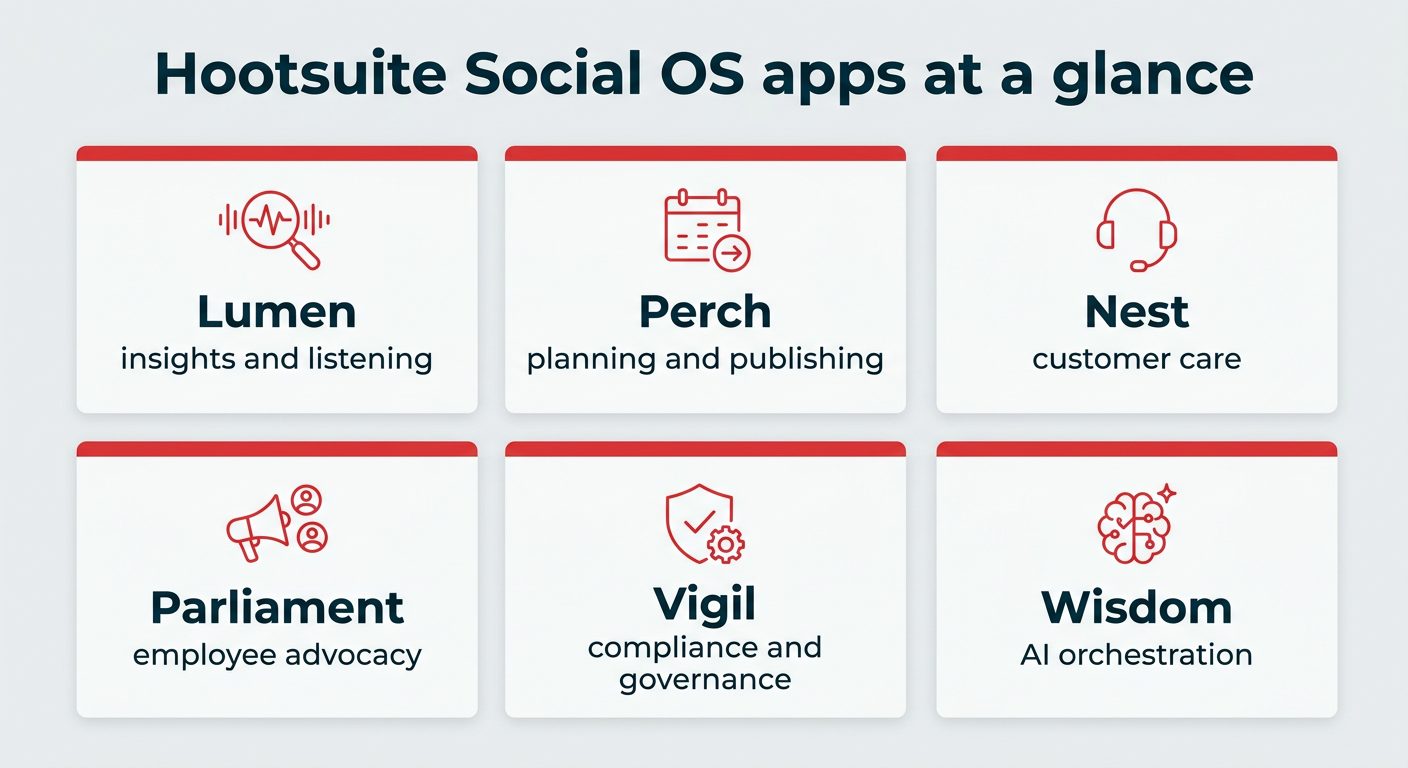
Hootsuite Social OS gives financial services teams one connected system to manage social media safely, from insight to publishing to compliance.

Here’s how the apps work together:

  • Lumen: Surfaces AI-powered insights and social listening for market intelligence, sentiment tracking, and early crisis detection.
  • Perch: Handles content planning and publishing, with governed workflows so every post moves through the right approvals.
  • Nest: Unifies social customer care across private messages, comments, and mentions, with Salesforce and Microsoft Dynamics integrations.
  • Parliament: Powers employee advocacy, giving advisors compliant, ready-to-share content.
  • Vigil: Adds the compliance and governance layer, enforcing approval chains and policies across teams.
  • Wisdom: Orchestrates AI across the platform, connecting contextual intelligence to action.
Hootsuite Social OS apps at a glance

The result is operational coordination across marketing, customer care, compliance, and advisors, all in one place. That means less risk, faster responses, and more time spent on the work that drives results.

FAQ: Social media financial services

What is social media marketing for financial services?

Social media marketing for financial services is the use of social platforms to educate audiences, build trust, generate leads, and provide customer support within a regulated industry. It applies to banks, credit unions, insurance companies, wealth management firms, and fintech companies, and it must balance engagement with strict compliance requirements.

How do financial services companies use social media safely and compliantly?

Financial services companies use social media safely by combining clear processes with the right tools. Vigil, the compliance and governance layer in Hootsuite Social OS, lets teams set up approval workflows, control who can post, monitor brand mentions, and archive content for record-keeping. Paired with a strong social media policy, this makes it far easier to stay compliant.

What social media platforms work best for financial services marketing?

The best social media platforms for financial services depend on your goal. LinkedIn works well for professional insights and executive voices, Facebook for community and customer service, Instagram for visual storytelling and reaching younger audiences, X for real-time updates, TikTok for short explainer videos, and YouTube for longer, in-depth content.

How often should financial services companies post on social media?

Financial services companies post an average of 5.9 times per week on Facebook, 5.6 on Instagram, and 5.3 on LinkedIn, based on our benchmarks data. The right frequency depends on your audience and goals, so use these figures as a starting point and test what performs best.

What are social media best practices for banks, insurance companies, and financial institutions?

The best social media practices in finance focus on education, consistency, and caution. Teams run a regular social media audit, maintain a clear social media policy, plan content with a calendar, follow a strict approval process, and run compliance checks before anything goes live to avoid creating risk.

How do financial services teams manage social media risk and compliance?

Financial services teams manage risk by creating approval workflows, social media policies, and access controls that align with regulations like FINRA and SEC rules. Many also use tools such as Vigil that enforce those workflows and store records automatically, so nothing gets missed.

What are the risks of social media for financial services companies?

The main risks of social media for financial services companies include regulatory non-compliance, reputational damage from public missteps, fraud and impersonation scams, and customer privacy violations. Because a single misstep can carry legal and financial consequences, strong governance and monitoring are essential.

How is AI changing social media for financial services?

AI is changing social media for financial services by enabling faster content creation, real-time social listening, earlier risk detection, and more personalized audience engagement. Tools like Lumen and Wisdom in Hootsuite Social OS help teams surface insights and act on them within governed workflows.

What are the biggest social media trends for financial services in 2026?

The biggest social media trends for financial services in 2026 include AI-powered intelligence and content creation, the continued growth of short-form video, expanding employee advocacy programs, and more finfluencer partnerships. Together, they point toward faster, more human, and more scalable social strategies.

What are examples of successful social media strategies in financial services?

Successful strategies focus on being helpful and consistent, as shown by campaigns from Current, BNY Mellon, and Vanguard. These brands used trusted creators, real client stories, and a steady educational cadence to build awareness and trust while matching content to each platform.

Save time managing your social media marketing strategy with Hootsuite. Publish and schedule posts, find relevant conversions, measure results, and more â all from one dashboard. Try it free today.

The post Social media for financial services: 2026 guide appeared first on Social Media Marketing & Management Dashboard.


* This article was originally published here

Tuesday, July 21, 2026

LinkedIn ads guide: Campaign types, ad specs, and expert tips

Key takeaways

  1. LinkedIn ads reach over 1.3 billion professionals, making it the top platform for B2B advertisers to influence buying committees.
  2. LinkedIn offers 12+ ad formats, from single image and video to Connected TV and Thought Leader ads, each suited to different campaign objectives.
  3. Average LinkedIn ad costs run higher than other social platforms, but stronger B2B targeting typically delivers a better cost per lead for qualified buyers.
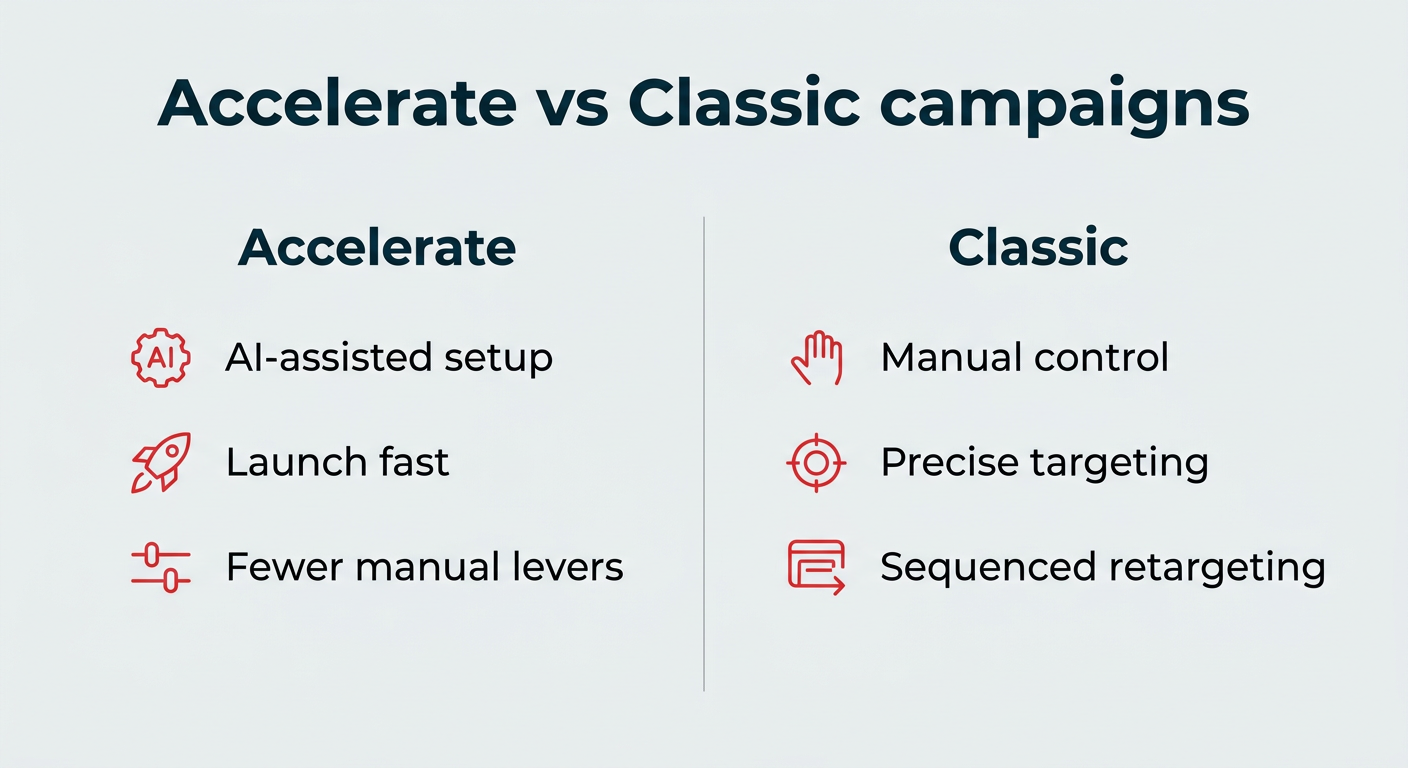
  4. Start with Accelerate campaigns for speed, then shift to Classic for precise retargeting and sequenced funnels.

Why advertise on LinkedIn in 2026

LinkedIn advertising is worth it for B2B marketers because it reaches decision-makers in a professional context you cannot replicate elsewhere. The platform is built around real career data, so you can target by job title, company, seniority, and industry rather than guessing from interests.

That precision matters when you are selling to a buying committee, not a single shopper. With B2B social trends in 2026 pointing toward more first-party data strategies, here are a few reasons teams keep investing in LinkedIn ads:

  • Professional targeting: Reach buyers by job title, function, seniority, industry, company size, and skills, using data members keep current themselves.
  • Buyer intent: People come to LinkedIn to learn, research vendors, and grow their careers, so your message lands in a work mindset.
  • Brand safety: Ads appear in a professional feed, not next to unpredictable user content.
  • Full-funnel capability: From awareness video to lead capture forms, one platform supports every stage of the journey.

LinkedIn reports its audience now tops 1.3 billion members, giving advertisers unmatched scale for reaching professional audiences. For B2B teams that need quality over raw volume, that combination of scale and precision is the core of the case for LinkedIn advertising.

How do you set up your LinkedIn ads account?

Setting up your account in LinkedIn Campaign Manager takes just a few minutes. Follow these four steps to get ready to launch your first campaign in 2026.

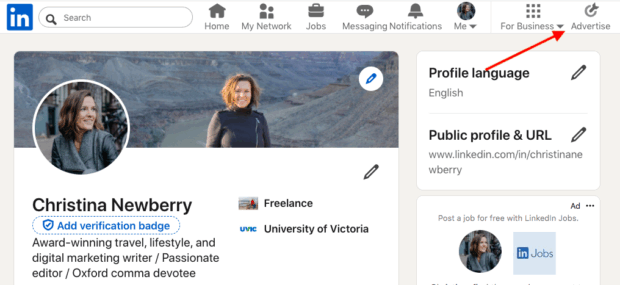
1. Open Campaign Manager

Log in to LinkedIn and click Advertise in the top navigation.

A screenshot of a user's LinkedIn profile, showing the top navigation bar. A red arrow points to the

Source: LinkedIn

2. Create your ad account

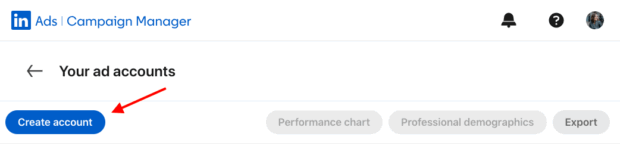
Click Create account, then add an account name and choose your billing currency.

A screenshot of the LinkedIn Campaign Manager interface. A red arrow points to a blue

3. Do your admin set-up

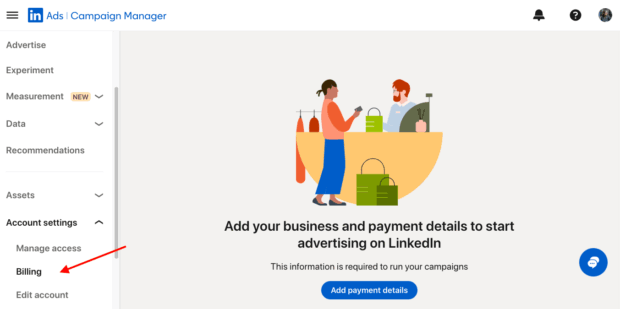
Select the LinkedIn Company Page you’ll advertise from, add a payment method (Account settings → Billing → Add payment details), and set permissions for teammates (Account settings → Manage access).

A screenshot of the LinkedIn Campaign Manager's

Note: Some formats can run without a Page, but connecting your Page now is best practice. You can authorize a Sponsored Content Poster if needed.

4. Start your first campaign

From your account dashboard, click Create. You’ll choose an objective and build your first Accelerate or Classic campaign (we’ll cover which to use next).

Bonus: Download a free step-by-step guide to combining organic and paid social tactics into a winning LinkedIn strategy.

How does the LinkedIn ad auction work?

When you advertise on LinkedIn, an auction system decides when your ad is served and how much you pay. Your ad competes with others that have similar formats and target audiences, and the winning ad maximizes value for both the member and the advertiser.

Bid strategies (pick one per campaign)

Maximum delivery (automated)

LinkedIn sets bids to spend your budget efficiently and maximize results for your objective. Best when you need scale and simplicity.

Cost cap

You set a target cost per result and LinkedIn auto-adjusts bids to keep your average near or below that cap while maximizing volume. Best when you need cost control without going fully manual. Available for brand awareness, website visits, engagement, video views and lead generation objectives.

Manual bidding

You specify the amount you’d like to bid for tighter test design or niche audiences. Best when you want strict control and are willing to monitor and adjust.

Budgeting and pacing

Use daily or lifetime budgets. Lifetime lets LinkedIn pace spend over time to hit your objective more efficiently. Avoid making too many reactive changes; pacing and learning work best with stable settings.

How do you make it work?

Start new campaigns on Maximum delivery, then move to Cost cap (or Manual) once you have a baseline. Choose lifetime budget for steadier performance. When tuning bids or budgets, make small, spaced-out changes and give the campaign time to relearn.

How much do LinkedIn ads cost in 2026?

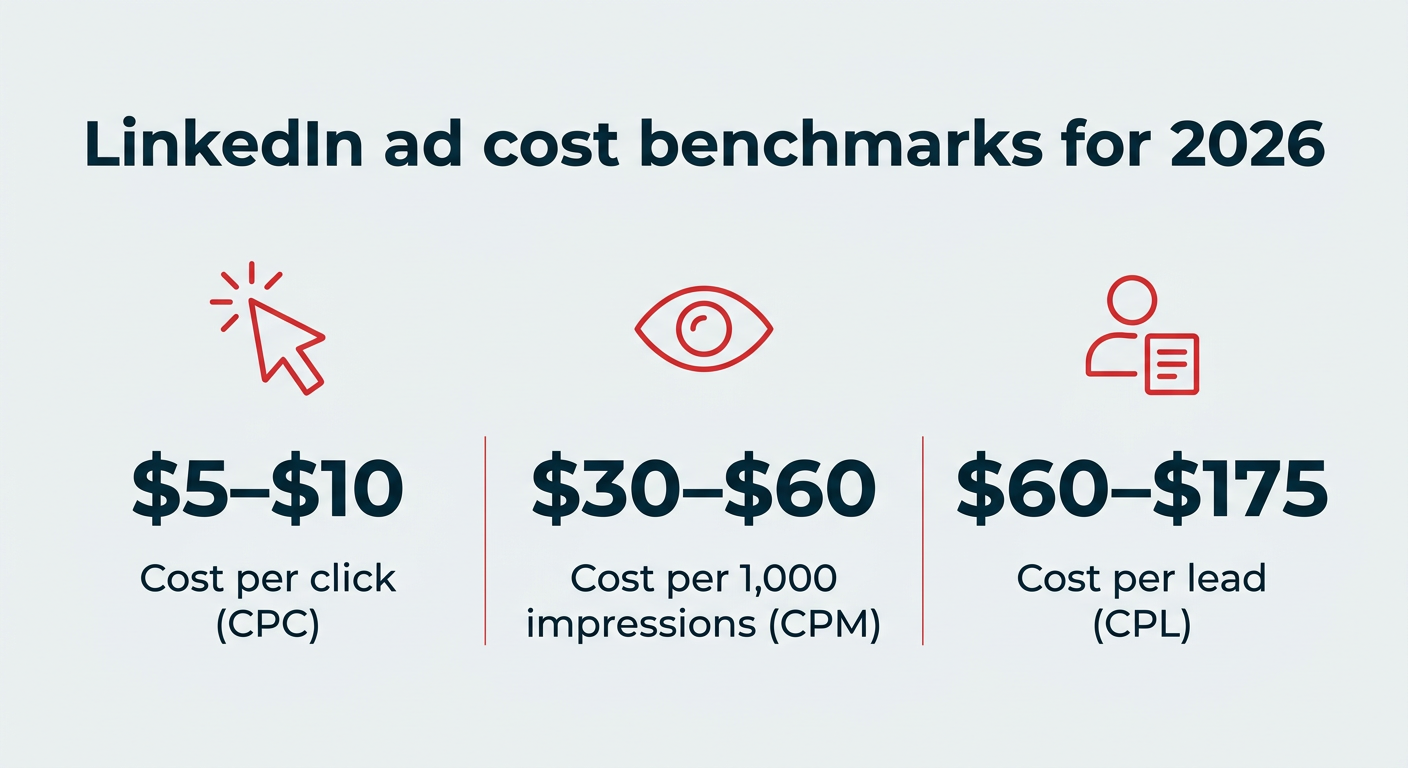
LinkedIn ads typically cost more per click than other social platforms. LinkedIn does not publish fixed rates because pricing is auction-based, but third-party benchmarks for 2026 commonly cluster around $5–$10 per click, $30–$60 per 1,000 impressions, and $60–$175 per lead.

Treat these as directional only — your actual costs will vary by audience, objective, industry, and bid strategy.

LinkedIn ad cost benchmarks for 2026

Several factors move your LinkedIn ad cost up or down:

  • Audience competitiveness: Popular job titles and industries cost more because more advertisers bid on them.
  • Objective: Lead generation and conversion goals usually cost more than awareness or reach.
  • Ad relevance: Higher engagement and quality scores lower your effective cost.
  • Time of year: Costs rise during busy periods like Q4 as competition peaks.
  • Industry: Regulated and high-value sectors like financial services and tech tend to see higher costs.

Here is how LinkedIn’s typical cost ranges compare to other platforms for B2B campaigns.

PlatformAvg. CPCAvg. CPMAvg. CPL
LinkedIn$5–$10$30–$60$60–$175 (2026 third-party benchmarks; LinkedIn’s official pricing is auction-based and not published as fixed rates)

LinkedIn sits at the higher end on cost per lead, but the leads it delivers tend to be closer to your ideal buyer. For most B2B teams, a good cost per lead is one that produces qualified pipeline, not just the cheapest form fill. Judge value on downstream opportunity quality, not the raw click price.

What are the LinkedIn campaign types and when should you use them?

LinkedIn offers you two ways to build campaigns. Both support the same objectives and formats; the difference is how much control you want vs. how quickly you want to launch.

Accelerate vs Classic campaigns

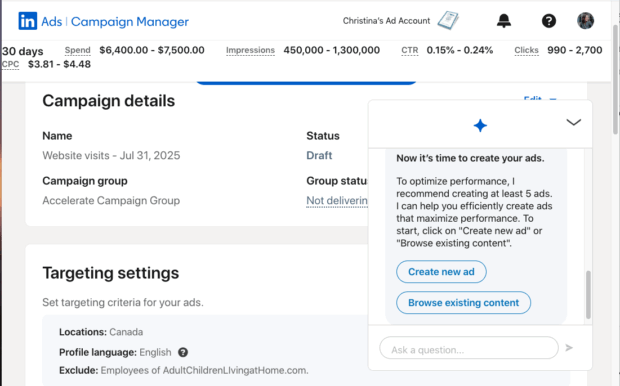
Accelerate (AI-assisted) campaigns

What it is: Accelerate is a guided mode that leverages LinkedIn’s AI to find the right combination of targeting, creative, bidding, and placements based on your objective and inputs, then optimizes toward your goal.

A screenshot of the LinkedIn Campaign Manager's campaign details page. The page shows a draft campaign named

Source: LinkedIn Campaign Manager

When you launch the campaign, it goes through an optimization period of about 10 to 14 days as Accelerate uses machine learning to figure out how to best optimize the campaign.

Best for:

  • Getting live fast with sensible defaults
  • Lean teams or first-time advertisers
  • Upper/mid-funnel programs (video, thought leadership, content downloads)

Accelerate campaigns offer fewer manual levers, so review the suggested audience before launch and set clear budget caps. (You can always shift to Classic for tighter control later.)

Classic (manual control) campaigns

What it is: LinkedIn’s traditional ad builder that allows you to manually define audiences (attributes, lists, exclusions), placements, bidding, and scheduling.

Best for:

  • ABM and narrow ICP targeting
  • Sequenced funnels and retargeting logic
  • Experiments that need strict control (A/B cells, bid strategy tests)

Pro tip: Many teams start with Accelerate to build qualified remarketing pools, then use Classic for precise retargeting and lead capture. LinkedIn’s training materials cover using both modes for full-funnel programs.

How do you target LinkedIn ads?

You can target a specific audience on LinkedIn using professional attributes, matched audiences, and exclusions to keep your budget focused on your ideal buyer. This is where LinkedIn’s advertising advantage shows up: no other platform lets you reach a buying group with this level of professional precision.

The most effective campaigns target the full buying group, not just one decision-maker. As Gabe Feingold, Product Marketing Leader at LinkedIn, puts it:

“LinkedIn is the only platform purposefully built for B2B advertisers and the most powerful platform to influence B2B decision-makers. On LinkedIn, you can engage the full buyer group, from the C-suite to daily practitioners, in a trusted, professional environment.” – says Gabe Feingold, Product Marketing Leader at LinkedIn.

Professional attribute targeting

Professional attributes let you build an audience from the career data members keep current. Start broad enough for LinkedIn to optimize, then tighten with the attributes that define your buyer.

Common targeting attributes include:

  • Job title: Reach specific roles directly.
  • Job function and seniority: Group roles by department and level.
  • Industry and company size: Focus on the types of companies you sell to.
  • Skills: Target the expertise your buyers list.
  • Groups and interests: Reach members by professional community and topic.

Matched audiences and retargeting

Matched audiences let you reach people who already know you. Upload CRM contact or company lists, retarget website visitors using the LinkedIn Insight Tag, and build audiences from video viewers, lead form openers, and post engagers. You can also create lookalike audiences to find new buyers who resemble your best customers.

When prospecting, exclude employees, competitors, current customers, and recent converters so your budget stays focused on new demand. The right mix of attributes and matched audiences gets your message to the whole buying group without wasting spend.

#1 for LinkedIn marketing

Schedule posts, answer messages, and manage ads from one spot. Then, show off your results in beautiful reports. It’s so easy.

Start your free trial

What are the LinkedIn ad formats and specs?

LinkedIn offers 12+ ad formats, and the right choice depends on your objective. Each LinkedIn sponsored content format has its own benefits and requirements, so use the summary below to shortlist a format, then check the detailed specs.

FormatBest objectiveKey spec
Single imageAwareness, conversions1.91:1, 1:1, or 4:5
CarouselConsideration, feature stories2–10 cards, 1:1
VideoBrand building, demos3 sec–30 min, MP4
DocumentLead gen, contentPDF/DOC, under 10 pages
EventEvent promotion4:1 banner
Thought LeaderEngagement, awarenessUses member’s post
Article/newsletterReadership, leadsUses original post
MessageDirect offersUp to 1,500 characters
ConversationMulti-path nurtureUp to 5 CTAs per message
Lead Gen formsLead captureUp to 12 fields
Dynamic AdsFollowers, promotionsDesktop right rail
Connected TVUpper-funnel reach16:9, 6–60 sec

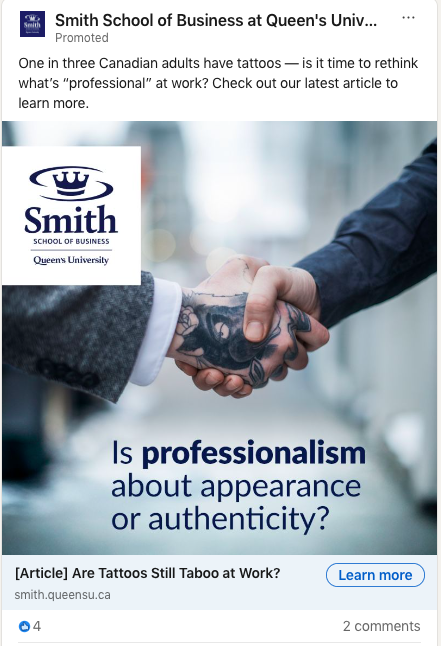
Single image ads

Single image ads are quick, versatile, and work across most objectives. A clear visual plus one strong promise can build awareness and nudge action without extra complexity.

A LinkedIn ad from Smith School of Business at Queen's University, showing a handshake where one person has a tattooed hand. The ad asks,

Source: Smith School of Business at Queen’s University

Best for: Clear value propositions, product launches, and retargeting.

Image dimensions: 7680 × 4320 px recommended

File size: up to 5 MB

File type: .jpg, .png, .gif

Text limits: intro 150 characters recommended (up to 600); headline 70 characters (max 200)

Aspect ratios: 1.91:1 horizontal, 1:1 square, 4:5 vertical

Carousel ads

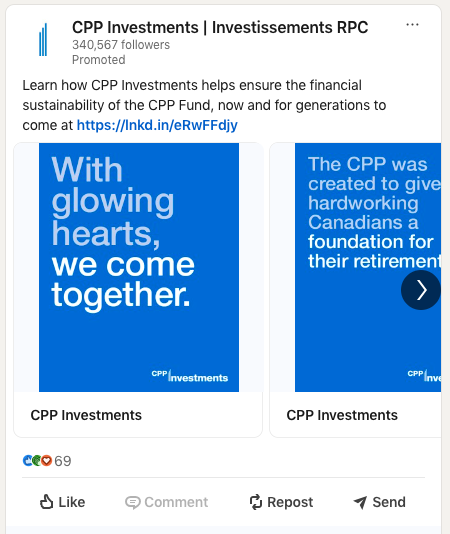
Carousel strings multiple images into a swipeable story — ideal for showing steps, features, or variants in one ad without sending people off platform.

Because each card carries its own headline and link, you can test messages side by side and learn quickly what drives action.

A carousel of LinkedIn ads by CPP Investments. The first image has the text,

Source: CPP Investments | Investissements RPC

Best for: multi-feature stories, step-by-step walkthroughs, product comparisons, and showcasing different customer outcomes.

Cards: 2–10

Image dimensions: 1080 × 1080 px (square)

File size: up to 10 MB per card

File type: .jpg, .png

Text limits: intro up to 255 characters; card headline up to 45 characters

Aspect ratio: 1:1 only (video is not supported in carousels)

Video ads

According to eMarketer, LinkedIn is the top platform to reach a B2B audience with video, and LinkedIn even says video is one of their fastest-growing formats.eMarketer reports that video posts receive 20x more shares and 3x the engagement of other post formats.

Video is your best format for building attention and recall while telling a richer story. Use it to demo a product, explain a point of view, or bring customer outcomes to life without sending people off-platform.

Because videos auto-play muted in feed, front-load branding and key visuals in the first few seconds, add captions, and choose a clear thumbnail to earn the click.

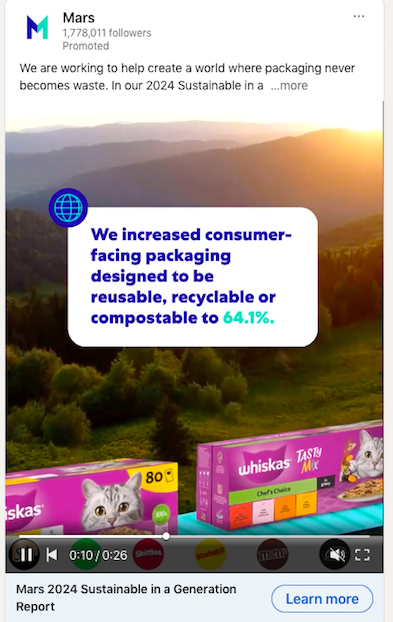
In Feed Video Ads are video units that run up to 30 minutes long, as sponsored posts in the LinkedIn feed and across the LinkedIn Audience Network. With video ads, you can include a lead gen form as the CTA.

A LinkedIn video ad by Mars highlighting a sustainability report. The ad features a text overlay stating,

Source: Mars

Best for: Brand building, product demos, thought leadership, and retargeting sequences.

File type: MP4 (AAC audio)

Duration: 3 seconds–30 minutes (15–30 seconds is a reliable sweet spot)

Dimensions and ratios: 1:1, 16:9, 4:5, 9:16; 360–1920 px

File size: up to 500 MB

Text limits: intro ~150 characters recommended (up to 600); headline ~70 characters recommended (up to 200)

Thumbnail and captions: add a still that matches the aspect ratio; include captions for silent autoplay

Document ads

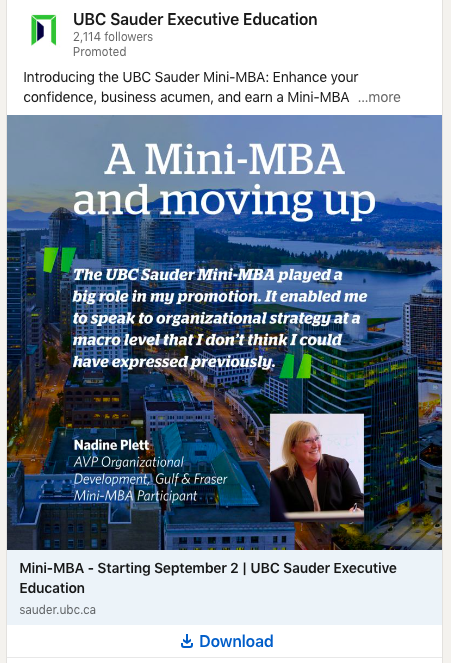
Document ads let people read and download your asset directly in the feed. Share it ungated to build reach, or gate with a Lead gen form to capture high intent before download.

A LinkedIn ad from UBC Sauder Executive Education promoting a Mini-MBA program. The ad features a testimonial from a participant, Nadine Plett, with an image of her and a city skyline.

Source: UBC Sauder Executive Education

Best for: Guides, checklists, benchmark reports, case studies, and templates.

File types: PDF, DOC, DOCX, PPT, PPTX

File size: up to 100 MB

Length: aim for under 10 pages for in-feed browsing; hard max 300 pages (or ~1M words)

Layout: any standard page size; design for mobile legibility

Text limits: intro ~150 characters recommended; headline ~70 characters

Tips: title the cover with a clear promise (“Template,” “Checklist,” “Benchmarks”); keep hyperlinks clean and test the downloadable file

Event ads

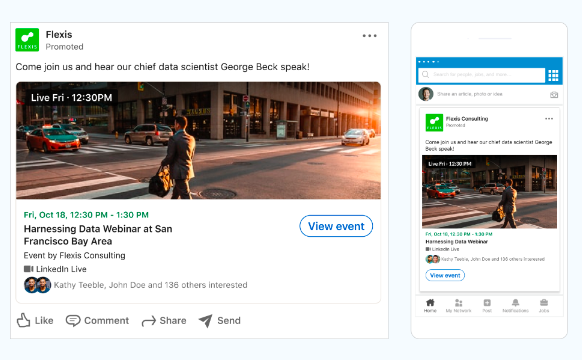
Event ads promote a LinkedIn Event directly in the feed so people can discover it, RSVP, and join — marketers who use them see up to 31x more viewership. You can run them before, during, and after the event to keep momentum going, including live streams and replays.

A side-by-side view of a desktop and mobile version of a Flexis event LinkedIn ad. The ad promotes a live webinar with a chief data scientist, showing event details, including the date, time, and location in the San Francisco Bay Area.

Source: LinkedIn

Best for: Webinars, product launches, conferences, community meetups, and post-event replays.

Note: To make an event ad on LinkedIn, you must first create a LinkedIn event on your page.

Source: Pulls name, date, and image from your LinkedIn Event

Image ratio: 4:1 (from the Event banner)

Intro text: up to 600 characters

Event name (optional in ad): up to 255 characters

URL: must link to a LinkedIn Event page

Timing: set start and end dates and times in Campaign Manager

Retargeting: audiences available from registrants, viewers, and engagers

Thought leader ads

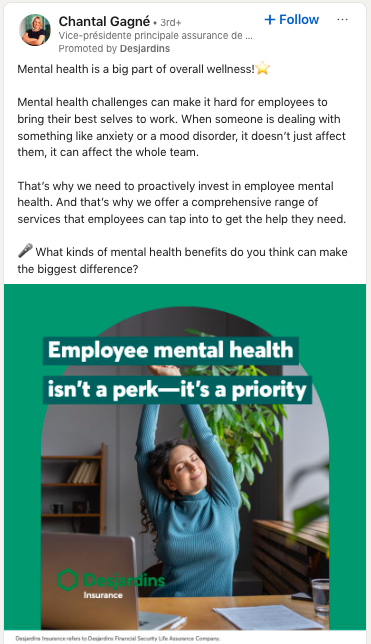
Thought Leader ads promote a member’s LinkedIn post (an executive, product manager, creator, customer, or partner) so it appears in-feed with a small “Promoted by [Your Company]” label. Because the creative is the original post, the message stays authentic and often earns stronger engagement than Page-first ads.

A LinkedIn ad by Desjardins Insurance promoting employee mental health. The ad copy discusses mental health as a priority, not a perk, and shows a woman stretching in an office environment.

Source: Chantal Gagné

Best for: Executive points of view, product explainers, customer or employee storytelling, and event promotion using a member’s post that links to your LinkedIn Event.

Objectives: Brand awareness, Engagement

Ad formats: Single image, Video, Event

Who you can promote: Employees and 1st- or 2nd-degree connections (author approval required)

Eligible content: Member posts with image or video, third-party links, Event posts, LinkedIn Articles, and Newsletters

Not eligible: Documents, multi-image, polls, reshared, “celebration” posts; posts shared to Groups

Permissions: Super admin, Content admin, or Sponsored Content Poster on your Page

Creative and CTA: Uses the original post; no separate ad fields. Single image/video TLAs have no CTA button; Event posts include RSVP; links in the post stay clickable

Reporting: Full metrics in Campaign Manager; author sees combined organic and paid totals

Article and newsletter ads

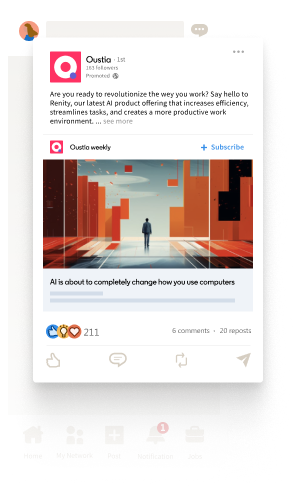
Article and newsletter ads promote your native long-form content on LinkedIn. The ad uses the original post, so it feels authentic and sends clicks straight to the Article or Newsletter page. It is a solid way to grow qualified readership and, for Articles, capture leads with a lightweight unlock flow.

A screenshot of a mobile LinkedIn feed showing an Oustio LinkedIn ad. The ad promotes a new AI product,

Source: LinkedIn

Best for: Growing Article reads and Newsletter subscribers, distributing long-form points of view, and turning engaged readers into leads with Unlock Article.

Creative source: Uses the original Article or Newsletter post; you don’t upload new media into this ad.

Text fields: You cannot add a separate headline or intro text here. Edits must be made to the original post.

Clickthrough behavior: No custom URL field. Clicks take members to the Article or Newsletter page on LinkedIn.

CTA options: With the Lead Generation objective (Article Ads only), the CTA is “Unlock Article.” Other objectives don’t offer a CTA button.

Dimensions and file limits: Follow Single image ad specs for images and text limits (since the ad uses an image-based post). See Single image specs for details.

Sponsored messaging ads

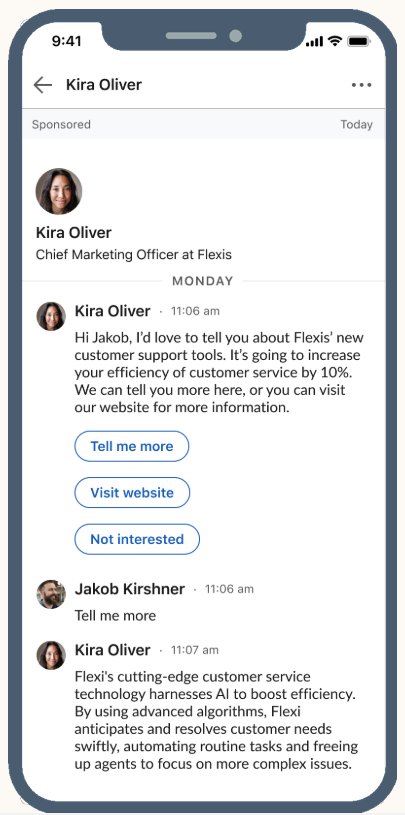
Sponsored Messaging ads are a great way to engage your prospects with 1:1 messages sent directly to their LinkedIn Messaging inbox. There are two types: Conversation ads and Message ads.

A sponsored LinkedIn ad in a message conversation on a mobile phone. The ad is from Kira Oliver, Chief Marketing Officer at Flexis, speaking to a user named Jakob Kirshner. The conversation promotes Flexis's new AI customer support tools and includes call-to-action buttons like

Source: GGU International on LinkedIn

Message ads

Message ads deliver a one-to-one sponsored message to a member’s LinkedIn inbox from a chosen sender. They are built for a single, clear action, with an optional desktop banner to reinforce your offer.

Best for: Webinar or event invites, product offers with one next step, trials and demos, and time-sensitive announcements.

Subject line: up to 60 characters

Message text: up to 1,500 characters

CTA button: up to 20 characters

Custom footer (optional): up to 2,500 characters

Landing page URL: up to 1,024 characters; must use http:// or https://

Banner (optional, desktop only): 300 × 250 px, JPG or PNG, up to 2 MB

Sender: uses the LinkedIn profile image and name of your designated sender

Frequency cap: each member can receive Sponsored Messaging about once every 45 days

Conversation ads

Conversation ads create a choose-your-own-path experience in LinkedIn Messaging. Multiple buttons branch to different offers or next steps, so people can self-select what they want.

Best for: Multi-offer nurtures, product tours with several paths, qualification flows, and lead generation directly from the inbox.

Message text: up to 8,000 characters

CTA buttons: up to 5 per message, 25 characters each; up to 50 buttons total across a conversation

Custom footer (optional): up to 20,000 characters

Landing page URL: up to 2,000 characters; must use http:// or https://

Banner (optional, desktop only): 300 × 250 px, JPG or PNG, up to 2 MB

Sender: uses the LinkedIn profile image and name of your designated sender

Frequency cap: each member can receive Sponsored Messaging about once every 45 days

Lead gen forms

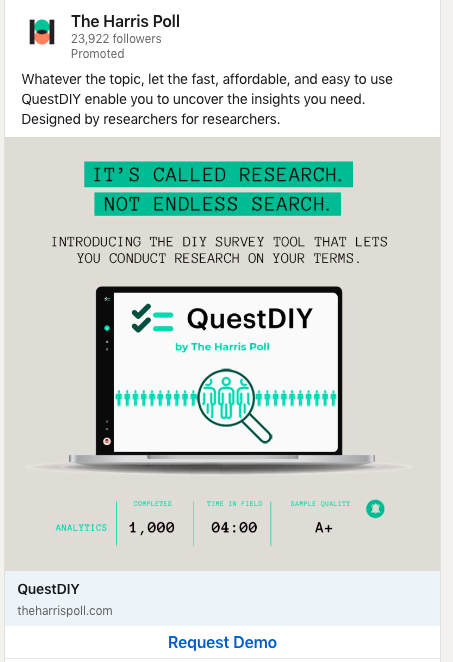
Lead Gen forms let people submit their information without leaving LinkedIn. Forms are pre-filled with LinkedIn profile data and can be attached to in-feed ads (single image, video, carousel, document) and to Sponsored Messaging, or used to unlock a LinkedIn Article.

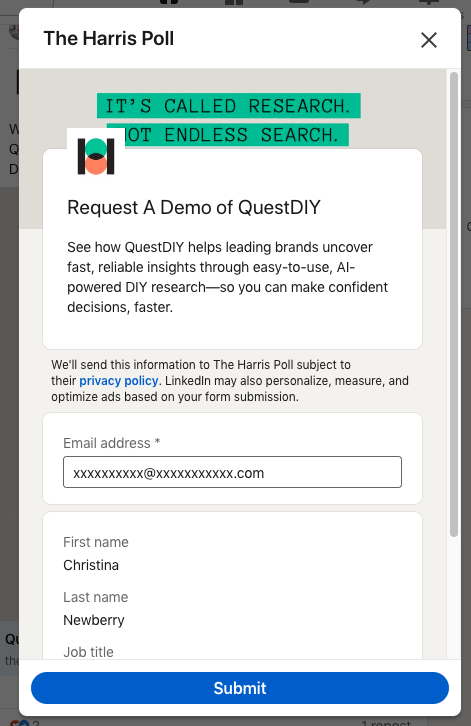
A LinkedIn ad for
A LinkedIn ad lead generation form for

Source: The Harris Poll

Best for: Demos, trials, webinar registrations, content downloads.

Form name: up to 256 characters

Offer headline: up to 60 characters

Offer detail (optional): up to 160 characters

CTA label: up to 20 characters

Confirmation message: up to 300 characters

Fields per form: up to 12 (3–4 recommended)

Custom questions: up to 3, 100 characters each

Available fields: contact, work, company, education, demographic

Privacy policy URL: required; up to 2,000 characters (http or https)

Delivery: sync to your CRM or download from Campaign Manager

Dynamic ads (Follower, Spotlight, and Text ads)

Dynamic Ads run in the desktop right rail and personalize with a member’s name and, if enabled, their profile photo. This group includes Follower ads, Spotlight ads, and Text ads, each with a slightly different goal.

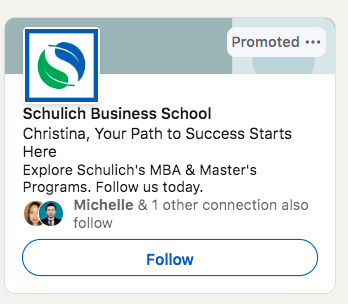
Follower ads

Follower ads promote your LinkedIn Page to the right people in the desktop right rail. The unit personalizes with a member’s name and, if enabled, their profile photo to make the follow feel more relevant.

A LinkedIn ad promoting Schulich Business School's MBA and Master's programs, personalized with the user's name, Christina. The ad also shows that a connection named Michelle follows the school.

Source: Schulich Business School

Best for: Growing high-quality Page followers among specific roles, industries, or regions.

Placement: Desktop right rail (Dynamic Ads)

Destination: Your LinkedIn Page

Company logo: 100 × 100 px, JPG or PNG, up to 2 MB

Headline: up to 50 characters

Description: up to 70 characters

Company name: up to 25 characters

CTA options: Visit company, Visit jobs, Visit careers, Visit life

Personalization: Member name macros; optional member profile photo

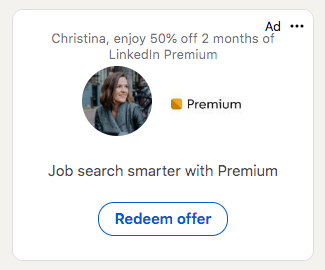
Spotlight ads

Spotlight ads drive people to a specific landing page, product page, or promotion. They appear in the desktop right rail and personalize with a member’s name and, if enabled, their profile photo.

A LinkedIn ad offering a 50% discount on a LinkedIn Premium subscription. The ad is personalized for the user, Christina, and encourages a smarter job search.

Source: LinkedIn

Best for: Product launches, limited-time offers, pricing or comparison pages, and fast paths from impression to landing page

Placement: Desktop right rail (Dynamic Ads)

Destination: Any landing page (http or https), up to 500 characters

Company logo: 100 × 100 px, JPG or PNG, up to 2 MB

Optional background image: 300 × 250 px, JPG or PNG, up to 2 MB

Headline: up to 50 characters

Description: up to 70 characters

CTA label: up to 18 characters

Personalization: Member name macros; optional member profile photo

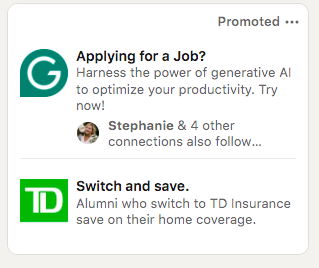
Text ads

Text ads are small pay per click or cost per impression units that appear on desktop in the right rail or top banner. Use them to reinforce your message alongside in-feed campaigns and drive efficient traffic.

Two separate LinkedIn ads displayed in a sidebar. One is from

Best for: Efficient desktop reach, ABM coverage and retargeting, quick value proposition tests.

Placement: Desktop right rail and top banner

Destination: Your landing page (http or https)

Logo image: 100 × 100 px, JPG or PNG, up to 2 MB

Headline: up to 25 characters

Description: up to 75 characters

CTA options: Apply, Download, Learn more, Sign up, Subscribe, Register, Request demo

Connected TV ads

CTV ads reach professional audiences while they stream on the big screen via Paramount and NBCUniversal’s platforms. You set up the campaign in Campaign Manager, target with LinkedIn’s first-party professional data, and later retarget viewers with in-feed formats to drive action.

Best for: Upper-funnel reach, brand storytelling, product launches, and creating high-quality video audiences to retarget.

Dimensions: 1920 × 1080 px (recommended) or 1280 × 720 px

Aspect ratio: 16:9

Format/codec: MP4, H.264

Duration: 6–60 seconds (15 or 30 seconds recommended)

Max file size: 500 MB

Bitrate: 12 Mbps minimum (15–40 Mbps recommended)

Frame rate: 23.98, 24, 25, 29.97, or 30 fps (29.97 fps recommended)

Audio: 2-channel AAC or PCM, 48 kHz; target −23 LUFS

Retargeting: Build audiences from CTV video viewers for follow-up in feed

Brand safety: Category exclusions available during setup

How do you build a high-impact LinkedIn ad?

Here’s how Feingold framed the single most important principle behind successful campaigns:

“One of the most effective ways to create a LinkedIn campaign is to start with your business objective and work backwards. Begin by choosing the right campaign objective in Campaign Manager, tailor the creative to the business outcome you want to drive, and make sure you have the right measurement in place to measure what actually drives pipeline, rather than vanity metrics.”

Why should you start with the outcome?

Pick your objective first, then let it guide your decisions. An awareness campaign should communicate the payoff at a glance and earn attention quickly. A lead generation campaign should lower friction and make the next step feel safe and useful. Hold yourself to the scorecard that matches the objective you chose.

How do you make your creative earn attention?

Lead with the outcome your buyer will feel. People decide in seconds, so open with a clear hook, keep copy tight, and show brand or product early without crowding the message.

Design for mobile with square or vertical crops and legible type.

In video, captions are essential and the first three seconds do most of the work. In document ads, promise something concrete on the cover and keep it short enough to skim in feed, even if the download goes deeper.

How should you plan the sequence?

Treat campaigns as a journey. A LinkedIn strategy template can help you map the sequence: warm new audiences with thought leadership or product education (video, document, or article), follow with single image or carousel offers, then ask for a form fill.

Remember to target the whole buying group as you sequence (see how to target LinkedIn ads above). Launch distinct concepts, give budgets time to exit learning, and make small changes so delivery can stabilize.

How do you measure what matters?

Judge success against your chosen objective. Awareness is about reach and quality attention. Tools like sentiment analysis can help gauge brand perception shifts. Lead programs are about completion rate and downstream opportunity creation.

Keep attribution windows consistent so trends are comparable, and use diagnostics to explain performance shifts, not incidental clicks.

How do you measure and track LinkedIn ad performance?

The cleanest way to judge success is to measure against the objective you chose at the start, then set up tracking so you can connect ad spend to pipeline.

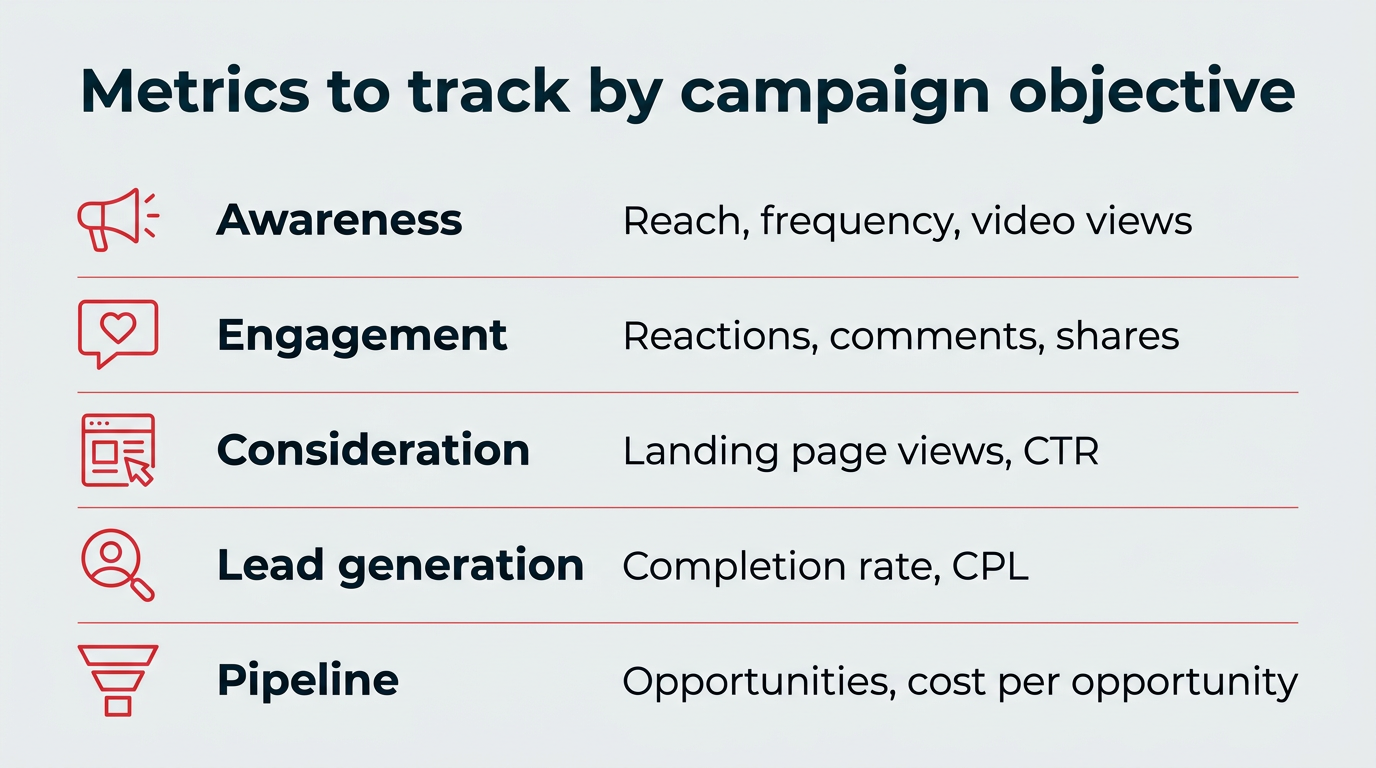
What should you track by objective?

Here are the top metrics to track, depending on your goal.

  • Awareness: Reach, frequency, video completions (if applicable). Look for follower growth and expanded retargeting pools too.
  • Engagement and thought leadership: Reactions, comments, shares, saves, follows. For video, include cost per engaged view.
  • Consideration and site traffic: Landing page views first, then CTR and cost per LPV. If CTR is fine but LPVs lag, fix page speed or message match.
  • Lead generation: Form open rate, completion rate, and CPL. Sanity-check quality (role, seniority, industry) and sync to CRM fast.
  • Pipeline impact: Lead→MQL→SQL conversion, opportunity rate, and cost per opportunity. Just keep attribution windows consistent.
  • Diagnostics: CPM, CPC, conversion rate, frequency, audience size, and creative diagnostics. Make small, spaced changes and allow learning to complete.

Check early signals on day 1 and day 3 for breakage, then make decisions weekly.

Metrics to track by campaign objective

How do you set up conversion tracking?

To measure LinkedIn ads ROI accurately, install the LinkedIn Insight Tag, a lightweight JavaScript snippet you add to every page of your site. You can find it in Campaign Manager under Analyze → Insight Tag, then place it in your site’s global footer or through a tag manager.

Once the tag is live, create conversion actions in Campaign Manager for the events that matter, such as demo requests, sign-ups, or purchases. Assign a value to each conversion so LinkedIn can report cost per conversion and return on ad spend.

For full pipeline attribution, connect those conversions to your CRM so you can trace a lead from click to closed deal. You can find setup details in LinkedIn’s Insight Tag documentation. Clean tracking turns raw clicks into the ROI story your leadership actually cares about.

What are the best tips for optimizing and scaling LinkedIn ads?

You have your account set up, formats chosen, and a clear measurement plan. Now it’s time to help good campaigns learn fast, keep creative fresh, and scale what’s working.

How do you tune for delivery without whiplash?

Launch with an automated bid strategy to establish a baseline, then move to cost control once stable. Make small, spaced changes (one variable at a time). Check early signals on day 1 and day 3, then adjust weekly.

Why should you improve creative before micromanaging bids?

Most gains come from clearer offers and stronger first impressions. Rotate 3–5 distinct creative concepts, retire fatigue, lead with the outcome, and make the first three seconds of video earn the next ten.

How do you build and sequence audiences by intent?

Create audiences for site visitors, video viewers, lead form openers and completers, and post engagers, and keep them in separate ad sets for pacing. Then sequence the journey: educate new viewers, use proof for warm visitors, and ask for forms only when curiosity is there.

Warm with thought leadership or product education (video, document, article), follow with single image or carousel offers, then ask for a form fill. For Sponsored Messaging, respect channel frequency limits so messages feel useful, not intrusive.

How do you scale what works carefully?

When a campaign hits goal, widen reach or test adjacent audiences, or increase budget gradually. If expansion stalls performance, roll back to the last stable setting and change one lever at a time (creative, audience, or bid).

Feingold shares that, “just like B2B advertising, LinkedIn Ads is not about quick wins; it’s about quality outcomes that advance pipeline performance by nurturing your ideal customers and building your brand.

We recommend that B2B marketers focus on targeting the whole buyer group that will influence a purchase, not just executive decision makers. And rather than jumping right into lead generation, engage your audience first with thought leadership and brand storytelling before asking for a lead.”

FAQ: LinkedIn ads

What are the main LinkedIn ad formats?

The main LinkedIn ad formats in 2026 are: single image, carousel, video, document, event, article and newsletter, thought leader, sponsored messaging (Message and Conversation), Dynamic Ads (Follower, Spotlight, Text), and Connected TV.

How much do LinkedIn ads cost?

LinkedIn ads costs vary by industry, audience, and objective because pricing is auction-based. Third-party 2026 benchmarks commonly cite ranges around $5–$10 per click, $30–$60 per 1,000 impressions, and $60–$175 per lead, but your actual costs will depend on your specific campaign settings.

Are LinkedIn ads worth it for B2B marketing?

LinkedIn ads are worth it for B2B marketers because the platform’s professional targeting data lets you reach decision-makers by job title, company size, industry, and seniority, which typically delivers higher-quality leads than broader social platforms despite higher per-click costs.

How does the LinkedIn ad auction work?

It is a second price auction that picks a winner based on your bid and predicted relevance and quality, then charges just enough to beat the next best ad.

How do I target a specific audience with LinkedIn ads?

You can target a specific audience with LinkedIn ads using professional attributes (job title, function, seniority, industry, company size, skills), matched audiences (CRM contact lists, website visitors, lookalikes), and exclusions to keep your budget focused on your ideal buyer profile.

What is the LinkedIn Insight Tag and do I need it?

The LinkedIn Insight Tag is a lightweight JavaScript snippet you add to your website that tracks conversions, enables website retargeting, and provides demographic data about your site visitors, and yes, you need it to measure LinkedIn ad ROI accurately.

Should I use Accelerate or Classic campaigns?

You should use Accelerate to launch fast with guided targeting, creative, and bidding. Choose Classic when you need precise control, complex exclusions, or sequenced retargeting.

What should I measure for LinkedIn ads?

When measuring the performance of LinkedIn ads, match metrics to your objective: awareness (reach, frequency, video completions), engagement (reactions, comments, shares, follows), consideration (landing page views, CTR, cost per LPV), leads (open rate, completion rate, CPL), and pipeline (opportunity creation and cost per opportunity).

When should I use Lead Gen forms instead of a landing page?

You should use Lead Gen forms for quick, pre-filled capture inside LinkedIn; send to a landing page when you need richer context, multi-step validation, or a deeper product story.

How often can I send Sponsored Messages?

Each member can receive Sponsored Messages about once every 45 days, so pace Message and Conversation ads accordingly.

Save time managing your social media marketing strategy with Hootsuite. Publish and schedule posts, find relevant conversions, measure results, and more â all from one dashboard. Try it free today.

The post LinkedIn ads guide: Campaign types, ad specs, and expert tips appeared first on Social Media Marketing & Management Dashboard.


* This article was originally published here
4 tips to build a Snapchat marketing strategy - Social Media Today

4 tips to build a Snapchat marketing strategy    Social Media Today * This article was originally published here