Tuesday, April 29, 2025

51 LinkedIn statistics to shape your social strategy

LinkedIn statistics are the finger on the pulse of the professional world. They give us a glimpse into the trends and behaviors of millions of working professionals. Plus, they help us understand LinkedIn’s impact on businesses and organizations that use the platform for marketing, lead generation, hiring, and more.

As we enter 2025, let’s look at some key LinkedIn statistics you need to know to inform your LinkedIn social media strategy.

Bonus!!!

Download a free guide that shows the 11 tactics Hootsuite’s social media team used to grow their LinkedIn audience from 0 to 511,000 followers.

General LinkedIn statistics

Ready to dive into the world of LinkedIn marketing? Here are the top general LinkedIn statistics you need to know.

1. LinkedIn turns 23 years old in 2025

LinkedIn officially launched on May 5th, 2003, just nine months before Facebook launched at Harvard. The platform was originally founded by Reid Hoffman, who built the initial version in his living room.

Microsoft acquired LinkedIn in 2016, and today, it leads a diversified business with revenues from membership subscriptions, advertising sales, and recruitment solutions under Ryan Roslansky.

2. LinkedIn has 38 offices and more than 18,500 employees

LinkedIn maintains a global presence, with more than 18,500 full-time employees working out of offices around the world.

3. LinkedIn offices are present in 38 cities worldwide

LinkedIn offices are located in more than 38 cities worldwide, including 11 in the United States.

4. LinkedIn is available in 36 languages

This allows many global users to access the network in their native language.

text on white background listing the 36 languages linkedin is available in
Source: LinkedIn

5. LinkedIn made more than $16 billion during the 2024 fiscal year

In Q4 of FY2024, LinkedIn’s revenue increased by 10% year-over-year, with the platform reporting record engagement and member growth metrics.

Source: Statista

6. Globally, women represent nearly 49% of LinkedIn’s global leadership

LinkedIn’s core values include a dedication to diversity, inclusion and belonging. As a business-focused social network, LinkedIn says, “We realize our responsibility both on our platform and in our company to create a more equitable and inclusive world of work.”

7. LinkedIn hired more Black and Latino senior staff in 2024

In 2020, LinkedIn made a commitment to double the number of U.S. Black and Latino senior individual contributors (ICs), managers, and leaders by fiscal year 2025. The platform ended FY2024 by hitting 124% of its goal for senior-level Black employees, though the goal for senior-level Latino employees sits at 82% as of this year.

8. White and Asian staff make up the majority of the LinkedIn workforce

The slim majority of LinkedIn’s employees (40.5%) are Asian, and 36.8% are White, with Black, Latino, and mixed-race populations making up smaller percentages.

graph showing race and ethnicity breakdown of linkedin workforce
Source: LinkedIn

9. Men make up 51.9% of LinkedIn’s workforce

Followed closely by women at 47.6% of the workforce and 0.7% choosing not to disclose their gender.

10. Women make up more of the non-technical roles at LinkedIn

Women hold 57.6% of non-technical roles at LinkedIn, while men hold just over 40% of those roles. White women make up the majority (53%) of the non-technical positions held by female workers, while Asian men make up the majority (63.8%) of technical roles held by men.

11. LinkedIn’s revenue increased by 10% in Q1 of 2024

In the first quarter of 2025, LinkedIn’s revenue increased by 10% year-over-year (9% in constant currency).

12. LinkedIn video viewership is up 36% year-over-year

Video continues to be a popular format across social media platforms, with LinkedIn reporting weekly immersive video views increased 6x quarter-over-quarter in Q1 FY25.

LinkedIn user statistics

Now that we’ve covered LinkedIn’s general statistics, let’s examine some key user stats that every marketer should know.

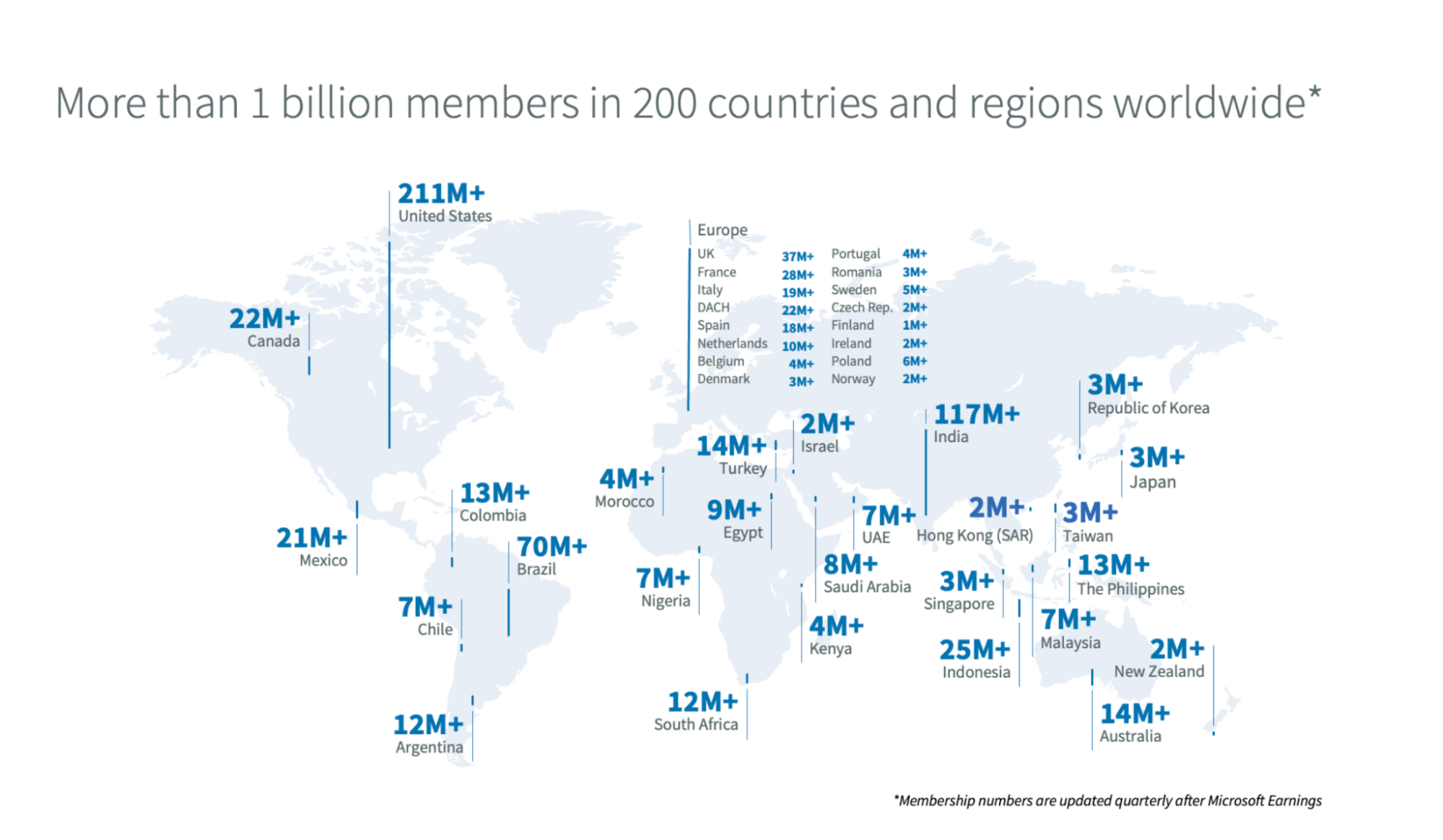
13. LinkedIn has 1 billion members around the world

LinkedIn now has over 1 billion members worldwide, making it the largest professional networking platform in the world. The majority of these users are found in North America, then Asia-Pacific, then Europe, Latin America, and the Middle East and Africa.
graph showing race and ethnicity breakdown of linkedin workforce
Source: LinkedIn

14. 56.4% of LinkedIn users identify as men and 43.6% identify as women

Men outnumber women on LinkedIn overall, but you’ll need to do some research to understand the makeup of your specific LinkedIn audience. Note that LinkedIn does not report any genders other than male or female.

(Psstt! These are the latest numbers LinkedIn’s reporting, but they’re as of January 2024.)

15. Over 74% of LinkedIn users are from outside the US

While the US is LinkedIn’s biggest market, with over 230 million users, the network has gained traction worldwide. Coming in second place is India with 143 million users, followed by Brazil with 81 million users, and the United Kingdom with 41 million users.

LinkedIn does not report data about users in Mainland China, though it does report 3 million users in Hong Kong.

LinkedIn global membership as of FY25 Q1
Source: LinkedIn

16. LinkedIn has members in 200 countries and regions worldwide

LinkedIn’s users live in more than 200 hundred countries and regions around the world. This includes over 296 million in Europe, 72 in the Middle East and Africa, 323 million in the Asia Pacific, and 183 million in Latin America.

17. More than 67 million companies are listed on LinkedIn

Similarly, LinkedIn users can also find educational opportunities by searching through the platform’s directory of more than 136,000 schools. Users can also use LinkedIn to find mentors, build professional relationships, and network with potential employers.
#1 Social Media Tool

Create. Schedule. Publish. Engage. Measure. Win.

Free 30-Day Trial

18. Most of LinkedIn’s traffic comes from the U.S.

Americans continue to be the most frequent visitors to LinkedIn, with 32.48% of all web traffic coming from the United States. India follows behind at 9.2%, signaling its sizable influence in global professional networking.

19. Hirers who use AI-assisted messages see a 44% higher acceptance rate

LinkedIn continues to add new AI-powered features to help transform how people “sell, learn and hire.” These tools are designed to help hirers find qualified candidates faster by tackling the most time-consuming tasks

20. 32% of U.S. adults use LinkedIn

According to Pew Research, 32% of U.S. adults report using LinkedIn. This places LinkedIn below other top social sites like YouTube, which took first place at 85%, and Facebook, which came in second with 70%.

which social media platforms are the most popular
Source: Pew Research

21. Americans aged 30 to 49 used LinkedIn the most

LinkedIn is more popular with older demographics, which makes sense when you think about the wider professional market. Data shows that in the U.S., 41% of adults aged 30 to 49 report using the platform, compared to just 15% of those 65 and older.

22. Educated Americans are more likely to use LinkedIn

Pew Research found that LinkedIn is more popular among college-educated Americans. 54% of Americans with a bachelor’s degree report using the platform, while only 31% who have some college education say the same.

Those with less education or without a high school degree make up only 12% of the platform.

LinkedIn usage stats

The latest LinkedIn usage stats are in, and they might even change how you see this platform.

23. LinkedIn members consume ~138 hours of learning content every minute

LinkedIn members collectively spend around 138 hours every minute engaging with professional learning content, highlighting the platform’s significant role in skill development and continuous education.

24. 7 people are hired every minute through LinkedIn

This is up from 6 people per minute in 2024.

25. More than 9K LinkedIn members apply for jobs every minute

To put this already remarkable figure in perspective, that’s 540,000 applications per hour, 12.9 million per day, and more than 90 million per week.

26. Roughly 40% of EU LinkedIn users log in every month

LinkedIn didn’t traditionally share active user counts, but thanks to the EU’s Digital Services Act, the platform now publishes regular updates on EU user counts.

Platform use when compared to total users in EU member states remains high: up to 80% of Finland’s one million users log in each month, while five million of the Netherlands’ eleven million total members are monthly active users.

27. 51.9 million logged-in users in the EU visit LinkedIn every month

Between January and June 2024, a monthly average of 51,900,000 logged-in users and 192,900,000 logged-out users visited LinkedIn’s services in the EU.

28. 1.6 billion people visit LinkedIn every month

Not only is LinkedIn popular in terms of membership, but it also sees a significant amount of traffic. In fact, 1.6 billion people visit LinkedIn every month.

29. 40% of LinkedIn visitors organically engage with a page every week

Organic engagement is hard to come by these days. But according to LinkedIn’s internal data, 40% of visitors engage with a page organically each week. That’s an impressive statistic demonstrating the platform’s staying power and relevance in the market.

30. There are more than 41,000 skills listed on LinkedIn

LinkedIn has over 41,000 skills listed, making it an excellent resource for employers looking to find just the right candidate.

LinkedIn advertising statistics

Have your wallet ready because, by the time you finish reading these LinkedIn advertising statistics, you’ll be ready to start running campaigns.

If you’re new to using paid features on LinkedIn, we’ve got a whole guide to LinkedIn ads to get you started.

31. LinkedIn ad revenue is expected to reach $10.35 billion USD by 2027

LinkedIn Marketing Solutions, the branch of the platform dedicated to helping businesses grow with ads, generated more than $5 billion in revenue for the first time in July of 2022. This number is expected to surpass $10.35 billion in the next two years.

32. Vertical ads on LinkedIn drive 31% more engagement than horizontal ads

Not only do vertical ads take up more real estate in your target audience’s feeds, but they also enjoy an 11% higher CTR.

Image showing engagement and CTR for different ad sizes on LinkedIn
Source: LinkedIn

33. Funny content earns 65% more engagement on LinkedIn

When compared to non-humorous content, funny LinkedIn ads earn 65% more engagement and a 42% higher lead generation form fill rate.

Stat showing humour improves content performance on LinkedIn
Source: LinkedIn

34. Display and video ads can improve brand favorability and purchase consideration

According to LinkedIn, video and display ads can have a significant impact on brand KPIs like favorability, intent and purchase consideration

chart showing increased brand favorability, research intent, and purchase consideration for linkedin display and video ads
Source: LinkedIn

Video ads, in particular, have the potential to make a big impact — but only if they’re done well.

35. Brands have seen a 33% increase in purchase intent resulting from ad exposure on LinkedIn

Marketers can benefit from LinkedIn’s ability to connect with members early in the marketing funnel through users engaging with brand posts and sharing them on their feeds. This type of exposure has brought brands increase as high as 33%.

36. Marketers see up to 2x higher conversion rates on LinkedIn

LinkedIn’s range of tools for audience targeting means website visits originating from the platform are more likely to increase conversions on B2B sites. Conversion rates remain high this year—take advantage of them.

37. LinkedIn Marketing also brings 2x higher engagement rates

An in-depth analysis of LinkedIn advertising statistics revealed that ads made through LinkedIn Marketing Solutions produce twice the engagement rate compared to organic. For more insights on leveraging LinkedIn for your marketing efforts, check out this article on LinkedIn marketing tools.

38. Ads using LinkedIn’s conversion tracking tool see a 13.5% lower cost per acquisition

LinkedIn stats show that when you use their conversion tracking tool, the cost per acquisition (CPA) is 13.5% lower than when not using it. This tool helps businesses track conversions from LinkedIn Ads and gives them more insight into which campaigns are working best for them.

39. Members on LinkedIn have 2x the buying power of the average online audience

LinkedIn users have higher-than-average buying power compared to other online audiences. This makes it a great platform for businesses looking to target customers who are more likely to make purchases.

LinkedIn business statistics

Next up in our LinkedIn statistics round-up, let’s explore the LinkedIn business statistics driving the professional world this year.

40. 4 out of 5 people on LinkedIn “drive business decisions”

LinkedIn’s chief selling point for marketers is its ability to target an audience by their job, not just their demographics. This allows B2B marketers, in particular, to reach the decision-makers.

41. More than 67 million companies are listed on LinkedIn

If you are still on the fence about using LinkedIn for business, you may be in the minority. Data shows that 67 million companies have a LinkedIn page, and growing.

42. 82% of B2B marketers see success on LinkedIn

Compared to other social channels, LinkedIn has been the most successful platform for B2B marketers. In fact, 82% of B2B marketers have reported their greatest success on LinkedIn.

linkedin infographic brands that have seen increased engagement and purchase intent
Source: LinkedIn

43. LinkedIn users post an average of 6 times per week

Hootsuite partnered with data science agency Critical Truth for a comprehensive analysis of over 1 million social posts — across industries and social networks — and found that most LinkedIn users post almost every day of the week.
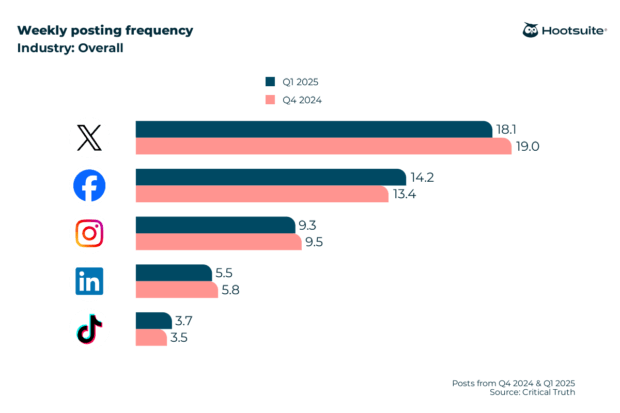
Weekly posting frequency across major social networks Q1 2025

44. 40% of LinkedIn users engage with business pages every week

LinkedIn audiences are also highly engaged, with 40% of users regularly engaging with business pages each week.

45. LinkedIn pages that post weekly see 5.6x more follower growth

Businesses that manage to post weekly see a significant boost in their follower growth. LinkedIn reports that these businesses experience 5.6 times more growth than pages that don’t post as often.

Not sure what to post on LinkedIn? Here’s a guide on what to post to grow your network and boost engagement.

46. More than 1.6 million feed updates are viewed each minute

According to the platform, LinkedIn users view over 1.6 million feed updates each minute, which means plenty of opportunities to expand your reach on the platform.

47. 85% of B2B marketers say LinkedIn offers the best value

According to a Content Marketing Institute study, LinkedIn is the social platform of choice for most B2B marketers, followed Facebook, YouTube, and Instagram.

LinkedIn delivers best value for B2B marketers
Source: Content Marketing Institute

48. 40% of B2B marketers say LinkedIn drives high-quality leads

LinkedIn users can use professional demographic data to target the right people based on their job title, company, industry, and seniority.

49. 68% of B2B marketers increased their use of LinkedIn in the last 12 months

With the majority of B2B marketers saying LinkedIn offers the best value, it makes sense that 31% of those users increased their use of LinkedIn in the last year.

50. LinkedIn posts with images see 2x higher comment rates

Organizations looking to get the most engagement from their posts should include an image with each post on LinkedIn. Custom image collages (3-4 images in one post) perform especially well, giving users more visual context and can help expand your reach.

51. LinkedIn pages see more than 2 billion interactions each month

Being present and active on LinkedIn can open your brand up to a wider audience. LinkedIn’s internal data shows that LinkedIn members engage with LinkedIn Pages more than 2 billion times per month.

Easily manage your LinkedIn Page alongside your other social channels using Hootsuite. From a single platform, you can schedule and share content (including video), engage your network, and boost top-performing content.

The post 51 LinkedIn statistics to shape your social strategy appeared first on Social Media Marketing & Management Dashboard.


* This article was originally published here

Monday, April 28, 2025

Ideal length of social media posts: A guide for every platform

You’re busy crafting quality content and mastering your social media strategy. You don’t have time to exhaustively compile a list of the ideal length of social media posts for every single platform.

So we did it for you. (Please, hold your applause.)

This isn’t just a list of how long social posts can be: it’s a list of the best social media post lengths to drive the most engagement.

If you want more likes, shares, video views, and comments (and what kind of monster doesn’t?!), it’s pivotal to nail the length of your message.

Are you writing too much in your social media posts? Too little? Are your videos too long or not long enough? Read on for our curated research on the ideal character counts for social media posts (not to be confused with character limits) and other types of content on:

  • Facebook
  • X (formerly Twitter)
  • Instagram
  • TikTok
  • LinkedIn
  • Youtube
  • Pinterest
  • Snapchat

TL;DR: Optimize the length of your content, and you’ll be more likely to engage and convert your audience. Let’s go.

Bonus!!!
Get ahead in 2025! Download our free social media calendar template now to plan and schedule your content like a pro — start today!

The ideal length of social media posts

The ideal Facebook post length

While you have enough space to craft a short novella on FB, the truth is, shorter posts usually receive more likes, comments, and shares.

People like it when a message makes its point quickly and concisely. It’s satisfying.

Organic posts length: 1 to 80 characters

We scoured the World Wide Web for research, and the most recent study is from way back in 2016… an eternity in Social Media Years. But it’s all we have to work with, so it makes the best starting point we have:

In 2016, BuzzSumo analyzed more than 800 million Facebook posts. Based on their findings, posts with less than 50 characters “were more engaging than long posts.” According to another, more precise study by Jeff Bullas, posts with 80 characters or fewer receive 66% higher engagement.

There are a couple of reasons for this…

Barrier to entry: Facebook cuts off longer posts with an ellipsis, forcing users to click “See More” to expand the text and read the entire message.

This extra step may not seem like much, but it will reduce engagement. Every time you ask the audience to take action, a percentage of people will lose interest.

Barrier to comprehension: The longer a person reads, the harder his or her brain must work to process information. Content that demands less work to consume and understand will enjoy higher engagement rates.

Paid posts length: 5 to 19 words

Every Facebook ad needs three types of content: a Headline, Ad Text, and a Link Description.

After analyzing 752,626 Facebook ads back in 2018, AdEspresso found that ads did best when the copy in each element was clear and concise. According to the data, the ideal length for a:

  • Headline, the first text people read, is 5 words.
  • Ad text, which appears above the ad, is 19 words
  • Link description, which appears below the headline, is 13 words

Here’s a great concise example from AirBnb. No words wasted here.

The bottom line: Whether the post is organic or paid, brevity seems to drive engagement.

Capitalize on this by keeping your ad copy concise: don’t use two words when one will do. And keep it clear: omit adverbs, jargon, and the passive voice from your copy.

Video length: 30 to 60 seconds

Sure, you can upload a 240-minute video to Facebook… but will anyone actually watch it all the way through? With video, one of the primary measures of success is how long people watch, also known as your video retention rate.

For viral content, Facebook recommends videos that are less than one minute or stories that are less than 20 seconds in length.

That said, if you’re hoping to qualify for in-stream ads, you might want to linger a little longer — videos need to be over three minutes to qualify.

Facebook also recommends videos over three minutes for episodic series, live streaming, or story development.

Careful! Don’t go over the limit:

Facebook TextCharacter Limit
Facebook Post63,206
Username50
Page Description255
Facebook Ad Headline40
Facebook Ad Text135
Facebook Link Description30

The ideal length of a post on X

So, how many characters are in an X post (formerly known as a tweet)? Back in 2017, Twitter doubled its character limit from 140 to 280 to help make writing on the platform easier.

Still, just because you have twice the room doesn’t mean people want to see you use it.

Organic and promoted post length: 71 – 100 characters

Whether you’re running an ad or not, data from Buddy Media shows that X posts containing less than 100 characters receive, on average, 17 percent higher engagement than longer tweets.

This is, in part, because shorter posts are easier to read and comprehend.

There is a way to get around the character limit on X:

Back in 2022, Warby Parker cleverly combined a long list of short tweets to get the best of both worlds by creating a long thread for the longest day of the year: quick and cheeky content, delivered in a large volume.

X hashtag length: 6 characters

“The best hashtags are those composed of a single word or a few letters,” writes Vanessa Doctor from Hashtags.org. “Experts recommend keeping the keyword under 6 characters.”

Again, this length is about reader comprehension, especially since hashtags don’t support spaces.

Careful! Don’t go over the limit:

X TextCharacter Limit
Post (Organic or Paid)280
Direct Message10,000
Handle15
Profile Bio160

The ideal TikTok video length

People have downloaded TikTok more than 3 billion times, which means you’ve got a lot of short attention spans out there in the world to appease.

For most users, the max video length on TikTok is 10 minutes, though the platform has been experimenting with video lengths of 20, 30, and even 60 minutes.

But just because you can do something doesn’t necessarily mean you should. On TikTok, brevity thrives.

Organic TikTok video length: 7 to 15 seconds

To hook a viewer and keep their attention, aim for a 15-second video.

The more people who watch and like your video, the more likely you are to appear on someone else’s For You Page, so it’s important to really knock it out of the park. (For more on appeasing the great TikTok algorithm, click here.)

That said, you may still want to try out TikTok’s 7-second challenge. When our social team tried it, their video received half a million views —not too shabby at all.

@hootsuite

try this hack yourself 🙌💯

♬ original sound – edsheeransgingerpub3s 😘🤪

TikTok ads length: 21 to 24 seconds

For top performance of ads, TikTok recommends 21-34 seconds.

But of course, length isn’t everything: content and quality formatting matter, too. We’ve got the rundown of everything you need to become a TikTok ads master right here.

Careful! Don’t go over the limit:

TikTok TextCharacter Limit
Caption (Organic and Paid)300
Handle24
Bio80

Ideal LinkedIn post length

More than 1 billion professionals use LinkedIn, and as the platform’s user base grows, it becomes increasingly difficult to win organic attention. Marketers must continually optimize their messaging for quality, timing, and of course, length.

Organic and paid updates length: 25 words

The research on this topic isn’t very recent, but Hootsuite finds that, as with all other types of social updates, it’s best to keep LinkedIn updates short.

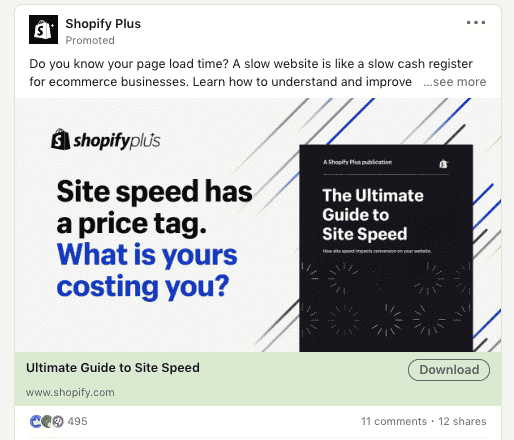
The LinkedIn post character limit before the “See More” button is 140. Your message will be cut off at the 140-character mark — like Shopify’s ad here did.

shopify plus ultimate guide to site speed

As a general rule of thumb, we stick to 25 words or fewer. In fact, we’d recommend making sure your message is clear within the first 150 characters.

Article length: 1,900 to 2,000 words

Paul Shapiro, founder of Search Wilderness, analyzed more than 3000 of the most successful posts on LinkedIn’s publishing platform. These posts, on average, received 42,505 views, 567 comments, and 138,841 likes.

He discovered that articles with more words perform better.

“Posts between 1900 and 2000 words perform the best,” writes Shapiro. “[They] gain the greatest number of post views, LinkedIn likes, LinkedIn comments, and LinkedIn shares.”

Shapiro also learned that the ideal LinkedIn character limit for titles is between 40 and 49 characters. Titles in this range received the greatest number of post views overall.

Video length: 30 seconds

In 2017, LinkedIn gave its users the ability to natively upload videos that play automatically in their followers’ feeds. Unlike other platforms, LinkedIn also shares video data (e.g., viewers’ companies and job titles), making it a valuable resource for marketers.

According to LinkedIn, the most successful video ads are less than 15 seconds long. However, the lengths can vary when it comes to a native LinkedIn video.

For brand awareness and brand consideration videos, LinkedIn recommends keeping the length under 30 seconds.

Meanwhile, videos that meet upper-funnel marketing goals should stick to a 30 to 90-second video length.

Interested in best practices for LinkedIn video? We got you.

Careful! Don’t go over the limit:

LinkedIn TextCharacter Limit
Company Page About2,000
Comment1,250
Company Page Status Update700
Article Headline100
Article Body Text110,000
Organic Post Caption3,000
Paid Sponsored Post Caption600

The ideal Instagram post length

Unlike Facebook and X, Instagram was founded on visual content. The platform was made to showcase compelling pictures and videos, but the right combination of words will promote engagement on any post.

Engagement, of course, is crucial to maximizing your content’s reach, since Instagram’s algorithm places posts with the most likes and comments near the top of your followers’ feeds.

Organic Instagram post caption length: 138 to 150 characters

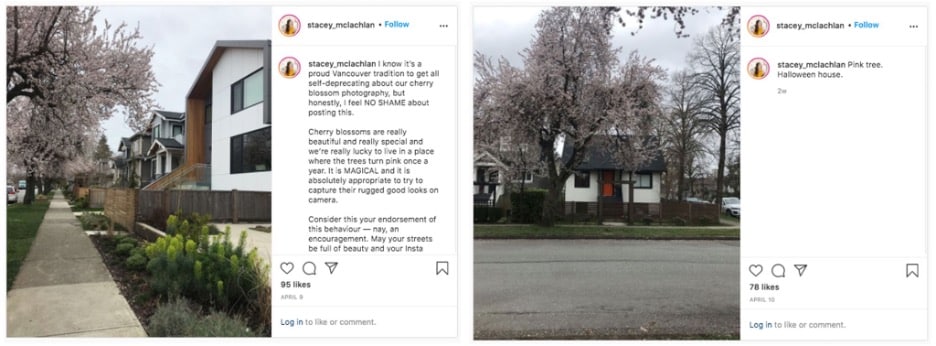
A successful Instagram caption adds context, shows off your brand’s personality, entertains audiences, and compels your followers to take action.

Instagram caption Vancouver houses side-by-side

The Instagram caption limit is 2,200 characters. But you’ll only need a fraction of that limit to move the needle (as our very scientific experiment about caption lengths can attest).

Most people scroll through their feed quickly, so it makes sense to keep your captions clear, concise, and punchy.

Brief copy is easy to consume. It also doesn’t get cut off with an ellipsis. Need some writing inspo? Find 311 creative Instagram captions to get you started right here.

Sponsored Instagram post caption length: 125 characters or less

Instagram recommends keeping the captions on sponsored posts under 125 characters.

Again, this length supports readability and ensures that the text won’t get truncated.

Looking for more inspiration? Here are 53 examples of amazing Instagram ads.

Instagram video length: 15 seconds

Most people will watch your Instagram video (organic or advertisement) on their phones, so following best practices for mobile video length is important if you wanna keep the viewer’s attention.

That means keeping videos here to 15 seconds or less. Short! And! Sweet!

Find more best practices for Instagram ads here.

Instagram hashtags: 3-5 per post, at fewer than 24 characters each

Instagram posts can have up to 30 hashtags, making it tempting to stuff each caption with as many as possible. As a marketer, fight this urge. Using more hashtags won’t necessarily yield higher visibility.

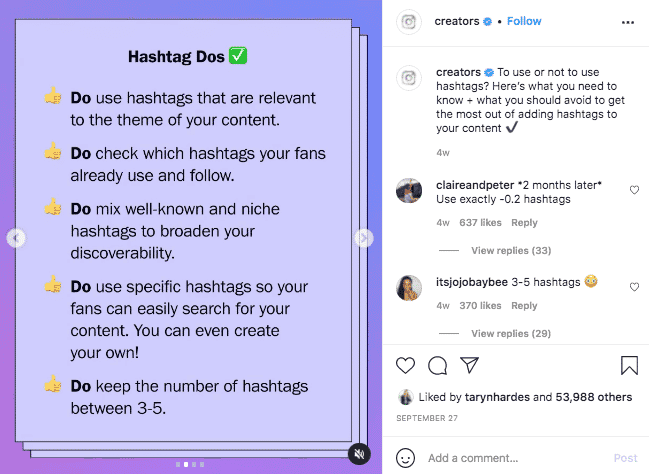
In fact, Instagram revealed that 3-5 hashtags will actually get you the best results, and our own little experiment confirmed just that.

Instagram Creator hashtag best practices

Source: @creators

Of course, picking the right hashtags to use is a whole other story. Our guide to Instagram hashtags will walk you through your options.

Instagram Stories length: 7 to 15 seconds

Instagram’s parent company, Meta, notes that people consume Stories much faster than other content, so it’s important to capture their attention right off the bat.

You’ve really only got 15 seconds to work with — that’s the maximum length of an Instagram Story — so hit the ground running.

Instagram Reels length: 7 to 15 seconds

While Reels can be much longer than Stories — up to a minute in length for most people, and 90 seconds for select beta-testers —that same short-attention-span principle applies here. Get to the point quickly and keep it short.

Careful! Don’t go over the limit:

Instagram TextInstagram Character Limit
Caption (Organic)2,200
Caption (Sponsored)255
Hashtag Limit30 hashtags
Reels Caption2,200
Ad Text2,200
Bio150
Username30

The ideal length for YouTube posts

At the end of the day, YouTube is a search engine, meaning it relies on text to organize and rank the nearly 500 hours of video uploaded to its servers every minute.

Therefore, in addition to optimizing video length, marketers must front load their content’s title and description copy with relevant keywords—and that means keeping an eye on character count.

YouTube video length: 7 to 15 minutes

Whether you’re watching videos on YouTube or anywhere else, one of the most important KPIs is retention.

How long do people actually watch? Are viewers finishing your videos at a high rate? If so, you’re doing something right.

Statista reports that the average video is 11.7 minutes long, and the Social Media Examiner endorses this as the ideal, writing that videos between 7 and 15 minutes have the best performance.

Here’s one that’s nine minutes, for instance. Ooh! Ahh!

Of course, there’s more to a successful YouTube strategy than just the right length for your video. Here’s everything you need to know about creating great YouTube content for your business.

YouTube title length: 70 characters

The most important SEO factor to consider for YouTube is the title of your video.

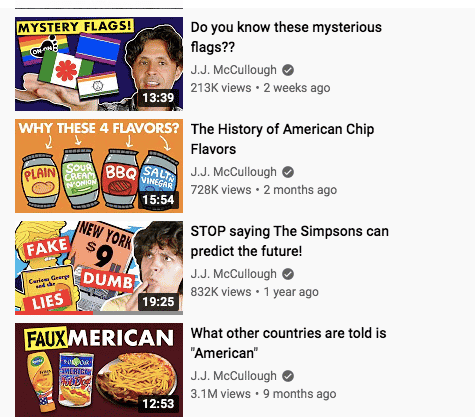
Include relevant keywords to make sure you’re reaching high rankings in Google and YouTube search, while simultaneously being compelling enough to encourage clicks and views.

J.J. McCullough relevant keywords YouTube titles

It’s a tall order! And, P.S., it should be pretty tightly crafted: Influencer Marketing Hub suggests keeping it to 70 characters maximum so that it doesn’t get cut off.

If you need help honing your YouTube title, we’ve got a free AI tool that’ll do it for you. Check out our YouTube title generator for the quickest path to video success.

YouTube description length: 150 characters

The first 100 to 150 characters will appear under your video, so optimize that chunk of text with both rich description and lots of intriguing keywords.

Hone your description-writing skills with our YouTube caption guide or head straight to our handy AI-powered YouTube video description generator.

Careful! Don’t go over the limit:

YouTube TextCharacters
Video Title100
Video Description5,000
Username20
Bio1,000
Playlist Title100

The ideal size and length for Pinterest posts

On Pinterest, image size matters. So does the length of your description.

Pinterest images: 1000 X 1500 pixels

According to Pinterest best practices, images on the platform should have a 2:3 aspect ratio, which is how the height and width of an image relate.

Description length: 200 characters

Studies show that descriptions containing about 200 characters receive the most repins. (For more juicy numbers, check out our guide to must-know Pinterest stats here.)

Your Pinterest caption is your chance to add context, persuade, and sell. It’s your chance to tell a story and conjure emotion, to make a promise. The description is your chance to compel.

A well-written description is also an opportunity to get discovered, so make sure to brush up on your Pinterest SEO best practices.

Careful! Don’t go over the limit:

Pinterest TextCharacter
Pin Title100
Pin Description500
Username30
About You160
Board Name50
Board Description500

The ideal length of Snapchat videos and captions

Given how brief the limits are on Snapchat captions and videos, it’s almost impossible to go too long.

To really thrive with engagement on this platform, it’s really more about what you’re posting, not how long that content plays for.

Ideal Snapchat Story length: 15 seconds

Snapchat Story videos can be up to 60 seconds long, but it’s pretty rare for engagement to be high for those (relatively) long-form pieces of content.

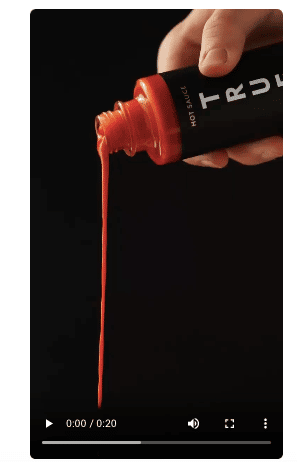
Instead, aim for (we’ve said it before, and we’ll say it again!) short-and-sweet videos that hit hard off the top, like this hot sauce ad, which clocks in at just 20 seconds but makes a serious impact.
hot sauce 20 second Snapchat ad

New to Snapchat? Here’s our guide to Snapchat for Business for beginners.

Ideal Snapchat video caption length: 50 characters

Captions for snaps can be up to 80 characters, but they’re really secondary to the visual content, so don’t stress too much about making the most of this.

Snapchat TextCharacters
Brand Name25
Headline for Ad34
Caption80

Now, over to you.

This article breaks down best practices, but ultimately, every social account is a unique beast… and you know it (or can learn to know it!) best.

Time and experimentation will reveal what resonates best with your specific followers and users. Try running A/B tests to help you determine if the suggested character counts in this guide are, in fact, ideal for you.

Use Hootsuite to share quality content on all your social media channels from one dashboard. Grow your brand, engage customers, keep up with competitors, and measure results. Try it free today.

Get Started

The post Ideal length of social media posts: A guide for every platform appeared first on Social Media Marketing & Management Dashboard.


* This article was originally published here

Sunday, April 27, 2025

Best time to post on social media: Q1 2025 update

Are you wondering about the best time to post on social media? We were too — so we decided to crunch some data and find out.

The Hootsuite team partnered with data science agency Critical Truth for a comprehensive study. We analyzed over 1 million social posts — across industries and social networks — and we found the definitive best times to post for maximum engagement.

Overall best times to post on social media in 2025

Generally, the best time to post on social media in 2025 overall is 8:00 AM on Wednesdays. But every network has its own sweet spot.

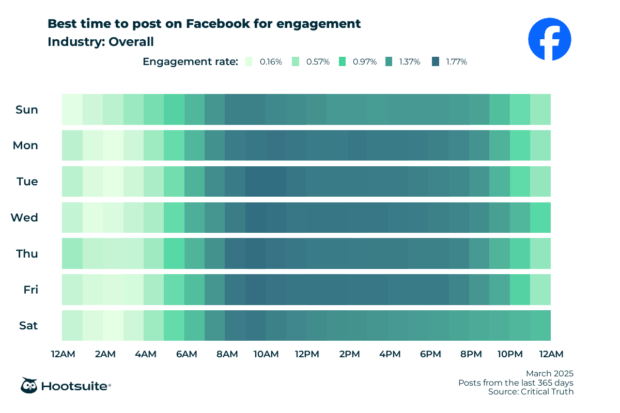
  • The best time to post on Facebook is 9 AM on Tuesdays.
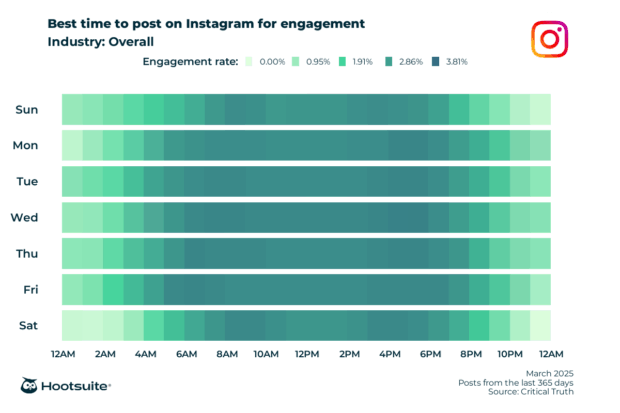
  • The best time to post on Instagram is 3 PM to 9 PM on Mondays.
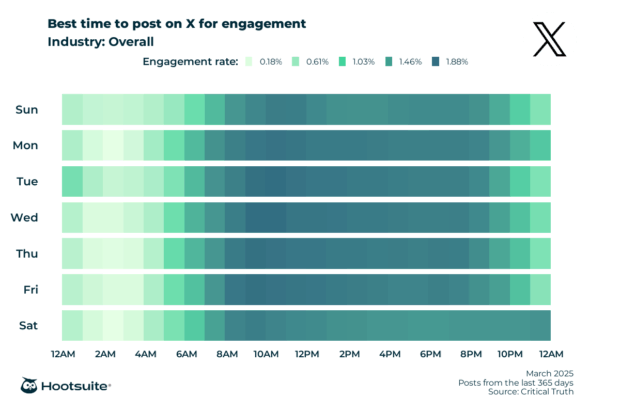
  • The best time to post on X (Twitter) is 9 AM to 11 AM on Wednesdays, Thursdays, and Fridays.
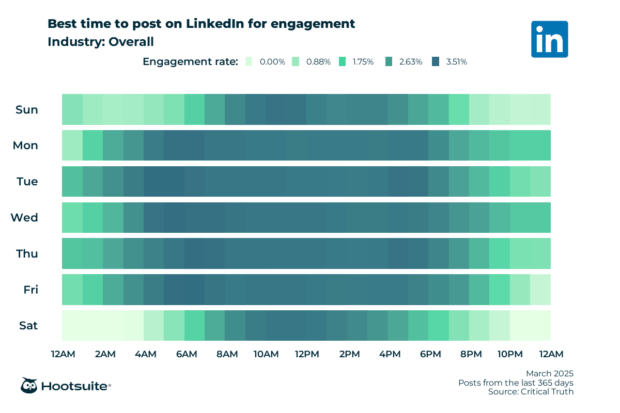
  • The best time to post on LinkedIn is 4 AM to 6 AM on Tuesdays and Wednesdays.
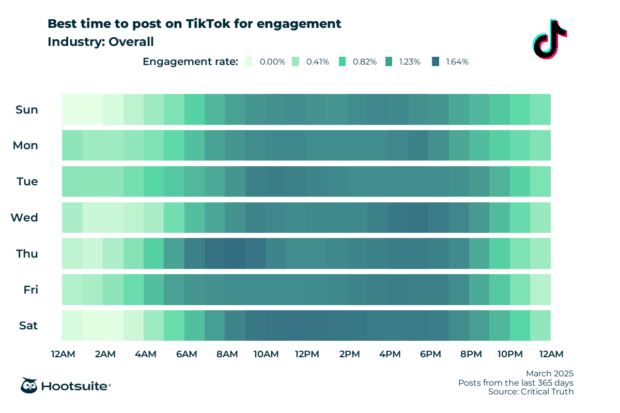
  • The best time to post on TikTok is 7 AM to 11 AM on Thursdays.
  • The best time to post on Threads is 8:00 AM on Tuesdays.
  • The best time to post on Pinterest is 12:00 PM on Fridays.

Note: Time of day was localized across 118 countries where sample data came from, i.e. the stats and graphs featured in this post are accurate across time zones.

If you’re looking for industry-specific best days and times to post, check out our dedicated articles, where we dig into details on construction, hospitality, education, finance, government, healthcare, retail, and more.

Best time to post on Instagram

The universal best times to post on Instagram are:

  • 3 pm to 9 pm on Mondays
  • 5 am to 8 am and 3 pm to 7 pm on Tuesdays
  • 5 pm to 7 pm on Thursdays
Q4 2024 & Q1 2025 data: Heatmap of the best times to post on Instagram for maximum engagement overall

Planning on posting more than once a week? Here’s a breakdown of the best times to post on Instagram for each day of the week.

Day of the weekBest time to post on Instagram
Monday3 PM to 9 PM
Tuesday5 AM to 8 AM / 3 PM to 7 PM
Wednesday5 PM
Thursday4 PM to 5 PM
Friday4 PM
Saturday11 AM / 5 PM
Sunday12 PM / 3 PM

Best time to post on Facebook

According to Hootsuite data, the best top time to post on Facebook for maximum engagement is 9 AM on Tuesdays.

Q4 2024 & Q1 2025 data: Heatmap of the best times to post on Facebook for maximum engagement overall

With all that said, here are the peak optimal times to post on Facebook day by day:

Day of the weekBest time to post on Facebook
Monday10 AM
Tuesday9 AM
Wednesday9 AM
Thursday9 AM
Friday9 AM
Saturday9 AM
Sunday9 AM

Best time to post on LinkedIn

The best time to post on LinkedIn is between 4 AM and 6 AM on Tuesdays and Wednesdays.

Q4 2024 & Q1 2025 data: Heatmap of the best times to post on LinkedIn for maximum engagement overall
Day of the weekBest time to post on LinkedIn
Monday5 AM
Tuesday4 AM to 6 AM
Wednesday5 AM
Thursday6 AM
Friday5 AM to 7 AM
Saturday10 AM to 12 PM
Sunday10 AM to 12 PM

Best time to post on X (Twitter)

According to our research, the best time to post on Twitter is from 9 AM to 11 AM on Wednesdays, Thursdays, Fridays.

Q4 2024 & Q1 2025 data: Heatmap of the best times to post on Twitter for maximum engagement overall
Day of the weekBest time to post on X (Twitter)
Monday10 AM
Tuesday10 AM
Wednesday9 AM to 11 AM
Thursday9 AM to 11 AM
Friday9 AM to 11 AM
Saturday8 AM to 10 AM
Sunday9 AM to 12 PM

Best time to post on TikTok

According to our analysis, the best time to post on TikTok is from 7 AM to 11 AM on Thursdays.

Q4 2024 & Q1 2025 data: Heatmap of the best times to post on TikTok for maximum engagement overall
Day of the weekBest time to post on TikTok
Monday4 PM to 7 PM
Tuesday9 AM to 12 PM
Wednesday4 PM to 7 PM
Thursday7 AM to 11 AM
Friday4 PM
Saturday9 AM – 12 PM
Sunday3 PM – 5 PM

Best time to post on Threads

According to our data, the best time to post on Threads is 8:00 AM PST on Tuesdays.

Best times to post on Threads in 2025

When to post on Threads:

  • Monday: 9:00 AM PST
  • Tuesday: 8:00 AM PST
  • Wednesday: 12:00 PM PST
  • Thursday: 9:00 AM PST
  • Friday: 2:00 PM PST
  • Saturday: 12:00 PM PST
  • Sunday: 1:00 PM PST

Best time to post on Pinterest

The best time to post on Pinterest, according to our data, is 12:00 PM PST on Tuesdays and Fridays.

Best times to post on Pinterest in 2025

When to post on Pinterest:

  • Monday: 10:00 AM PST
  • Tuesday: 12:00 PM PST
  • Wednesday: 10:00 AM PST
  • Thursday: 6:00 PM PST
  • Friday: 12:00 PM PST
  • Saturday: 1:00 PM PST
  • Sunday: 4:00 PM PST
Always post at the right time

Find out when your audience is online and optimize your posting schedule for maximum engagement. It’s so easy.

Start free 30-day trial

What do experts say about the best times to post on social media?

We’ve interviewed the experts from Hootsuite’s very own social media team for additional insights on the best times to post. Here are their top tips for reaching your audience when they’re most active.

1. Instagram: Early mornings are best for brands, evenings for personal accounts

Eileen Kwok, Social and Influencer Marketing Strategist at Hootsuite, notes that the type of account you manage will determine the right approach:

If you’re managing a brand account, I think it’s always good to post on Instagram early in the day. However, I find that when it comes to personal accounts, your own Instagram account for example, most people prefer to post at night time — 8 or 9 p.m.

The team also believes that evening scrolling habits can be more beneficial for certain industries, such as real estate, retail, and entertainment:

People tend to house hunt, shop, and watch videos later in the day.

2. Facebook: Focus on time zones

Trish Riswick, Social Media Marketing Team Lead at Hootsuite, emphasizes the importance of aligning posts with your audience’s time zone:

Our biggest piece of advice is always to target the time zone where your audience is. For us, North America and the U.K. are our primary targets. If we’re posting things at 3 p.m. PST, that’s 10 p.m. in the U.K. We have to be a bit more morning-focused to make sure we’re reaching our U.K. audience.

That said, the nature of Facebook gives brands a lot of flexibility:

The good news is that almost half of all users check Facebook multiple times a day, and they spend longer on this social media platform than many others.

3. LinkedIn: Mornings are for reads, afternoons for videos

For LinkedIn, Trish suggests tailoring your content type to different times of the day:

We tend to post more written content in the morning and videos in the afternoon.

She also highlights the evolving audience on the platform:

You would think that early mornings would tend to do better on LinkedIn, but we’ve found that our afternoon posts do sometimes blow up. While it used to be primarily professionals who are up and scrolling at 5 a.m., LinkedIn now has a lot of young professionals who are browsing in their leisurely time, too.

4. X (Twitter): Timing is key for trends and news

The recency-focused nature of X means that mornings can often be the best time to post. As Trish notes:

We recently ran a poll that suggested we should be posting more readable things in the morning when people are just getting ready for work or on their lunch break.

However, keeping an eye on real-world events is crucial for X’s fast-paced environment. Eileen says:

It’s smart to keep in mind what’s going on in the world as a basis of when you should be posting. For example, if it’s the Super Bowl and social media will be really busy with content, maybe you don’t want to post on that specific time or even on that day of the week because you will get less engagement.

5. TikTok: Patience pays off

TikTok’s algorithm takes some time time to deliver content to the right feeds, which means patience is key. Here’s Eileen’s advice on managing expectations:

Don’t get discouraged if your post doesn’t garner a lot of views in the first couple of hours it’s posted. TikTok videos tend to need 24 hours to be fully pushed out, so we recommend keeping the post out even if it doesn’t receive high engagement right off the bat.

Trish adds that timing your posts earlier than you’d expect can help:

Sometimes TikTok can take a little bit to actually get your video out because it’s trying to figure out what your video is, whose algorithm it should fall on, that kind of stuff.

6. Pinterest: Focus on SEO over timing

Unlike other platforms, Pinterest prioritizes content through searchability rather than recency. Eileen’s advice is to focus on optimizing your posts for search:

In my experience, the platform prioritizes your SEO strategy over the time you post. If you’re inputting the right keywords in your caption and optimizing your profile, your posts will get prioritized by the algorithm.

Eileen Kwok Social and Influencer Marketing Strategist at Hootsuite

What determines your best time to post?

Finding the best time to post to social media isn’t just about picking a random time and hoping for the best. It’s a blend of art and science, influenced by a variety of factors that shape your audience’s online behavior.

Let’s dive into what makes the timing tick.

1. Your unique audience

Your audience isn’t just a statistic; they’re real people with their own quirks and habits. Understanding who they are is the first step to figuring out when they’re most likely to be scrolling through their feeds.

When determining your personal best time of day to post on social media, think about your audience’s demographics (age, gender, location, interests), as well as their social media habits.

Are they night owls or early birds? Do they work 9-to-5 jobs or have flexible schedules? Knowing these details can give you clues about when they’re most active online.

But don’t stop there — use analytics tools provided by social media platforms to dig deeper.

Look for patterns in when your audience is most engaged. Maybe they’re more active on weekdays during lunch breaks or evenings after dinner.

By tapping into these insights, you can tailor your social media calendar to catch their attention at peak engagement times.

2. Your industry

Different industries have different rhythms when it comes to social media activity. What works for a fashion brand might not be the best social marketing strategy for a tech startup.

Take a moment to consider the nature of your business and how your audience interacts with similar businesses.

For example, if you’re in the fitness industry, you might find that your followers are most active in the early morning or late afternoon when they’re squeezing in workouts.

On the other hand, if you’re in the entertainment industry, evenings and weekends might be peak times for the most engagement when people are winding down and looking for something to do.

It’s worth keeping an ear to the ground in your industry, whether you learn tactics worth emulating, or just spot some pitfalls to avoid. (You might even consider adding publishing schedules to your ongoing social listening endeavors.)

3. The competition

Keep an eye on what your competitors are doing, too. While you don’t want to copy them outright, monitoring their posting schedules can give you insights into when your shared audience is most active.

Take a survey of their high-performing social media posts (or even do a full social competitive analysis) and see what patterns crop up, or perhaps reverse-engineer your competitors’ strategies.

Here at Hootsuite, for instance, we’ve learned to avoid publishing on the hour, because that’s when a lot of brands post.

Instead, we post on the :15 or :45 mark to give our social media content a little breathing room.

Hootsuite’s industry benchmarking tool within Analytics shows you how you stack up to the competition. It’ll even give you personalized tips for how to gain an edge against the leaders in your industry.

4. Time zones

Understanding your target audience’s time zones is crucial for ensuring that your posts reach them when they’re most likely to be online.

If your followers are scattered across the globe, you’ll need to consider the different time zones they live within.

For example, if you’re based in Vancouver but have followers in New York, London, and Tokyo, posting at 9:00 AM local time might mean reaching your East Coast audience bright and early, but missing out on social media engagement from your international followers who are fast asleep.

At Hootsuite, our channels strive to catch people across North America (PST through EST) by posting in the morning or early afternoon, Pacific Time.

For channels that also want to catch the UK, the earlier in the morning, the better.

Meanwhile, brands with a substantial audience in a specific region might consider creating a separate handle for that audience. (This may have the added benefit of allowing you to post in a target language, too.)

To accommodate everyone, you’ll need to find a balance that maximizes visibility across multiple time zones.

This might involve scheduling posts at different times throughout the day or using social media management tools that allow you to schedule posts in advance and target specific time zones.

5. Platform algorithms

Social media platforms are constantly tweaking their algorithms to deliver the best possible experience for users. While the specifics are often shrouded in mystery, one thing’s for sure: timing matters. Social platforms like Facebook, Instagram, and Twitter reward content that generates engagement shortly after it’s posted. That means if you want your post to get maximum visibility, you’ll need to time it just right.

Pay attention to when your audience is most active and aim to publish during those peak periods. But don’t forget about the lifespan of your content either.

While some posts might have immediate impact, others — like evergreen content — can continue to attract engagement over time. Experiment with different posting times and track the results to find what works best for your audience and content strategy.

6. Current events and trends

Social media is a dynamic landscape, shaped by current events, holidays, and trends. Paying attention to what’s happening in the world can help you capitalize on timely opportunities to connect with your audience.

Is there a big industry conference happening? A national holiday or observance? A viral meme or trending topic? Incorporating these events into your posting schedule can help your content feel relevant and timely, increasing the likelihood of engagement.

Just be mindful of the context and tone of your posts — what might be appropriate for one event could be off-putting for another. Keep your finger on the pulse of what’s happening and be ready to adapt your strategy accordingly.

Paige Schmidt, Hootsuite’s Social Engagement Coordinator, has noticed that events and trends are big in 2025. “There’s a growing demand for relevant and timely content that aligns with pop culture events such as sports events, award shows, and music/movie releases. Brands that plan content around these events or mark them for scheduling stand to capture audience attention effectively,” she says.

7. Experimentation and analysis

At the end of the day, there’s no one-size-fits-all formula for the perfect posting time. What works for one brand might not work for another. That’s why it’s essential to approach your posting strategy with a spirit of experimentation and a willingness to learn.

Test different posting times, frequencies, and types of content to see what resonates most with your audience.

Use analytics tools to track key metrics like engagement, reach, and click-through rates, and use that data to refine your approach over time.

You should also take a look at your top-performing posts from the past, and see what can be mimicked or improved upon there. Take a close look at posts that did the best in terms of:

  • Awareness (i.e., posts that have high impressions)
  • Engagement (i.e., posts that earned the highest engagement rates)
  • Sales/Traffic (i.e.,posts that attracted a lot of clicks)

Next, take a look at what time of day or week you posted successful content, and see what kind of patterns emerge.

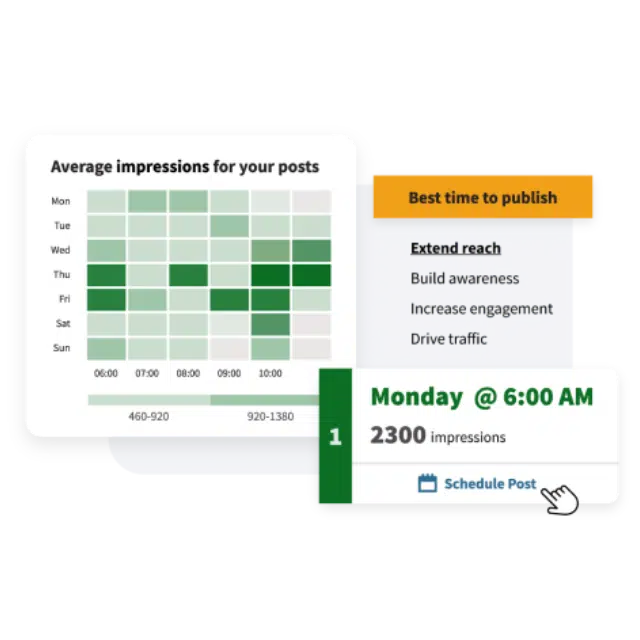
Pro tip: Hootsuite Analytics’ Best Time to Publish feature pulls your unique posting history automatically, without any data-crunching, and suggests times to post in order to maximize your ROI.

Remember, social media is a constantly evolving landscape, so be prepared to adapt and iterate as you go.

It can be gutting when you’ve worked hard on a post and it doesn’t land. My best piece of advice is to be patient. Sometimes the algorithm needs more time to place your content and sometimes your audience needs more time to warm up to the type of content you’re creating. Consistency is key, so keep trying!

Trish Riswick Social Marketing Team Lead at Hootsuite

How to find your unique best posting times with Hootsuite

Gone are the days of blindly tossing content into the digital ether and hoping for the best. Hootsuite offers two powerful tools – Best Time to Publish and Recommended Times in Composer – to help you schedule your posts at the best times for your audience.

Here’s how to take advantage of both.

#1 Social media tool

Create. Schedule. Publish. Engage. Measure. Win.

Free 30-day trial

Best Time to Publish

Imagine having your own personal social media strategist whispering in your ear, telling you exactly when to hit that “post” button.

That’s exactly what Hootsuite’s Best Time to Publish feature does for you.

Here’s how it works:

  1. Tailored suggestions: Hootsuite analyzes your social media performance over the last 30 days to provide personalized recommendations for the best times to publish your posts.
  2. Cross-platform compatibility: Whether you’re managing Facebook Pages, Twitter accounts, Instagram Business profiles, LinkedIn Pages, Pinterest, YouTube, or TikTok, Hootsuite can tell you exactly when your audience is most active on each individual platform.
  3. Simple Implementation: Once you have your suggested posting times, scheduling your posts is a breeze. Just hop over to the scheduling tool in Hootsuite and plug in your content for those optimal times.
hootsuite best time to publish feature showing best times and days to post on facebook, using a heat map

Recommended Times in Composer

Ever find yourself staring at a blank screen, wondering when on earth to schedule your next post? Say goodbye to that uncertainty with Hootsuite’s Recommended Times in Composer.

Here’s how it can simplify your life:

  1. Smart recommendations: When creating or scheduling a post in Composer, simply select “Schedule for later” and let Hootsuite do the heavy lifting. You’ll be presented with recommended times based on your audience engagement data.
  2. Continuous improvement: The more you post, the smarter Hootsuite’s recommendations become. As your engagement data grows, so too does the accuracy of your suggested posting times.
recommended times to post shown as suggestions in hoostuite composer

Get personalized recommendations for the best time to post on every network and manage your Facebook presence alongside other social channels with Hootsuite. From a single dashboard, you can schedule and publish posts, engage the audience, and measure performance. Try it free today.

The post Best time to post on social media: Q1 2025 update appeared first on Social Media Marketing & Management Dashboard.


* This article was originally published here

Employee advocacy in 2026: How to build a program

Key takeaways Employee advocacy is when employees share company content or their own work-related posts on personal social media, extending ...