Wednesday, August 28, 2024

Social Media SWOT Analysis: How to Dig Up Impactful Insights

SWOT might sound like a modern digital marketing acronym. But SWOT analysis has actually been used since the 1960s to guide strategic planning.

A social media SWOT analysis uses this established framework to guide your social media strategy. It looks at both internal and external factors to guide your social media plans.

  1. A social media SWOT analysis is a strategic planning tool used to evaluate social media performance by analyzing internal strengths and weaknesses, as well as external opportunities and threats. 
  2. A SWOT analysis helps social marketers sett realistic goals, identify risks, and stay ahead of industry trends.
  3. This framework is particularly useful for making budget decisions, launching new campaigns, and performing annual social media audits. 

What is a social media SWOT analysis?

A SWOT social media analysis is a specific way of looking at your performance and understanding the climate in your industry and the social media sphere. SWOT stands for strengths, weaknesses, opportunities, and threats.

  • Strengths. Things you’re doing well – in comparison to your own previous results and to the competition.
  • Weaknesses. Areas where your brand could improve, from social media performance to resources to strategy.
  • Opportunities. External factors that present a chance for your brand to excel, like the emergence of a new social media platform.
  • Threats. External factors that could hurt how your content performs, like regulation or social media algorithm changes.

Strengths and weaknesses look at internal factors. These are things within your company that you can control. Opportunities and threats focus on external factors. These things happen outside of your company but still affect your strategy and goals. You can’t control them, but you need to be aware of them and understand how they will affect your work.

Swot analysis graph internal external and positive negative

What can a SWOT analysis on social media do for you?

Help you set impactful (but realistic) goals

For goals to be effective, they need to be ambitious but achievable. To understand what’s possible, you need to understand both your own history of success and what’s happening in the social media world.

We’ve got separate blog posts to help you with the details of setting SMART goals and social media KPIs. A SWOT includes benchmarking and analysis to aid the goal-setting process.

Identify and mitigate risks

Weaknesses and threats might sound scary. But taking a detailed look at these areas will help you prepare for curveballs coming your way.

Weakness analysis helps you spot internal risks related to process, tools, teams, and so on. Meanwhile, threats analysis highlights potential risks. These may include compliance obligations, shifting cultural norms, or changes to the economy.

For example, 51% of consumers say they are likely to stop using a brand’s product or service if their ad appears near inappropriate content. And 72% believe brands are responsible for the content surrounding their ads.

How does this data impact a social media SWOT analysis? It highlights brand safety as a potential threat when creating social media ads. But identifying this threat means you can put strategies in place to mitigate the risk. For example, you can use risk tolerance tools within social ad platforms to adjust the types of content your ads may appear next to.

Risk management is an important part of your social media strategy. A SWOT analysis ensures you’re focused on the right risks at the right time.

Keep ahead of the curve

A social media SWOT analysis forces you to think beyond your own social media analytics. It considers the broader landscape and changes on the horizon, so you are always ahead of the game.

For example, most retail brands should look at holiday shopping patterns in their opportunities analysis for the latter half of the year.

New data from Civic Science shows that 28% of holiday shoppers had already begun holiday shopping in August of 2024. And 34% plan to start before Thanksgiving. These early shoppers present a clear opportunity for social media marketers. But only if you also get things moving early.

Civic Science also found that shoppers who use buy now, pay later plans are more likely to start holiday shopping earlier. If you want to encourage earlier shopping, there’s an opportunity to highlight that option in social campaigns. If you don’t yet offer these services, there’s an opportunity to test them out.

graph of responses to question when will you begin your holiday shopping

Source: Civic Science

Stay in touch with your performance

You already use social analytics to understand your performance and report to stakeholders.

But reporting in a bubble can give you a false sense of the possibilities. Conducting a SWOT analysis includes external data like industry benchmarking and competitor research. This reveals the true level of your success compared to your peers.
#1 Analytics Tool for Growth

Beautiful reports. Clear data. Actionable insights to help you grow faster.

Start free 30-day trial

Allocate resources effectively

Internal social media analysis only considers the strategies you already use. This is a good starting point for determining how to allocate your social media resources. But it misses out on all the strategies you have not yet tried.

A SWOT for social media takes things a step further by incorporating data from beyond your organization. For example, recent data from LinkedIn and Ipsos shows that 55% of B2B marketers say short-form social video has the highest ROI of any type of video.

video ROI graph by type with highest percentage short form social videos

Source: LinkedIn 2024 B2B Marketing Benchmark

If you’re a B2B marketer who’s not yet using short-form social videos, this presents a clear opportunity. This external information doesn’t guarantee short-form social videos will provide the best ROI for you. But it’s an indication that you should allocate some resources to test them out.

Look beyond social media

The information you gather from a social media SWOT analysis applies to departments across your brand. There are often particularly relevant insights for product development and customer service.

Pay particular attention here to weaknesses and threats. These areas provide the greatest opportunity to collaborate with other departments to course-correct.

For example, social media will likely be the source of some customer challenges and complaints. This is not all bad news! In fact, identifying common themes in negative social media feedback allows you to address the problem much faster than you ever could without social media analysis in place.

How to run a social media SWOT analysis

Now that you understand what you can gain from doing a social media SWOT analysis, let’s look at how to gather all the data you need.

Strengths

Data in the strengths quadrant of your SWOT for social media should focus on metrics where you’re performing well. Especially if you’re performing better than the competition.

Start by gathering your own metrics through social media analytics tools. Then take a look at the competition to see if you can understand where you’re outperforming.

Hootsuite’s industry benchmarking and competitive analysis features are really useful for getting an inside look at your competitors’ performance and how you stack up.

Hootsuite industry benchmarking profile impressions

You can see how you compare against your industry as a whole based on profile impressions, audience growth rate, and post engagement rate. You can also see how you compare against specific competitors.

Looking at your social share of voice and measuring social sentiment are also important ways of understanding and measuring your success. Hootsuite Listening provides these important metrics for your social media SWOT analysis.

Hootsuite social listening graph results to compare suncreen and SPF keywords

Weaknesses

The process and tools here are pretty much the same as identifying your social media strengths. Start with your own metrics. Compare your most recent results with results from previous social media campaigns or time periods. Then, benchmark yourself against the competition.

This will allow you to see where you’re falling short. You can also identify strategies that worked in the past but are no longer delivering the results you expect.

Get quite specific as you identify your weaknesses. You can’t just say you’re falling behind the competition on TikTok. You probably have some strengths and some weaknesses on every platform. Only by breaking them down in detail can you properly understand what to do next.

A dedicated social analytics tool like Hootsuite provides a full picture of your cross-platform performance. This reveals how engagement and conversions shift across your accounts over time.

Also take a broader look at your organization beyond the social media team. List any changes that have the potential to affect your social media presence. Have there been layoffs? Budget cuts? Maybe you’re recovering from a social media crisis?

Monitoring social sentiment can be particularly important here. It helps you understand the mood behind the mentions of your brand on social media. For example, high engagement numbers on a particular post or platform might initially look like a strength. But if your social sentiment is dropping, you might have uncovered a weakness in disguise.

Opportunities

Remember that opportunities and threats look at factors external to your organization. So, to look for opportunities, you need to make sure you have a firm understanding of what’s happening right now. That means looking at the overall economic/business climate and the social media world as well as your own industry niche.

Start by setting up a social listening program to monitor the competition. For example, if conversation volume around a specific keyword is on the rise, there’s opportunity to create content targeting that keyword and reach that active community.

Hootsuite Listening can help you spot both specific keywords and overall themes. Both present opportunities for new social content.

sunscreen and SPF search results themes top hashtags brands and shared URLs

On the social media front, keep an eye on this blog and the Hootsuite social media channels. Both are good places to learn about new social developments that might present opportunities for your brand.

Our annual Social Media Trends report is a particularly useful read here.

Threats

Just like opportunities, threats are external factors. So, again, you need to understand the climate you’re operating in. It’s especially important to understand upcoming changes that might threaten your status quo.

For example, all social media managers know the pain of algorithm changes. (We’re looking at you, Instagram!) Algorithm updates need to be on your radar so you can plan for ways to pivot. (Like focusing on social SEO.) We’ve got your back there with regular updates on this blog.

The future of TikTok is another potential threat for marketers in the United States. Parent company ByteDance has said it would rather shut down the app in the United States than sell it if all legal challenges fail.

Social listening is an important strategy here, too. It allows you to keep an eye out for new products, services, or marketing approaches from competitors that could be a threat to your market share.

When should you run a SWOT analysis?

Making budget decisions

A detailed SWOT analysis can help you anticipate new strategies, surfaces, or features as you plan your annual budget. It can also help identify opportunities to reallocate resources more effectively. All of this works to maximize ROI.

Launching a new campaign

Before you launch a new campaign, it’s important to look back at what has worked well – and not so well – in the past. This applies to both your own campaigns and those of your competitors.

You don’t want to copy your competitors’ ideas. But you can certainly learn from their biggest wins and losses.

Your SWOT for social media also ensures you’re on top of the latest shifts in social culture. This is important for spotting opportunities for new campaign ideas and directions. Be sure to test any new strategies with a small budget and target audience rather than making wild swings.

Annual social audits

An annual social media audit is an important strategic check-in. You look at your social accounts, check for necessary changes, review performance, and plan your strategy for the year ahead.

A social media SWOT analysis provides context for your social audit. This helps you evaluate results more accurately and highlight new ways to adapt your social marketing efforts to the changing road ahead.

Conversely, your social audit provides detailed information for the internal portions of your SWOT analysis. Social media strategic planning benefits from doing both activities at the same time. Cross-pollinating the data makes both your SWOT and your audit more effective.

Free social media SWOT analysis checklist

Bonus: Get your FREE social media SWOT analysis checklist to get to the bottom of your results and start making improvements faster.

3 social media SWOT analysis tools

1. Hootsuite

Hootsuite Analytics graph data mention count and traffic by page

Hootsuite is a particularly useful tool for social media SWOT analysis. It gives you a clear picture of your social results across platforms, all on one screen.

This side-by-side comparison shows which social tools are working best for your brand. You can confidently identify your strengths and weaknesses.

The industry benchmarking tool shows how your results compare to the industry average. And the competitive analysis feature measures your results against up to 20 competitors of your choice.
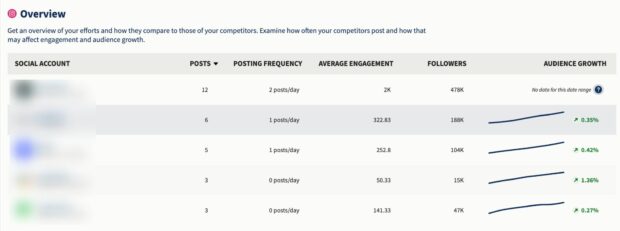
Social media competitor analysis in Hootsuite Analytics: Overview report

In addition, Hootsuite Listening is an industry-leading tool for detailed social sentiment analysis, social listening, and competitive intelligence. You can track what people are saying about you, your top competitors, and your products. These detailed analyses help you identify specific opportunities and threats as they emerge.

2. Meta Business Suite

Meta Business Suite Insights Facebook and Instagram reach and profile visits

Source: Meta Business Suite

The native analytics tools within Meta Business Suite give you a picture of your social media results on Facebook and Instagram.

This can help you understand which of these platforms is working best for your brand right now. You can also see how your results differ across surfaces within the platforms. This helps identify specific strengths and weaknesses for your social media SWOT analysis.

You can get into some external factors here too with basic benchmarking features. Just keep in mind that Meta Business Suite only provides data for Meta properties. You’ll need separate tools for other platforms and social listening.

3. Sprinklr

Sprinklr campaign overview mentions summary and share of voice

Source: Sprinklr

Sprinklr offers solid social media analytics and customer insights. These help you complete the strengths and weaknesses portions of your social media SWOT analysis. Brand monitoring and competitive intelligence reports provide details useful in completing the opportunities and weaknesses assessment.

Sprinklr offers social listening capabilities to help you identify important trends. However, the inputs are limited compared to Hootsuite’s 130+ million sources and 30+ social media channels. Sprinklr plans start at $299 per user per month.

See how Sprinklr compares to Hootsuite.

Save time managing your social media presence with Hootsuite. Publish and schedule posts, find relevant conversions, engage your audience, measure results, and more — all from one dashboard. Try it free today.

All your social media analytics in one place. Use Hootsuite to see what’s working and where to improve performance.

Free 30-Day Trial

The post Social Media SWOT Analysis: How to Dig Up Impactful Insights appeared first on Social Media Marketing & Management Dashboard.


* This article was originally published here

Monday, August 26, 2024

15 Facebook Ad Tools for Design, Testing, Scheduling, and More

Facebook ad impressions are up 31% in 2024 vs. 2023 while costs have dropped 6%, so there’s never been a better time to include ads in your Facebook marketing strategy. Using the right Facebook ad tools makes it even easier.

Facebook ad tools optimize your ad designs, report analytics, automate your budget, write copy, and more. You don’t need to use every Facebook ad tool on this list but try out a few to see how much time you can save, and how much better your ads perform.

Bonus: Use our free Facebook Ads budget calculator to figure out exactly how much you need to spend to get the results you want. Let us do the math for you!

What do Facebook ad tools do?

Facebook ad tools are apps or platforms that help you maximize the ROI of Facebook ad campaigns by assisting or automating ad creation and management, scheduling, ad copy, testing, and more.

Optimization and AI

Facebook ads AI tools identify opportunities to improve ads and make managing your campaigns faster and easier, either through recommendations or AI-powered automation.

Reporting

Analytics and reporting Facebook ad tools tell you how a campaign is performing. Accurate reports mean you can check in often and make tweaks, if needed, before a campaign is over, maximizing your ad spend.

Copywriting

Repurpose top-performing organic content into effective ads with copywriting and Facebook ads AI tools that help you brainstorm, plan, and draft campaigns.

Design

Keep your brand consistent across channels with Facebook ad design tools for templates, editing, and collaboration that allow everyone on your team, regardless of design skill, to produce high quality content.

Scheduling

Smart Facebook ads scheduling tools help your ads find the right audience and speed up campaign creation.

#1 Easy Social Advertising

Build and post ads for Facebook, Instagram, LinkedIn, and X. Our targeting and reporting are seriously easy.

Start free 30-day trial

15 Facebook ads tools for 2024

Facebook ads optimization tools

1. Meta Ads Manager

As the official Meta ads management platform, Meta Ads Manager is a one-stop shop for creating, managing, and analyzing ad performance across Meta’s apps: Facebook, Facebook Messenger, Instagram, and WhatsApp.

Meta Ads Manager campaign and bid strategy

Source: Meta Ads Manager

Best features:

  • Built-in tooltips help you learn the platform and Facebook ad best practices quickly.
  • Easy-to-use interface is great for beginners.
  • Keyboard shortcuts are great for power users.

Who it’s for: Everyone running Facebook ads will need to use Facebook Ads Manager to some degree. How much depends on which other Facebook ad tools you use in addition.

Pricing

Free; only pay for the cost of your ads.

2. Hootsuite Social Advertising

Speaking of all-in-one Facebook ad tools, Hootsuite Social Advertising has everything you need to create, manage, optimize, and measure your Facebook, Instagram, LinkedIn, and X ads along with all your organic social media content in one place.

View paid and organic content together in Planner, and manage ad campaigns without needing to leave Hootsuite. You can even create new campaigns and tweak existing budgets and targeting for all campaigns.

Social media managers and execs alike appreciate the ability to measure accurate social media ROI across paid and organic campaigns for all your profiles with Hootsuite Analytics. Set up automated reports and never have to dig through multiple platforms’ analytics to cobble together a unified report again.

Along with built-in industry-leading social listening and AI content creation tools, Hootsuite helps you efficiently plan, create, and manage everything you do on social media… and make it easy to report to your boss, too.

Hootsuite Analytics amount spent and post organic impressions

Best features:

  • Manage and measure all your paid and organic social media content in one easy-to-use dashboard.
  • Create advanced and lookalike audiences.
  • Automate your ad workflow by automatically turn organic posts into ads with auto-boosting based on your criteria.
  • Built-in audience engagement, social listening, collaboration, analytics, and AI tools.

Who it’s for: Anyone who wants to simplify and speed up their social media management, as well as measure the full impact of paid and organic efforts—together.

Pricing

Advertising tools are included with all Hootsuite plans, starting at $99/month.

#1 for Facebook marketing

Schedule posts, answer messages, and manage ads from one place. Then, show off your results in beautiful reports. It’s so easy.

Start free 30-day trial

Facebook ads reporting tools

Besides using Hootsuite to track your paid and organic social media campaign performance together with beautiful, automatic reports, there are a few other Facebook ads reporting tools to check out.

3. TapClicks

If you track analytics and data from multiple sources, such as Facebook ad performance, website analytics, and sales data, TapClicks can help you streamline reporting inside one tool. Track KPIs you care most about in custom dashboards and easily export reports with custom branding and templates.

Tap Clicks reporting and analytics overview edit widget

Source: TapClicks

Best features:

  • Connect multiple data sources to measure cross-channel analytics in one platform.
  • Not limited to Facebook ad analytics; add search, web, radio, TV, and other data sources.

Who it’s for: Brands who want full-scale tracking across all touchpoints.

Pricing

Starting from $99 per month for limited features and channels, or $649 per month for advanced analytics.

4. Funnel

Funnel is another great Facebook ads reporting tool for multiple platforms. By connecting and viewing analytics from all your sources together, Funnel makes it easy to see trends in your data and how your campaigns are driving performance across channels.

Funnel paid ads overview

Source: Funnel

Best features:

  • Their AI matches up field names that may vary between platforms, ensuring all clicks and costs are recorded accurately, no matter what they’re called on each platform.
  • Endless ways to model, export, and update reports by currency, metric, location, and more without damaging the original data.

Who it’s for: Organizations wanting insightful, cross-platform analytics with flexible reporting options.

Pricing

There is a free Starter plan, though the more capable Business plan starts at $750 per month.

Facebook ads AI tools

5. OwlyWriter AI

When it comes to repurposing your top social content into effective ads, OwlyWriter AI—included in Hootsuite—saves tons of time. Write Facebook ads (and organic posts!) from scratch, or based on an existing post or external link, like a blog post or product page. After OwlyWriter drafts it, you can edit or schedule the post with only a few clicks.

Besides writing copy, OwlyWriter is also a great ad copy brainstorming and trend discovery tool and place to see your top performing posts for inspiration.

OwlyWriter AI speed up content creation repurpose top posts or start from scratch

OwlyWriter goes beyond other generative AI apps like ChatGPT because it includes years of our first-hand expertise as the world’s #1 social media management tool to generate social content that actually achieves your goals.

“OwlyWriter AI is a phenomenal tool that really helps crank out great verbiage on the fly or whenever my team is in a pinch. I’ve seen better numbers since my team has been using OwlyWriter AI. I love it and I don’t know how I lived so long without it.”

  • Joel Acosta, Digital Media Manager, Concert Golf Partners
Create caption for waterproof road running shoes content idea

Best features:

  • Instant Facebook ad copy and social media content that aligns with your brand.
  • Generate ad copy based on a link, such as a product page.
  • Brainstorm ad ideas and generate options in minutes, to use as-is or serve as inspiration.
  • Discover your top performing posts and repurpose them into new posts or ads.
  • Schedule OwlyWriter AI content in a few clicks inside Hootsuite.

Who it’s for: Social media managers who enjoy saving time and having access to all the social media tools they need to grow in one easy-to-use dashboard.

Pricing

OwlyWriter AI is included in all Hootsuite plans.

Craft perfect posts in seconds

OwlyWriter AI instantly generates captions and content ideas for every social media network. It’s seriously easy.

Start free 30-day trial

6. Perfect Audience

SharpSpring’s Perfect Audience tool does one Facebook ads task really well: automating Facebook retargeting ads. If someone browses your website and doesn’t convert, SharpSpring will add them to your Facebook retargeting ads campaign. SharpSpring also offers many other marketing automation features designed to increase conversions across multiple channels.

Sharp Spring Ads campaigns

Source: SharpSpring

Best features:

  • Built-in lead tracking.
  • Automates Facebook retargeting ad campaigns.
  • Offers other tools as part of the SharpSpring platform, including email marketing, landing pages, and more.

Who it’s for: Organizations with an established budget looking to automate Facebook ad retargeting.

Pricing

SharpSpring plans are based on the number of contacts (e.g. customers) you have, starting at $449 per month for 1,000 contacts.

7. ChatGPT

Perhaps the best known generative AI tool, ChatGPT is a conversational chatbot that uses natural language processing (NLP) models to understand text prompts and deliver relevant answers. When it comes to Facebook ads AI tools, ChatGPT can help you brainstorm ideas, write copy, repurpose one ad into several variations, and more.

ChatGPT prompt creative Facebook ad idea to encourage sign up for free trial

Source: OpenAI

Best features:

  • Brainstorm creative Facebook ad ideas.
  • Easy to use and perfect for “AI newbies” to explore generative AI for ad copy.

Who it’s for: Marketers wanting to brainstorm Facebook ad ideas or quickly generate test copy variations.

Pricing

Limited use of the GPT-4o mini model is free. For advanced GPT models, such as GPT-4, pricing starts at $20 per month for individuals or $25 per month per user for teams.

8. Customers.ai

Customers.ai helps retarget ads to your website visitors, similar to SharpSpring, but it uses AI to identify visitors for highly accurate targeting while still being compliant with web privacy laws. Customers.ai can uncover visitor names, email addresses, phone numbers, and more to improve your Facebook ad campaign targeting.

Customers.ai Facebook integration

Source: Customers.ai

Best features:

  • Automatically syncs your audience with Meta to keep your Facebook ad campaigns current.
  • Can track visitors even if the visitor’s browser blocks the official Meta Pixel.
  • Identifies the same user across platforms and devices.

Who it’s for: Experienced Facebook advertisers who want to test improving conversions with AI tools.

Pricing

Plans start at $199 per month.

9. Madgicx

Madgicx is a powerful Facebook ads AI tool for optimizing everything from ad targeting with first-party data collection to ad performance. The real “magic” of its AI comes from its ability to analyze your Facebook ad account and suggest specific actions to improve performance, instantly.

Madgicx personal AI marketer with performance recommendations

Source: Madgicx

Best features:

  • AI-powered assistant suggests personalized actions to improve performance.
  • Improve tracking with first-party data collection.

Who it’s for: Organizations already running Facebook ad campaigns wanting to take ad performance to the next level.

Pricing

Plans start at $31 per month and vary according to average monthly ad spend.

Facebook ads design tools

10. Facebook Ad Library

Wondering what ads your competition is running? Stuck in a rut and need inspiration from your favorite brands? Facebook’s Ad Library is a searchable database of every ad currently running on Facebook, plus social issue and election ads that have run in the past seven years.

You can search ads by country, category, and keyword, such as a topic or brand name.

Meta Facebook Ads Library Hootsuite search results

Source: Facebook

Best features:

  • Research your competitors’ ads and ensure yours will stand out against them.
  • Filter by Meta platform, media type, language, and more.
  • Save searches for regular research.

Who it’s for: Anyone who needs inspiration for their next campaign, or conducting competitive research for their social media audit.

Pricing

Free.

11. Canva

A staple in the design world for social media managers and businesses of all sizes, Canva is an excellent Facebook ads design tool for both individuals and teams. Canva makes creating Facebook ads easier and faster—including generative AI tools—as well as a shared online workspace to store branded templates to ensure all your ad creative stays consistent.

Canva design templates by content type

Source: Canva

Best features:

  • Anyone can easily create ads and social content for Facebook and beyond.
  • Directly integrates with Hootsuite, so you can create and add designs from your Canva account to social posts as you schedule them in Hootsuite.

Who it’s for: Individuals or teams wanting to maintain brand consistency with creative assets.

Pricing

There is a free plan. Paid plans start at $15 per month for individuals and $10 per user per month for teams (minimum three users).

12. Unsplash

There are many stock photo websites out there but Unsplash is one of the best known sources for free stock photos for commercial purposes, including social media content and Facebook ads.

Unsplash visuals free stock photos

Source: Unsplash

Best features:

  • 100% free stock photos and illustrations.
  • For brands wanting extra legal protection, the Pro plan is an affordable option to access model releases for each photo.

Who it’s for: Creators and brands looking for high quality, free stock photos.

Pricing

Unsplash basic photos are free. Unsplash Pro is $4 per month for access to exclusive stock photos and model releases.

13. Pexels

Like Unsplash, Pexels offers royalty-free stock photos to use in your projects, but they also have a large collection of free stock videos. I like that you can sort by vertical or horizontal orientation to quickly find the perfect stock video for your next Facebook ad design (or social post).

Pexels search for free stock videos

Source: Pexels

Best features:

  • High-quality free stock videos.
  • Regularly updated.

Who it’s for: Creators and brands looking for high-quality, free stock photos and videos.

Pricing

Free.

Facebook ads scheduling tools

14. Hootsuite

Besides automatically scheduling your organic social media posts at your personalized best time to publish so your audience actually sees them, Hootsuite can also help you create and schedule Facebook, Instagram, LinkedIn, and X (Twitter) ads.

Easy ad scheduling combined with insightful analytics means you can tell how a campaign is or isn’t working and make tweaks—fast! Get the most out of your ad budget with scheduling, analytics, and cross-platform ads management in the same place you manage all your other social media tasks too.

Hootsuite Analytics advertising performance campaigns and ad sets

Best features:

  • See your organic content and ads side-by-side in Hootsuite Planner for full visibility of all your social media marketing efforts.
  • Fast, customizable analytics that show both organic and paid performance and how each is impacting the other.
  • The most complete collection of social media management tools for the world’s best social listening, effortless ads, scheduling, AI content creation, and audience engagement.

Who it’s for: You 😉

Pricing

Plans start at $99 per month with options available for everyone from individual creators to enterprise companies. Get a free trial.

15. RevealBot

RevealBot allows you to set up rules to automate campaign scheduling, such as running a specific campaign when the weather hits 20 degrees in a specific area. Plus, upload and schedule bulk ads, including images and videos.

RevealBot new creation template campaigns and ad sets

Source: RevealBot

Best features:

  • Highly customizable automation rules to start/stop campaigns based on your criteria.
  • Ability to bulk schedule.

Who it’s for: Established Facebook advertisers who want to automate more of their ads management workflow.

Pricing

Plans start at $99 per month and vary based on monthly ad spend.

Create, analyze, and edit Facebook, Instagram, LinkedIn, and X ad campaigns inside Hootsuite. Manage all your organic and paid social media together with AI content creation and audience engagement tools in one easy-to-use dashboard. Try it today.

Paid 🤝 Organic

Easily plan, manage and analyze ads and organic content from one place with Hootsuite Social Advertising. See it in action.

Free 30-day trial

The post 15 Facebook Ad Tools for Design, Testing, Scheduling, and More appeared first on Social Media Marketing & Management Dashboard.


* This article was originally published here

Thursday, August 22, 2024

Facebook Boosted Posts: Expert Tips for Great Results [2024]

It’s 2013. You sit down and craft a new post for your client’s Facebook Page. As you’re rewatching NSYNC at the VMAs, you take a sip of your nonfat caramel macchiato and check your Facebook analytics. Half your followers have seen it and it has 100,000 impressions already. Life is good.

Sorry, friend: in 2024, social media managers would be lucky to get an average 0.07% engagement rate on Facebook posts. Womp womp.

But all is not lost, intrepid marketer. The Facebook boost post is your first class ticket back to the glory — and organic reach — of the good old days.

With noteworthy tips from marketing experts, we’re breaking it all down below.

  1. A boosted post is a type of targeted ad created from an existing, organic Facebook post. It offers a quick and easy way to reach a new audience without complicated ad campaign setup.
  2. Boosting a post involves selecting an existing post, defining a goal (e.g. increasing engagement or driving website traffic), editing the action button and URL, selecting the target audience, and setting a budget. This can be done directly from Facebook or via tools like Hootsuite, which can automate the process.
  3. Key strategies for maximizing the effectiveness of boosted Facebook posts include defining clear goals and KPIs, boosting content that is already performing well, learning from competitors, and continuously refining your strategy based on performance metrics.

What is a Facebook boost post?

A Facebook boost post is a targeted ad you create from an existing, organic post on your Facebook Business Page.

Unlike traditional Facebook ads that are in-depth campaigns created from scratch (more on that later), boosted posts offer a quick and easy way of surfacing the content you already have to a new audience by putting some advertising budget behind it.

Boosting posts on Facebook can help you:

  • Attract new followers (Page likes)
  • Increase clicks and likes (hello, improved engagement rates!)
  • Promote your brand to audiences who don’t know you (yet)
  • Understand what content works best for your goals and audience
  • Begin exploring social media advertising

Don’t have a boost-worthy post just yet? Use OwlyWriter AI to create organic content your audience will love.

#1 for Facebook marketing

Schedule posts, answer messages, and manage ads from one place. Then, show off your results in beautiful reports. It’s so easy.

Start free 30-day trial

How to boost a post on Facebook

Ready to find out how you too can get your Facebook content the attention it deserves? Watch our video on how to boost a Facebook post:

Boosting a Facebook post in the Facebook dashboard

Boosting a post is quick to do from Facebook, but there are a few prerequisites:

Once you have these two things sorted, follow the steps below to boost your first post.

Step 1: Go to your Facebook Page

You can boost a Facebook post from a web browser or Facebook’s mobile app.

Step 2: Find a Facebook post to boost

Scroll through your recent posts to find the one you want to boost, then click the Boost Post button at the bottom.

Button grayed out? You can’t boost some Facebook posts, but 99% of the time, you’ll be able to.

Step 3: Choose a goal

Facebook will automatically fill in goal suggestions, audience targeting criteria, a link, duration, budget, and more. You could press Publish right away and run your ad with full trust in Facebook’s recommendations.

But for the best results, go through each section of the page to ensure everything makes sense for your needs. Start by clicking Change in the Goal section to see all available options and choose the best fit.

For example, if you’re including a link in your boosted post, your goal should likely be to “Get more website visitors.”

Choose goal of results from ad automatic or custom

Step 4: Edit the action button and URL

Next, choose what you want the action button to say. Facebook defaults to Shop Now, but there are a handful of options to choose from. Ensure the URL is accurate, too.

Action button such as book now learn more and sign up

Step 5: Target your audience

Select who you want to target with your Facebook boost post, or choose one of your existing custom ad audiences (if you have any). You can also save your criteria as a new custom audience for next time.

You can target:

  • Gender (Only men, women, or both for now. Hopefully Facebook will represent all gender identities in the future.)
  • Age range
  • Location (Choose from the country level all the way down to individual cities.)
  • Interests
Edit audience gender age and locations

Targeting is optional. If you don’t specify any of these options, Facebook will attempt to target your boost post to who they think is most interested. Want a crash course? Learn Facebook ad targeting 101.

Step 6: Set a budget

The default duration of a boosted post campaign is seven days, which is fine in most cases. Set your total budget for the post and you’ll see an estimate of how many people you’ll reach and how many clicks your link will get.

Click Publish and that’s it.

Budget duration and estimated daily results

Boosting a Facebook post using Hootsuite

You can follow the steps above — or, save a ton of time with automatic Facebook post boosting in Hootsuite.

With Hootsuite, you can:

  • Manually boost a Facebook post, or…
  • Set up automatic boosting for posts for non-stop engagement

That is, of course, on top of all the other social media management tools that Hootsuite offers in one easy-to-use dashboard.

Grab your free 30-day trial to see how easy Hootsuite makes scheduling posts, engaging with your audience in DMs and comments, handling ads, tracking your results, and even snooping on competitors. Unlike the Facebook dashboard, Hootsuite is a central location for all major social media networks: Facebook, Instagram, Threads, X (Twitter), LinkedIn, TikTok, Pinterest, and YouTube.

FYI: To boost Facebook posts with Hootsuite, you’ll first need to add your Facebook Ads Manager account to Hootsuite.

Bonus: Use our free Facebook Ads budget calculator to figure out exactly how much you need to spend to get the results you want. Let us do the math for you!

How to manually boost a Facebook post in Hootsuite

Only interested in boosting a single post? We’ve got you.

You’ll see the Boost button on Facebook posts across several locations in Hootsuite, including:

  • Composer
  • Planner
  • In a Facebook Stream
Boost post on Hootsuite

Simply click Boost Post on the one you want, and choose your:

  • Objective (engagement or awareness)
  • Audience (build your own or use saved Facebook audiences)
  • Budget and duration (more $ + run time = better results)
Boost settings with preview on mobile desktop and Instagram

You can even preview your boosted post on Mobile, Desktop, and (if you choose to crosspost) Instagram.

Then, click Boost on Facebook to let the magic happen. Easy-peasy.

How to automatically boost Facebook posts in Hootsuite

Once you learn the ropes, you can put your boosting strategy on autopilot.

With Hootsuite, you can define a set of rules that will automatically boost specific Facebook posts — for example, organic posts that did particularly well with likes or generated a larger than usual number of comments. That way, you can consistently make your success even more successful by giving it a… well, boost.

Set your campaign objective

Step 1: Go to Ads, then Facebook Boost. Click on Get started with Boost.

Step 2: If you have multiple Facebook Pages connected to Hootsuite, choose the correct one. Then, give your automatic boost campaign a name.

Step 3: Choose an objective (the business goal you want to achieve) for your boost campaign from the following options:

  • Traffic
  • Engagement (on your ad or on your website)
  • Awareness
  • Leads
  • Sales
Campaign objective traffic engagement awareness

Step 4: Choose the result you want to optimize for.

Optimize for ad delivery landing page views link clicks or daily unique reach

NOTE: Available options depend on your campaign objective and the type of engagement you selected.

Step 5: Identify if your ad is in a Meta-designated special category to comply with Meta’s anti-discrimination policies.

Then, click Next: Audience and budget.

Choose your audience and budget

Step 6: Create a custom audience by selecting Edit and specifying which attributes to target, like location, gender, age — and more detailed targeting like demographics, interests, and behaviors.

You can also click Use saved audience or Use custom or lookalike audiences if you’ve already created them on Facebook.

Detailed targeting interests demographics and behaviours

Step 7: Select Yes, my ads target audiences in the EU, if your ad targets audiences worldwide or in EU countries or associated territories.

Step 8: Meta will automatically choose ad placements for you based on your objectives. If you’d like to choose your own placements, check I want to manually choose the placements. Learn more about Meta’s placements.

Placements manually choose and device selection

Step 9: Set your budget and the length of your promotion. You can set a daily or total budget for your ad campaign.

Then, select Next: Set your auto-boosting criteria.

Set your auto-boost criteria

Step 10: Let Hootsuite decide which Facebook posts to boost based on your average engagement rate, or set your own criteria.

You can trigger a Facebook boost post based on number of:

  • Likes
  • Shares
  • Comments
  • Reach
  • Video views

You can also combine criteria. For example, only trigger automatic boosting when a post has at least 100 likes and 15 comments.

Choose which posts to boost automatically by selecting a trigger

Step 11: Enter keywords that must appear (or cannot appear) in the posts you want to boost. You can also use your Hootsuite organization’s tags to visually classify posts and conversations by category.

Click Publish campaign and voila — you’re set. Sit back, relax, and watch your engagement flourish.

Need to make a tweak? No sweat, you can manage and edit your scheduled and past boosted Facebook posts at any time.

#1 Easy Social Advertising

Build and post ads for Facebook, Instagram, LinkedIn, and X. Our targeting and reporting are seriously easy.

Start free 30-day trial

How much does it cost to boost posts on Facebook?

You can boost a Facebook post for as little as $1 USD per day. But as Earth Rated’s Social Media & Influencer Marketing Director, Niki Hyde, puts it: the more you spend, the wider your reach.

“I typically use boosts for smaller campaigns (under $1000) and run them for at least a week to give Facebook enough time to optimize performance,” Niki shares.

When adjusting the settings for your boosted post, type in a specific amount or move the slider to set your maximum total budget — this is what Facebook will spend over the duration of your boosted post. Changing your budget changes your potential reach, which Facebook will estimate for you.

Duration budget and estimated daily results

For example, if your budget is $50 and the campaign duration is seven days, Facebook will spend an average of $7.15 per day. The actual daily spend will vary a bit, but you won’t pay more than the total budget specified for the campaign.

Facebook ads vs. boosted post

A Facebook boost post is a very simple form of Facebook advertising. They’re quick and easy to set up and a good way to get started with social media ads.

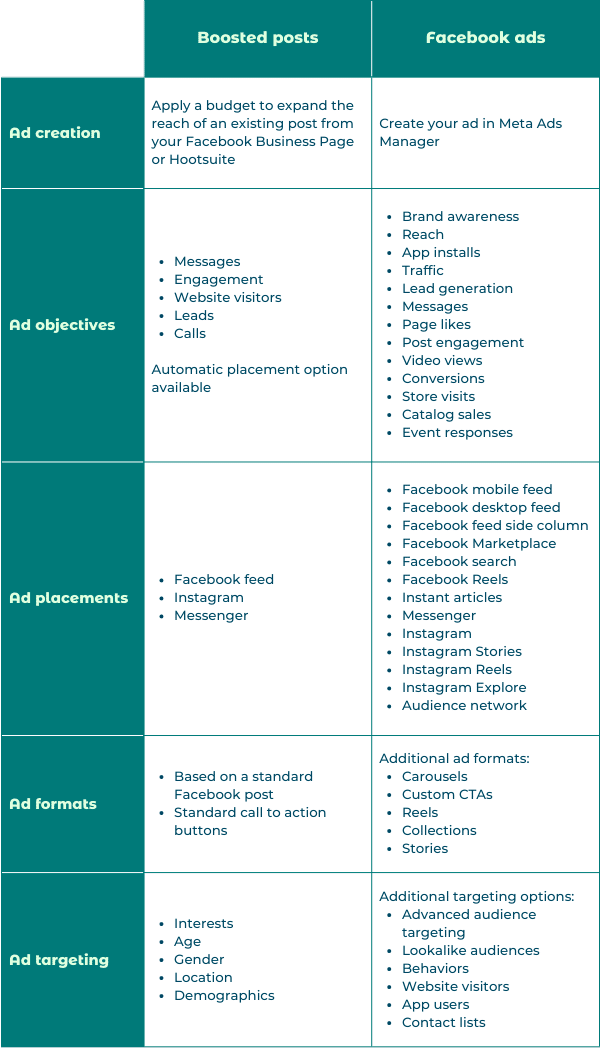
Here’s a rundown of the key differences between Facebook boost posts and traditional Facebook ad campaigns:

key differences between graph of comparison between Facebook boost posts and traditional Facebook ad campaigns

If you’re wondering how to fit Facebook boost posts or traditional ads into your overall social media strategy, check our (very) complete guide to Facebook marketing — freshly updated for 2024.

6 expert tips for boosting Facebook posts

Get ready to take notes. Here are six Facebook boost tips and tricks, straight from two social media marketing experts we interviewed.

#1: Define your goals & KPIs

Before you hit that glorious blue button, Niki says it’s worthwhile to define your goals and metrics.

“If you’re looking to drive engagement, track video views and engagements. If you want to drive leads or calls, hone in on cost per mille (CPM) and reach,” Niki says.

This will help you get the most out of your boost and create a launching pad for future campaigns. Win-win.

#2: Identify your target audience

Knowing your audience is a key component of any successful ads campaign — and Facebook boost posts are no exception.

Niki’s top tip: Align your targeting criteria with your audience as best you can.

“With organic reach dwindling every year, investing in boosts ensures that your top performing content is reaching your target audience,” Niki says.

The secret sauce? Samantha Skeen, Social Media Manager of Toronto Raptors & Raptors 905, says not to sweat the details.

“Pay attention to how your target audience engages with your content and little things like what devices they use,” Samantha adds.

#3: Boost the right content

While Niki and Samantha identify video as best for engagement campaigns and images for driving leads, Niki says the best content to boost is “posts that exceed the benchmarks you’ve set for your content’s performance.”

Why? “Promoting content that’s already building momentum on social media will help keep your costs down and let your boost run more efficiently.” Simple as that.

TIP: You can view your top performing posts at any time in Hootsuite Analytics.

#4: Timing is everything

While your level of spend should be relative to your overall budget, Samantha advises to run your Facebook boost post for three to seven days.

Niki is aligned. “This will give Facebook enough time to optimize the performance of your campaigns,” she says.

Translation: Let the clock run and watch the engagement roll in.

#5: Keep an eye on your competitors

To get a sense of what’s resonating (and what’s not), Samantha encourages social media managers to keep a pulse on the competition.

“Take note of the types of posts they promote, their engagement levels, posting frequency, and audience interactions,” Samantha says.

She reminds us: “The goal is to gain insights for improving your own content and campaigns, not to copy competitors directly.”

Plus, you can make this process a breeze by using Hootsuite’s Listening tool — no Inspector Gadget-eque skills required.

#6 Track results & refine your strategy

It’s always a good idea to track, monitor, and measure the results of your campaign.

Niki’s advice? “Start small, test a lot, and build a strategy for always-on investment” (cough, automatic boosting).

“It’s the best way to ensure the great content you’re working to create can be traced back to a clear business impact,” she says.

Bonus: You can review your Facebook boost performance with Hootsuite Analytics at any time.

Simply go to Ads, then select Facebook Boost and your ad account to see all Facebook Boost campaigns associated with it.

For each boosted post, you can review specific metrics like reach, amount spent, and engagement — making it easy to analyze your results and refine your strategy.

three advanced analytics dashboards shown in hootsuite

And there you have it — everything you need to know about boosting posts on Facebook. With expert tips and a leading tool in your back pocket, you’re bound to give your Facebook page the boost it needs.

Use Hootsuite Social Advertising to easily schedule posts and ads, build custom audiences, and get a complete view of your performance and ROI — across paid and organic social.

Grow your Facebook presence faster with Hootsuite. Schedule all your social posts and track their performance in one dashboard.

Free 30-Day Trial

The post Facebook Boosted Posts: Expert Tips for Great Results [2024] appeared first on Social Media Marketing & Management Dashboard.


* This article was originally published here

Social Media Stocks To Follow Today - September 30th - MarketBeat

Social Media Stocks To Follow Today - September 30th    MarketBeat * This article was originally published here