While social SEO is the content discovery darling of the moment, the truth is that hashtags are not going away anytime soon. From branded hashtag campaigns to X (formerly Twitter) chats to the latest memes and trends, hashtags remain an effective way to extend your social media reach.
The catch is that you have to use the right hashtags. Which means, you need to research, analyze, track, and compare your hashtags just like you would any other component of your social content.
So where exactly can you find the hashtag analytics you need to do all of that? You’ve come to the right place to find out.
Bonus: Download a free guide to discover which hashtags to use to boost traffic and target customers on social media. And then learn how you can use Hootsuite to measure results.
What are hashtag analytics?
Hashtag analytics are data that provide information about the performance of hashtags on social media. This can include both branded hashtags and generic hashtags. The idea is to see how the use of hashtags is impacting the discoverability and results of your social posts.
For example, you might find that posts with hashtags perform better than those without on one platform, but not on another. Or you might find that the number of hashtags you use impacts your results. And, of course, which hashtags you use – and how well they correlate to the content you’re actually posting – will affect how your content is discovered.
Hashtag tracking tools compile all of this data to make it easy for you to plan, refine, and test your hashtag strategy.
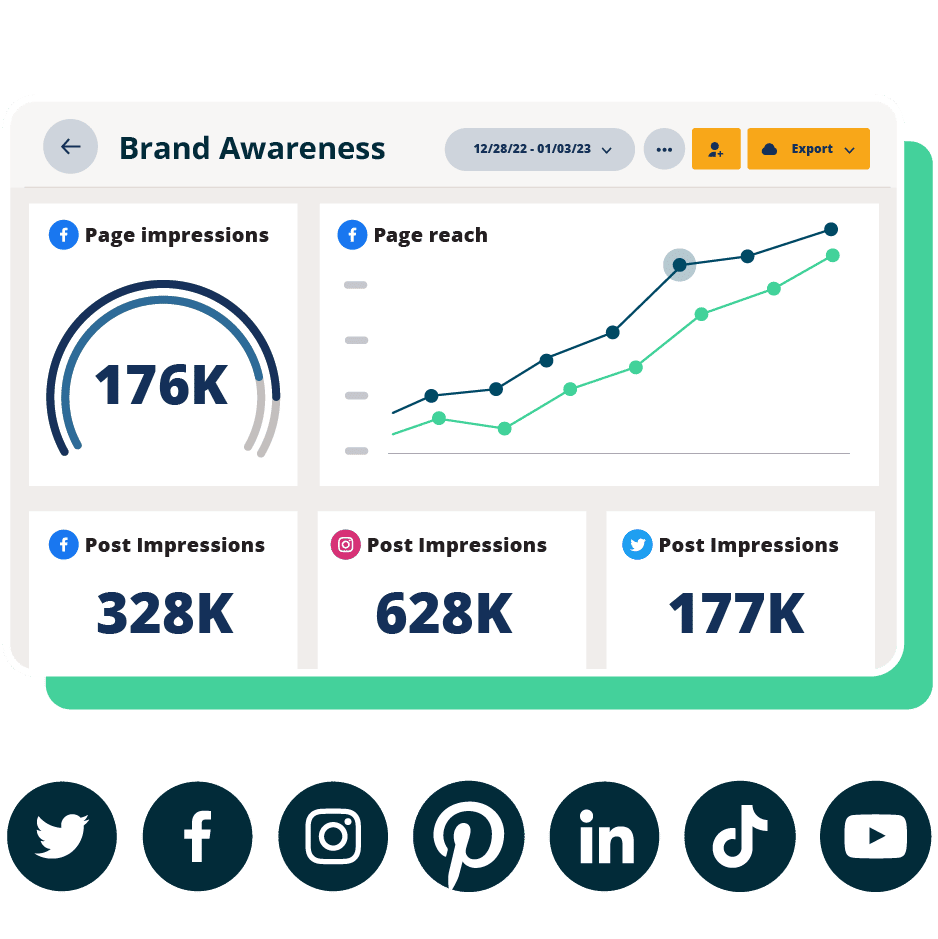
Beautiful reports. Clear data. Actionable insights to help you grow faster.
Start free 30-day trial13 best hashtag tools for 2024
Hashtag analytics tools
1. Hootsuite Analytics

The competitive analysis features within Hootsuite Analytics include trending hashtag breakdowns so you can see which hashtags are performing best within your specific niche.
Using the drop-down menu, you can analyze hashtags within your competitor group to see hashtags that drove the most comments, reactions, shares, likes, and estimated engagement. You’ll also see a trending hashtag set that you can copy and paste. Or, just click Publish a post with hashtags to go straight to composer, with the hashtag set already in your post.
2. Talkwalker

Source: Talkwalker
Talkwalker provides hashtag tracking tools for Instagram, Facebook, Twitter, and seven other social platforms in addition to websites, blogs, and forums. You get insights into important hashtag metrics like mentions, engagement, reach, and sentiment. There are loads of graphical reporting options to help you understand which hashtags are driving results for your brands.
Talkwalkers’ hashtag tracking tools also integrate into Hootsuite, so you can access your data in the same tool you use to create your social media content.
3. Synapview

Source: Synaptive
Synapview allows you to monitor posting frequency of hashtags on Instagram, Reddit, Pinterest, YouTube, and blogs. You can combine and exclude multiple hashtags to create complex searches and filter results. Synaptive integrates into Hootsuite to allow you to access your hashtag analytics directly from the Hootsuite dashboard.
4. Fedica

Source: Fedica
Fedica allows you to create a report for any hashtag that shows you who is using it, where it was shared, whether other relevant topics emerged from this hashtag, which influencers target the relevant demographic, and more.
The reporting includes important hashtag demographics like engagement, sentiment, demographics, and reach. Fedica can be integrated into the Hootsuite dashboard.
5. Later

Source: Later
If you’re specifically focused on Instagram, Later offers some good hashtag analytics tools. Using their tools, you can track and analyze your hashtags to see which ones lead to the most likes, comments, saves, and reach.
Keep in mind that this hashtag monitoring tool is only for Instagram. See how Later compares to Hootsuite.
6. Native hashtag analytics tools

Source: Instagram Insights
Some of the social platforms have some very basic built-in hashtag analytics. These are not really intended to be used as hashtag tools, so they’re a bit tedious to use for this purpose. But, if you want to stick to free hashtag trackers, these offer a place to get started. To create meaningful reports with any of the data you find here, you’ll need to copy and paste your findings into a spreadsheet.
- Instagram Insights: Tap View Insights under any post, then scroll down to Reach and look for Impressions from hashtags. You’ll be able to see how many people reached your post from a hashtag, but not which hashtag brought them there. This is most useful if you only use one hashtag per post.
- TikTok Analytics: Just like on Instagram, you can check your native TikTok Analytics to see how many accounts find each of your posts from hashtags. From Creator Tools, tap Analytics, and then tap any post. Scroll down to Traffic sources to see how much of the traffic for that post came from hashtags.
- LinkedIn hashtag pages: Copy-and-paste this URL into your browser and replace [your hashtag] with, well, your hashtag: https://www.linkedin.com/feed/hashtag/[yourhashtag]
This will take you to a results page for the hashtag that shows how many people follow it. You can also sort the posts using this hashtag by the most popular (top) or most recent.
Hashtag research tools
7. Hootsuite Streams

Hootsuite Streams is one of the best hashtag tracking and social listening tools out there. You can create streams to monitor recent and trending hashtags so you can keep tabs on the latest and most popular posts for those tags.
This is a valuable way to stay on top of the conversation in your industry. You can also analyze the posts in these streams to look for related hashtags you might want to test in your own content. This ensures you’re always aware of new hashtags associated with your niche.
8. Panoramiq Watch

Source: Synaptive
This dedicated set of hashtag tracking tools for Instagram allows you to create streams with complex searches using up to three hashtags. You can also exclude hashtags from a search and create saved competitor and hashtag searches. From your search stream, you can save content directly to Streamnotes, Evernote, Onenote Pocket, and more for research and future reference.
There’s also an analytics feature to see how often a hashtag is used.
Panoramiq Watch integrates into the Hootsuite dashboard for easy access to your hashtag tracking details.
9. Engage AI

Source: Engage AI
Engage AI offers quite a few LinkedIn automation and personalization features for social selling. But for this post, we’ll focus on their free hashtag tracking tools for LinkedIn.
First, they offer three free LinkedIn hashtag widgets that allow you to embed LinkedIn hashtag data on your website. (You could put the widgets on a hidden blog page if you just want to use them for your own research.) The widgets include the top 50 most followed, top 10 most searched, and top 10 weekly % change hashtags. The widgets also show how these trends change over time.
Second, they offer a hashtag analytics extension for Chrome that allows you to research any LinkedIn hashtag to see follower count, potential likes, and potential comments to be gained by using the hashtag. This hashtag analytics tool can be integrated into the Hootsuite dashboard for easy access to your go-to hashtag data.
Hashtag generators
10. Hootsuite’s free AI hashtag generator

This free tool uses artificial intelligence to generate relevant hashtags for your social posts. All you have to do is choose your platform and language, then enter a description of your photo or video. You can also include keywords to help guide the AI to be even more specific.
This is a web-based tool, so no accounts, payments, or logins are required. Just copy and paste the suggested hashtags into your social posts.
11. Hootsuite Composer

Hootsuite Composer has a built-in hashtag generator. It can suggest hashtags based on the text and links in your post. But it can also suggest hashtags based on the image, or a combination of the images and text. Just create your social post as usual, then click the AI hashtag suggestions button to get a list of useful hashtags. Click the boxes for the ones you want to use, then click Add hashtags to insert the hashtags into your post.
12. RiteKit

Source: RiteBoost
RiteKit offers two hashtag generator tools that automatically add hashtags to your social content.
RiteBoost automatically converts existing keywords in your social posts to hashtags to increase reach and engagement. The color coding indicates the real-time popularity of each hashtag.
RiteTag, on the other hand, suggests relevant keywords to add to a post based on the text or the image(s) used.

Source: RiteTag
Both of these tools can be used within Hootsuite to add hashtags without switching tabs. RiteBoost integrates directly into the Hootsuite dashboard, while RiteTag can be used within the Hootsuite Composer using a Chrome or Firefox extension.
13. Native hashtag suggestion tools (using the search bar)

We talked above about the native hashtag analytics tools baked into each social platform. The platforms all have a built-in hashtag suggestion tool, too. But it’s not something you’ll find identified as a hashtag tool. Instead, you can use the humble search bar to help generate hashtags for your post or marketing campaign.
All you have to do is go to the social platform you want to use and start typing a hashtag in the search bar. As you do so, you’ll see a list of hashtags that start with the letters you’ve typed. Some platforms even provide a total count of how many times the hashtag has been used.
Important hashtag metrics
- Trending hashtags: This metric identifies hot hashtags that are trending right now. If one is relevant to your business, or presents the opportunity to create relevant content to jump on a trend, you could incorporate it right away. However, keep in mind that brands should not jump on every trend. The key is to look for relevant ways to use these of-the-moment hashtags.
- Post volume: How many posts have been shared that include this hashtag.
- Number of followers: A hashtag that has a lot of followers indicates an interested community keen to see relevant content from accounts they may not yet follow.
- Hashtag frequency: How often is this hashtag used? You’re looking for the sweet spot here. An overused hashtag may be too diluted to be beneficial. At the same time, a very rarely used hashtag won’t have enough reach to boost your discoverability. Experiment with hashtags of different frequencies to find the level that works best for you.
- Hashtag reach: Posts and frequency show you how other accounts are using this hashtag. Reach shows how many people actually see posts using this hashtag.
- Hashtag engagement: Engagement shows you how people respond. Hashtags that inspire more likes, comments, shares, and follows may be more valuable to your brand than those that are simply popular or have higher reach.
- Top posts: The most popular posts that use a particular hashtag. This can help you identify potential influencers and thought leaders in your industry. These posts also provide good research material for understanding what kind of content resonates with your target audience.
- Sentiment analysis: This one is particularly important for branded hashtags. Performing sentiment analysis on posts containing your branded hashtag can help give you a sense of how social media users feel about a particular social media campaign, or your brand in general.
- Hashtag demographics: Analyzing the demographics of people who use or engage with your hashtags can help you better understand your audience.
Use Hootsuite to manage all your social media in one place and save time. Create and schedule posts on every network, track results, engage your audience, and more. Try it free today.
All your social media analytics in one place. Use Hootsuite to see what’s working and where to improve performance.
Free 30-Day TrialThe post 13 Best Hashtag Tools for Analytics, Tracking, and More appeared first on Social Media Marketing & Management Dashboard.
* This article was originally published here

 (@hootsuite)