Brands Prioritize Quality Over Quantity in Creator Budgets oakhillgazette.com
* This article was originally published here
Saturday, January 31, 2026

Friday, January 30, 2026
Thursday, January 29, 2026
Wednesday, January 28, 2026
Tuesday, January 27, 2026
8 employee advocacy tools to amplify your social media reach
Thinking of starting an employee advocacy program? Smart move. You could gain hundreds of influencers who are motivated to extend your brand’s social reach.
The question is, how will you manage it? In this guide, I’ve reviewed eight popular options and organized them for the types of teams they’d work best for.
Key takeaways
- Employee advocacy tools make it easy for employees to share pre-approved content on social media.
- The right employee advocacy tool depends on team size, goals, and budget, but ease of use matters for every business.
- Platforms like Hootsuite Amplify work best for large teams because they combine advocacy, collaboration, and social media management in one place.
What are the best employee advocacy tools for large teams?
The best employee advocacy tools for large teams are platforms that support approvals, analytics, and easy sharing at scale. Here are our top picks:
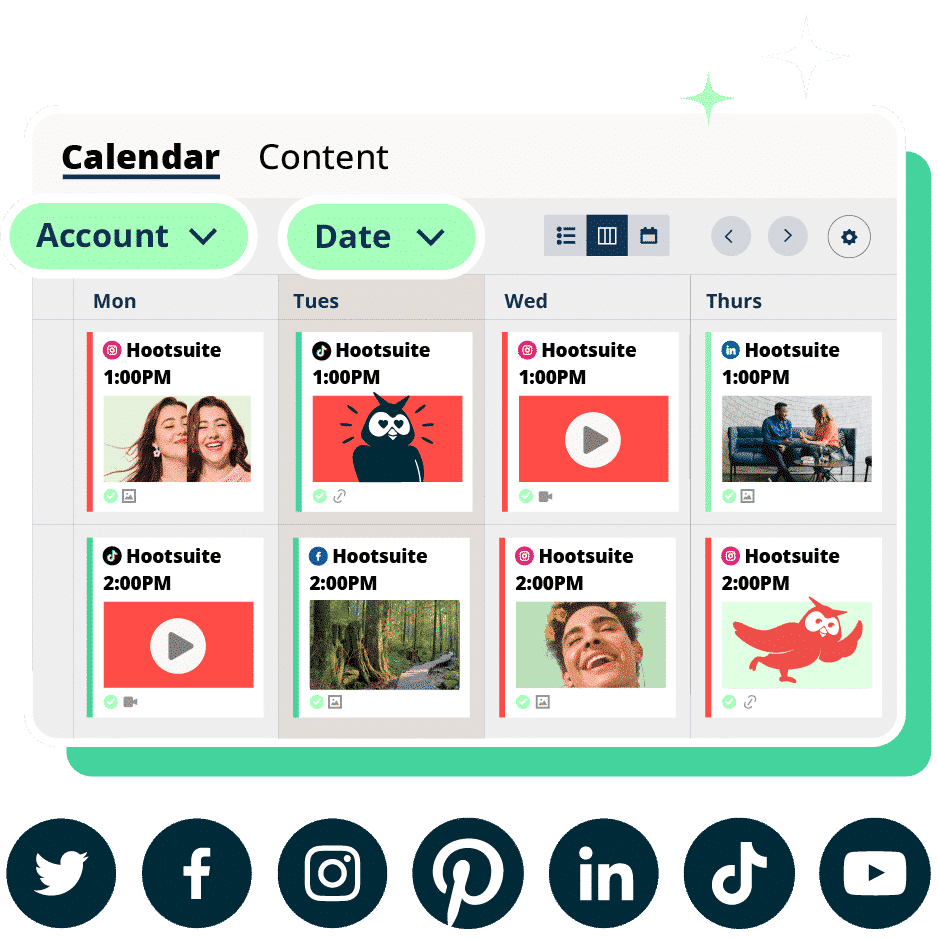
1. Hootsuite Amplify
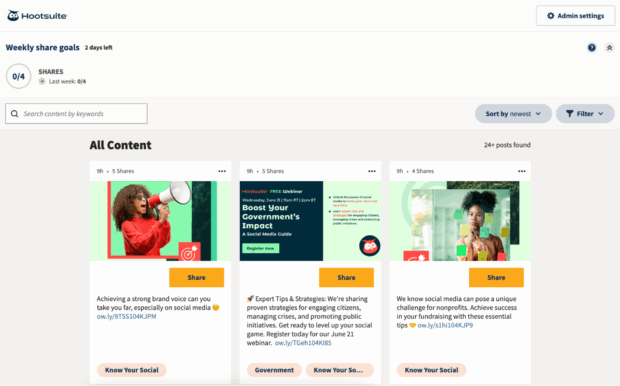
Employee advocacy is all about collaboration, and Hootsuite Amplify is the best at making it easy to collaborate with your entire team.
Amplify also has built-in approval processes and controls, which makes it easy for everyone to follow your social media guidelines. And since it’s part of Hootsuite social media management platform, you can boost and track all of your social engagement in one place.
Who is this for?
- Large businesses looking for a way to make employee advocacy easy, fun, and trackable.
- Teams that want to seamlessly fold an employee advocacy strategy into their larger social marketing plan.
Pricing: Amplify is included for Hootsuite Enterprise (custom pricing) customers.
SMM star rating: (5/5)
Key features:
- Slack and Microsoft Teams integrations: An employee advocacy program only works if it’s easy for people to do it. These integrations streamline the process, empowering employees to share content without leaving the platforms they use every day.
- Amplify Leaderboard: The Leaderboard lets you gamify employee advocacy. You get to see your own shares, reach, and clicks. Then, you can also see a list of those metrics for other advocacy members.
- AI content writer: Hootsuite’s AI content writer can quickly spin up post captions for advocacy content. You can also use it to repurpose top-performing social posts (e.g., case studies or company news) into something a team member can click and share — which saves a ton of time.
- A cohesive part of social media management: Amplify is part of Hootsuite, so managing employee advocacy feels like a natural extension of social media management. You don’t have to use multiple tools, and you can get your advocacy metrics in the same place as your other social analytics. Plus, the Amplify mobile app lets users share on the go.
What’s lacking/missing?
- It would be cool if you could set separate goals for individual users. Maybe newbies could have a lower “ramp-up” target for social sharing. Or, an executive could have more goals that encourage them to leverage their personal brand.
Customer review:
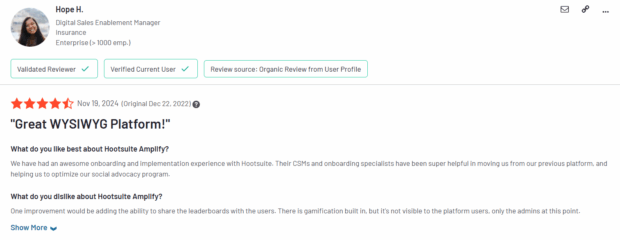
Source: G2
2. DSMN8
DSMN8 is one of the most full-featured, stand-alone employee advocacy platforms. It has just about everything you could ask for when you’re managing a huge group of advocates — especially if they work in different geos and job functions.
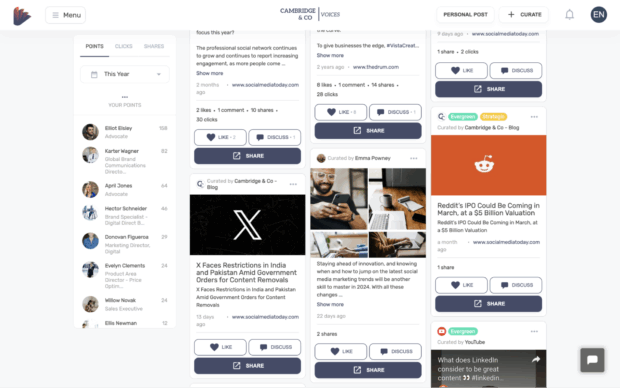
Source: DSMN8
Who is this for?
- Enterprise businesses with a large advocacy team (and budget).
Pricing: Starting at $850/mo for the Start-up plan.
SMM star rating: (4.5/5)
Key features:
- User segmentation: This tool lets you segment your advocates by geography and role so each gets relevant content for their employee networks.
- Content choices: You can create a variety of post captions, link titles, and preview images so your users can mix and match in their posts. That lets your team share unique content with just a few clicks that still honors the message.
- ROI tracking: There’s always a need to prove business results with an advocacy program, and DSMN8’s ROI tracking helps a lot here. It tells you the cost per click and earned media value for the attention your network’s posts get.
What’s lacking/missing?
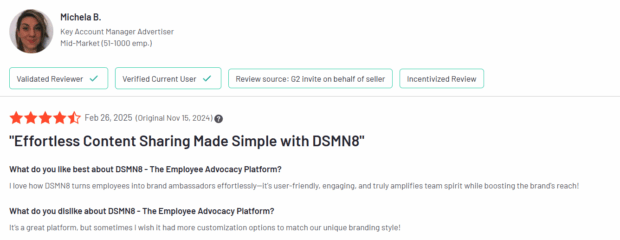
- The price puts DSMN8 out of reach for many businesses that don’t have huge advocacy programs.
- Advocates can piece together unique posts to share on their personal social media accounts, but they can’t customize them beyond that very much.
Customer review:
Source: G2
3. Sprinklr
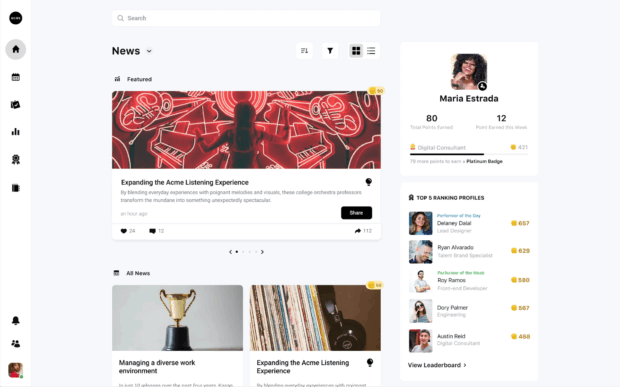
Sprinklr is a marketing and customer success management platform with basic employee advocacy features baked in.
While it doesn’t have some of the bells and whistles of other options on this list, it could be a good choice for brands that want fewer point solutions and the ability to incorporate advocacy into their CS and social management efforts.
Source: Sprinklr
Who is this for?
- Businesses that want to simplify their tech stack by incorporating basic employee advocacy tools along with their CS management platform.
Pricing: Sprinklr doesn’t share pricing on its website, but a comparable plan to Hootsuite starts at $249 per month.
SMM star rating: (3.5/5)
Key features:
- Simplified approval workflow: Sprinklr’s content and advocate approval screens are simple and intuitive. You don’t have to hunt to see where you are in the content approval process, who’s involved, and what needs to happen next. You can even set up notifications to track how things are progressing.
- Awards and badges: Sprinklr takes gamification one step further by awarding coins and badges for things like posts, likes, and comments.
- Salesforce integration: Sprinklr connects with Salesforce, which means you can synchronize the data from both platforms for a more unified view of customer management and your employee advocacy program.
What’s lacking/missing?
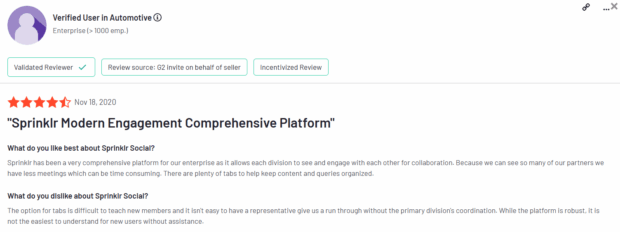
- Overall, Sprinklr is one of the more complex platforms on this list, so expect a learning curve once you get started.
Customer review:
Source: G2
4. Haiilo
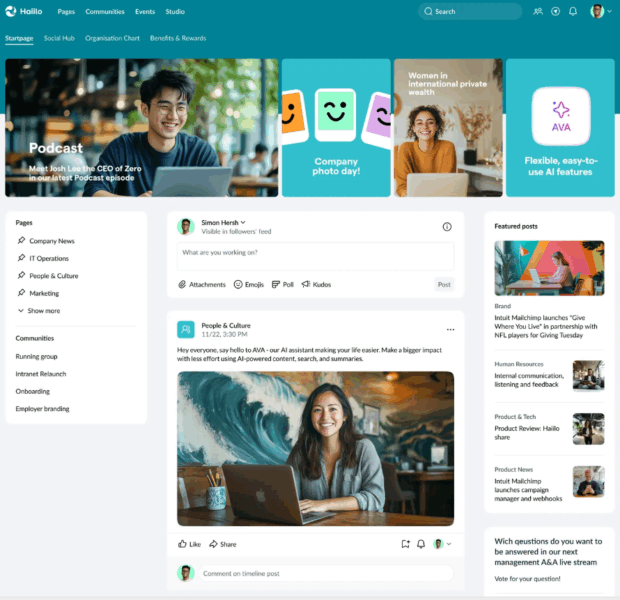
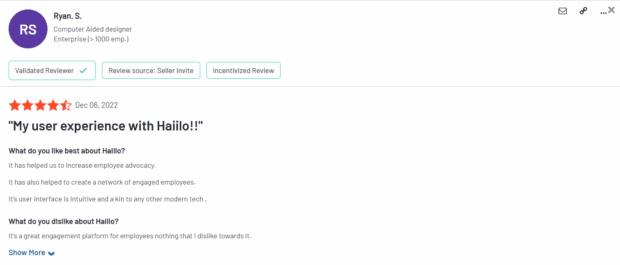
Haiilo is an employee engagement platform that operates like an internal social media app. Employees can share, like, and comment on each other’s posts, and even join themed groups —it’s like Facebook for your business.
It also works for sharing content on external social media platforms, turning internal ideas into thought leadership content.
Who’s this for?
- Because Haiilo relies on an active community of employees to generate content, it’s best for large companies with big teams.
- Businesses that need an employee engagement tool and also want to launch an organized employee advocacy program.
Pricing: Haiilo pricing is based on custom quotes, so you’ll need to contact their sales team for a demo first.
SMM star rating: (4/5)
Key features:
- Intranet to external sharing ease: I’ve worked with several company communication platforms, but the social media-like interface on Haiilo is so much more engaging than most. For advocacy, it feels so natural to turn posts from internal thought leaders into one that employees can quickly share. I love that workflow.
- Peer-to-peer content ideation: The toughest part of social media marketing is constantly coming up with new ideas. The peer-to-peer nature of Haiilo means employees are always germinating the seeds of the next viral thought leadership LinkedIn post.
What’s lacking/missing?
- Haiilo gets nearly flawless marks as an internal communication tool, but compared to more comprehensive advocacy tools, it’s missing some features like AI post creation and ROI tracking.
Customer review:
Source: G2
5. Sociabble
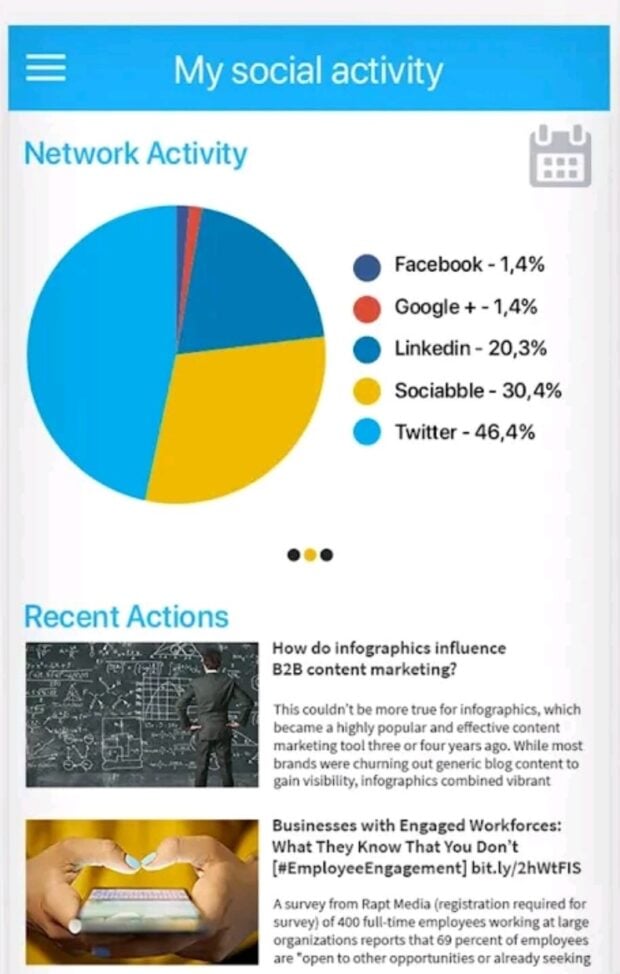
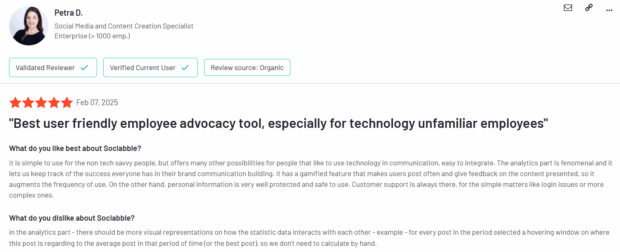
Sociabble is an internal communications platform that has employee advocacy features added in.
The platform emphasizes employee-generated content (like UGC, but for employees) and social selling. Plus, the tool integrates well with LinkedIn.
Source: Sociabble
Who is this for?
- Large brands that want to expand their social selling success on LinkedIn.
- Businesses that need an enterprise-level employee communication platform and advocacy tools.
Pricing: Sociabble doesn’t have a pricing or package landing page, so you’ll need to contact them for a custom quote.
SMM star rating: (3.5/5)
Key features:
- Contextual content generation: Sociabble’s AI content generator takes a bunch of factors into account when creating social media captions. It’ll consider the context, user profiles, compliance guidelines, and your brand tone. So, if I’m managing a lot of advocacy efforts with hundreds of participants, I don’t have to micro-manage what they share if they use Sociabble’s AI to write it.
- LinkedIn partnership: Sociabble’s LinkedIn API and partnership make it one of the best advocacy options for B2B businesses. For example, you can post and engage with LI content directly on the Sociabble app.
- Lead generation tracking: Sociabble is great for social selling. That carries through in its analytics, where you can track leads generated from your advocacy program. You can even use UTM tags to see which of your brand ambassadors is the lead-gen champion!
What’s lacking/missing?
- There doesn’t seem to be a way to tag personal or business LinkedIn accounts on posts you create in Sociabble.
Customer review:
Source: G2
What are the best employee advocacy tools for small teams?
These stand-alone employee advocacy tools can elevate your program without stressing smaller marketing budgets (even if they aren’t exactly “cheap”).
6. Clearview Social
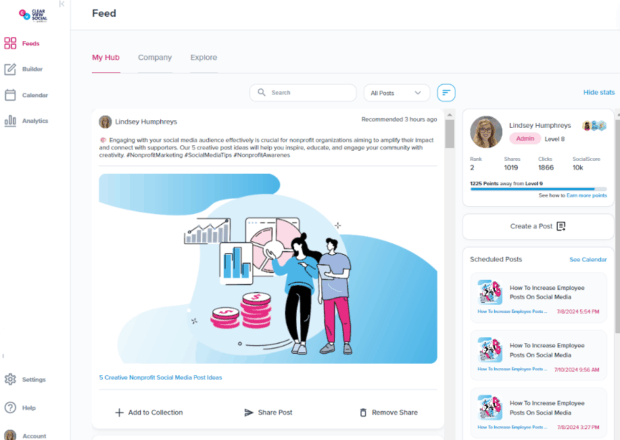
Clearview Social is an easy-to-use advocacy program that scales with you. It has an entry plan that comes in at about half the price of other dedicated employee advocacy software.
That said, Hootsuite’s social media management plans with advocacy tools are still less expensive. But if you want a stand-alone advocacy platform to compete with the big guys, I’d give Clearview a look.
Source: Clearview Social
Who is this for?
- Smaller businesses with fewer than 50 employee advocates will find Clearview more accessible than some of the more expensive options on this list.
Pricing: Plans start at $425 per month for one admin, three social accounts, and up to 50 employee advocates.
SMM star rating: (4/5)
Key features:
- Content discovery options: Clearview gives you several ways to curate content for your team to share. There’s a Chrome extension that allows users to grab what they like from the web. Integrated Google Alerts and RSS feeds continually send new content your way. And there’s a suggested content feature your employees can use to suggest content to the marketing team.
- Earned Media Value metric: It can be difficult to quantify the effects of PR and brand awareness. That’s why this platform’s Earned Media Value (EMV) metric jumped out at me. EMV calculates what it would cost to get the same amount of social media reach as your employee advocacy posts. That’s a quantifiable benefit you can include in monthly reports.
What’s lacking/missing?
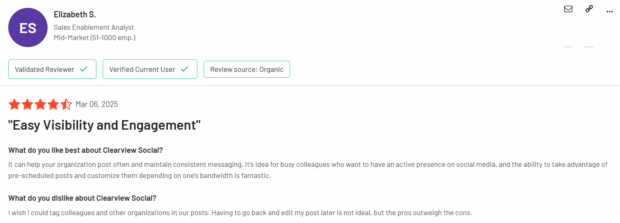
- Like other employee advocacy tools, Clearview Social doesn’t let you tag people and businesses in content you publish from the platform.
Customer review:
Source: G2
7. SocialToaster
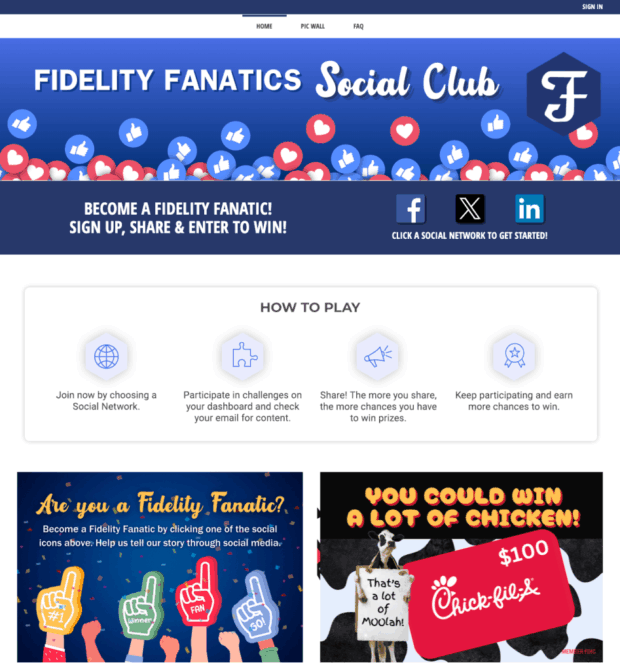
SocialToaster is an employee advocacy platform that includes a handful of standard features you typically see in other advocacy tools. However, it has a particular focus on gamification and rewards, which makes it an interesting choice for teams who want to ramp advocacy adoption in a hurry.
Plus, SocialToaster has a pricing tier that’s more palatable for smaller teams.
Source: SocialToaster
Who is this for?
- Smaller brands that want to get into the advocacy game.
- Any sized business that wants to use incentives to get lots of internal (and even external) influencers sharing their content.
Pricing: The Bronze tier costs $450 per month and lets you have three admins and 200 users.
SMM star rating: (3/5)
Key features:
- ContentToaster: This is an AI content curator. It continually reviews your digital assets (blog posts, white papers, etc.) and your advocates’ engagement. Then, it automatically sends content to each employer brand advocate that they’re more likely to engage with and share.
- Advocate rewards: Most advocacy platforms have some type of gamification feature. What’s interesting here is how SocialToaster lets you add and promote actual rewards (prizes, VIP experiences, etc.). That’ll motivate more employees to get involved. It also makes it possible to create a brand fan advocacy program where you incentivize customers to join and share your brand content.
What’s lacking/missing?
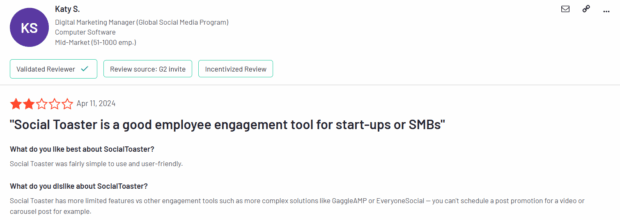
- You don’t get the same level of scheduling features on SocialToaster as you do on other platforms.
Customer review:
Source: G2
What are the best employee advocacy tools for agencies?
There aren’t any employee advocacy tools geared solely toward marketing agencies. But some do have features, like white-label reporting, that make them a fit for reselling an advocacy program.
8. GaggleAMP
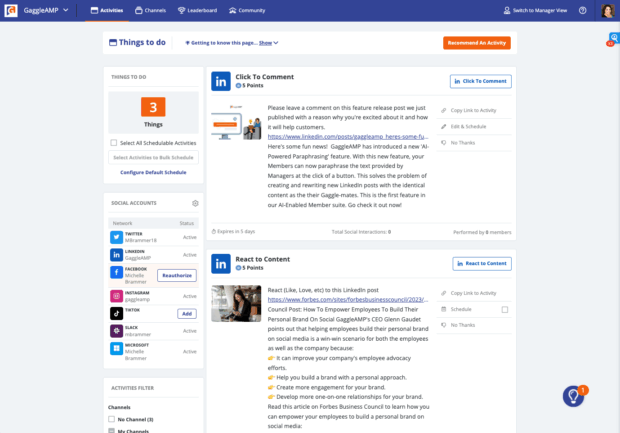
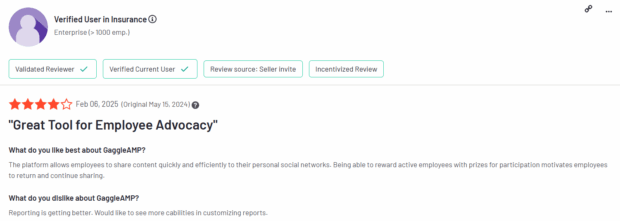
GaggleAMP is also a stand-alone employee advocacy platform with all the typical features like one-click sharing and analytics. It stands out by offering tools that help each employee create unique — but on-brand — content, and because it’s one of the easiest tools to learn and use.
I could have placed this tool in the “Large teams” group since GaggleAMP is designed for individual brand use. But it also has some interesting managed services training and features that help agencies offer it as a product to their clients.
Source: GaggleAMP
Who is this for:
- Agencies looking to add employee advocacy as a sellable line item.
- Marketing teams who want a diverse set of voices sharing a singular brand message.
Pricing: GaggleAMP pricing starts at $8,800 per year for up to 100 members.
SMM star rating: (4/5)
Key features:
- AI-powered Paraphrase: Gaggle’s Paraphrase feature lets each employee reword a personalized version of a caption based on a core brand message. It helps advocates write a unique post while staying on brand.
- Agency certification: GaggleAMP has a whole training and certification program for agencies. You’ll learn how to launch and run an advocacy program, how to package it with other services, and get some sales messaging to help you sell it.
What’s lacking/missing?
- GaggleAMP is easy to use, but there’s a lot to it, which can feel overwhelming at first.
- It would be cool if employees could get multiple AI post options to choose from.
Customer review:
Source: G2
How to optimize employee advocacy tools for better engagement [expert tips]
I’ve asked two experts for tips on getting the most out of your employee advocacy tool. Kim Snow is the Head of Demand Generation at TeamOhana. And Laura Moss is an experienced Content Marketer who’s worked with a variety of large and small brands.
Here are their best secrets to get more employees hyped to be active ambassadors of your brand.
1. Explain the “why” behind employee advocacy
Your employees aren’t sitting around thinking about brand awareness and content reach. But their networks on LinkedIn and Facebook would be perfect for your message. Give them a little context into how their advocacy helps them and the organization.
“Many employees, especially those outside of sales or marketing, may not immediately see the value of engaging with company content on social media,” Snow shares.
“It’s essential to communicate how even simple actions such as a like, comment, or reshare can significantly expand the reach and visibility of the company’s message,” she adds.
“When employees understand the tangible impact of their engagement, they are more likely to feel motivated and invested in contributing.”
This is where all of those gamification and ROI reporting features come in handy. Don’t just report those numbers; report them laterally to other team members. Show them the real value of posting an article on their LinkedIn feed.
2. Remove friction from the process
Want your advocacy program to really take off? Avoid complexity.
“Make it as easy as possible for employees to participate,” Snow says. “Share direct links to the posts you want them to engage with, clearly outline what action you’re requesting (e.g., like, comment, or share), and provide a suggested timeframe for completion.”
Most employee advocacy tools offer one-click publishing and scheduling to help. Leverage those features and think of other ways to make sharing content super simple.
“By removing guesswork and minimizing effort, you increase the likelihood of consistent engagement,” Snow says.
3. Secure executive buy-in
“Employee advocacy success starts at the top,” says Moss.
“Get leadership involved,” she explains. “Your C-suite should be active on social for a variety of reasons: they have a built-in following, they’re the face of the company, etc. But they also set an example for the rest of the company.”
Snow agrees. “Secure executive support early on and ask them to help reinforce engagement efforts with their teams,” she says. “It’s far easier to encourage peer participation when it’s modeled from the top.”
Most leaders want to understand the impact of a program before they support it. Start your pitch with the expected results, back it up with examples, and then lay out how it’ll work.
4. Identify existing advocates
You don’t need to start from scratch. It’s likely that some of your employees are already talking about your business.
“According to Weber Shandwick, 50% of employees who use social media are already posting about their companies there,” Moss points out. “Find these people, whether they’re in marketing or engineering, and empower them to lead the way for the rest of your employees.”
One good way to start is to check the activity on your brand’s LinkedIn account. Scroll through the reposts and company mentions to find employee posts.
This is also a great time to fire up your social listening tools. Make note of brand and product mentions from employees, then reach out to help them operationalize their advocacy.
And, of course, celebrate it with the team to get more people excited about joining.
FAQ: Employee advocacy tools
What are the best employee advocacy tools for large enterprises with global teams?
The best employee advocacy tools for large enterprises with global teams include Hootsuite Amplify, Sprinklr, Haiilo, and Sociabble.
Hootsuite Amplify, in particular, offers unmatched collaboration tools, built-in approval processes and controls, Slack and Microsoft Teams integrations, and gamification features.
How do employee advocacy platforms compare to social media management tools like Hootsuite?
Employee advocacy platforms focus on helping employees share approved content, while social media management tools focus on brand-owned accounts. A tool like Hootsuite supports both, helping you manage, boost, and track all of your social engagement in one place.
What features should enterprises look for in an employee advocacy tool in 2026?
In 2026, enterprises should look for an employee advocacy tool that includes AI content support, advanced analytics, strong security controls, and collaboration features. A platform like Hootsuite includes all of these, along with integrations for workplace tools like Slack.
Together, these features help teams save time, stay secure, and work better together.
How do employee advocacy tools increase organic reach and employee engagement?
Employee advocacy tools increase organic reach and employee engagement by making it easy for employees to share content with their own networks. This type of content sharing feels more authentic than brand posts alone and often performs better across social networks.
Save time managing your social media presence with Hootsuite. Publish and schedule posts, find relevant conversions, engage your audience, measure results, and more — all from one dashboard. Try it free today.
The post 8 employee advocacy tools to amplify your social media reach appeared first on Social Media Marketing & Management Dashboard.
* This article was originally published here
Monday, January 26, 2026
Sunday, January 25, 2026
Saturday, January 24, 2026
Friday, January 23, 2026
Thursday, January 22, 2026
Wednesday, January 21, 2026
Tuesday, January 20, 2026
What is social CRM? A guide for marketers, sales, and CS
Many customer relationships start with a comment, a DM, or a simple question. Without a social CRM, it’s easy for conversations to get lost.
In this article, we’ll explain what social CRM is, how it works, our top tools, and why it matters for marketing, sales, and customer service.
Key takeaways
- Social CRM (social customer relationship management) uses social media to help teams connect with customers across channels.
- It supports customer service, sales, and marketing by making customer interactions more personal and timely.
- Social CRM tools like Hootsuite, Salesforce, and Microsoft Dynamics 365 bring social listening, lead tracking, insights, and team collaboration together in one place.
Bonus: Get a free, easy-to-use Customer Service Report Template that helps you track and calculate your monthly customer service efforts all in one place.
What is social CRM?
Social CRM, short for social customer relationship management, is a way to use social media data to better understand your customers, prospects, and leads.
By adding social media data to a traditional CRM, customer-facing teams can do their jobs more effectively. Everyone has the context they need, right when they need it.
With social CRM, brands can:
- Offer better customer support on the social channels customers already use
- Find new customers and leads through social conversations
- Build and grow relationships over time, not just at the moment of purchase
- Learn what their audience cares about and create more relevant content
How does social CRM differ from traditional CRM?
Traditional CRM focuses on past customer actions like emails and purchases, while social CRM adds real-time social conversations to the mix. Together, this creates a more complete picture of each customer.
Here’s a quick look at how they compare.
| Traditional CRM | Social CRM |
| Focuses on past actions | Focuses on real-time conversations |
| Tracks structured data (emails, purchases, support tickets, phone calls) | Tracks structured + unstructured data (comments, mentions, DMs) |
| Usually managed by one team | Shared across marketing, sales, and support |
| Mostly reactive | Proactive and relationship-focused |
How does a social CRM work?
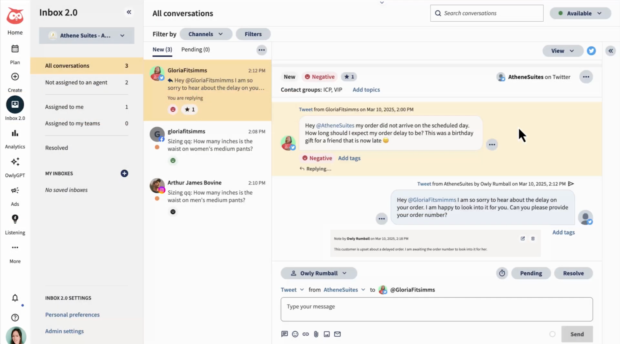
A social CRM works by pulling in social media activity and linking it to customer profiles in your CRM. This includes comments, messages, mentions, and other interactions from platforms like Instagram, X, Facebook, and LinkedIn.
For example, if a customer sends a direct message on Instagram, that message shows up alongside their past emails, calls, or support tickets. Teams can see the full picture in one place and respond with the right context.
Social CRM in customer service
Social CRM software gives your care team a more meaningful way to have conversations with your customer base – no matter which platform they choose to make contact.
Here’s what social CRM can do for your customer service team.
Increase relationship quality
Recent research shows that using social media for CRM can improve customer relationship quality. That’s not too surprising, since social CRM helps brands respond in more personal and timely ways.
In Hootsuite’s 2024 Social Media Consumer Report, 53 percent of respondents say timely replies to questions and comments are the most appealing part of a brand’s social presence when deciding to follow a brand.
Responsiveness also matters. 28 percent of respondents will unfollow a brand that ignores negative or challenging comments. And 32% will unfollow a brand that fails to interact with or respond to the community.
Take Starbucks, for example. The brand gets plenty of positive comments, but also negative feedback. When that happens, the team responds quickly and publicly, offering help right away or moving the conversation to DMs when follow-up is needed.

Source: @starbucks
Provide faster and smarter responses
Sometimes your social and customer support teams may interact with the same customer on multiple channels.
Social CRM tools connect messages to people — not just profiles — so everyone can see a customer’s full history in one view. With that context, teams can give consistent, personalized replies without duplicating work or asking customers to repeat themselves.
Social CRM also improves response time and accuracy. Incoming contacts and requests can be auto-routed to the best team member for the job.
Social CRM in sales
Your first contact with someone on any social media platform is generally not the best time to go in with a hard sell. But social connections can absolutely become real, qualified leads.
Here’s what social CRM can do for your sales team:
Turn social conversations into leads
Social CRM helps fill your funnel. By focusing on relationships first, teams can connect with people and slowly build interest over time. The idea is to work toward a sale over the longer term.
For instance, after KiwiCo tested ads on Instagram Reels, their paid social marketing manager, Lisann Arndt, said: “We’ve seen that Reels can be a significant acquisition lever if we engage audiences in an authentic way that reflects an understanding of their needs.” (Emphasis added.)

Source: Instagram
Qualify and nurture leads faster
Social CRM adds social activity to lead profiles, giving sales teams more context right away. Instead of starting from scratch, they can see past interactions and better understand what someone is interested in.
Of course, social leads still need nurturing. Offers like opt-in newsletters, drip campaigns, or helpful resources keep the relationship warm as teams work toward a sale.
Understand the true value of social leads
A full picture of how social interactions convert to sales gives you a true understanding of the value of a social lead. This will help you plan your social media budget, especially the amount you plan to spend on social ads.
Social CRM in marketing
Connecting CRM and social media provides a fuller picture of who your customers are and what they expect from your brand.
Your marketing team can use these insights in a couple of key ways.
Create targeted content
Social CRM makes it easier to create content that feels relevant and personal. Instead of guessing, your team can speak directly to the needs and interests your audience has already shared.
Forty percent of respondents to the Hootsuite 2024 Consumer Report said they would unfollow a brand that posts boring content that doesn’t appeal to them. Social CRM helps you better understand what type of content will appeal, making it easier to keep those hard-earned followers.
Say you happen to sell filled doughnuts. You suspect your customers want to see what’s inside those doughnuts before they buy. So, you create a series where you rip them open on Instagram.
That’s exactly what dohhut does. They’ve hit a nerve with their target audience. One recent tear-open Reel got more than 1,300 likes and 57 comments.

Source: dohhut
It’s a simple example of how content that matches audience interest can drive tons of engagement.
Social listening at scale
Social CRM helps teams look beyond the people they already engage with. Social listening tools can track:
- brand mentions
- influencer mentions
- customer sentiment
- and industry trends
This wider view makes it easier to understand what people really think and care about. You can spot early feedback, optimize marketing campaigns, see how conversations are changing, and pivot your marketing strategy in real time.
All of this feeds into smarter content planning, stronger messaging, and better customer engagement.

#1 Easy Social Listening
Brand mentions, trending topics, and sentiment at your fingertips. Enhance your social strategy with the insights that matter.
Start free 30-day trialBuild lookalike audiences
Social CRM data can also be used to create highly targeted lookalike audiences for social ads. You can base them on characteristics like age, location, demographics, and customer behaviors.
Since existing customers have already purchased from your brand, they’re a strong starting point. Lookalike audiences based on real buyers are more likely to convert than audiences based only on followers or fans.
Connect social activity to real results
Finally, social CRM helps you understand the true impact of your social marketing efforts. In Hootsuite’s 2024 Social Trends Report, 33 percent of respondents said they were facing an unsatisfactory connection between social metrics and business metrics.
By linking social activity to CRM data, actions like comments or clicks can be tied to outcomes like purchases or subscriptions. This makes it easier to prove social ROI — and improve it over time.
What are the benefits of using social CRM tools?
Social CRM tools bring customer conversations together in one place. This helps marketing, sales, and customer service stay on the same page, respond consistently, and avoid duplicate work.
Here’s what the benefits of social CRM look like in practice:
- Improved response times: Social CRM routes conversations to the right team to streamline responses across teams. It also gives everyone the context they need to get up to speed quickly.
- Clearer connection to business results: By linking social conversations to CRM data, teams can see how engagement turns into leads, sales, or customer retention.
- Smarter cross-team collaboration: Marketing, sales, and customer service all work from the same customer view, so nothing gets missed or repeated.
- Better audience insights: Social CRM turns everyday comments and feedback into actionable insights teams can use to improve messaging, products, and customer experiences.
- Stronger relationships with customers: Ongoing conversations on social media help current and potential customers feel heard, which builds trust, loyalty, and even customer advocacy.
5 social CRM tools to get started
The best social CRM tools let businesses do the following in one place:
- Manage customer profiles
- Listen to online conversations
- Analyze sentiment
- Drive social selling efforts
- Efficiently manage multiple social media management platforms
Here are our top picks.
1. Hootsuite

Hootsuite is a comprehensive social CRM tool. It’s an all-in-one platform that allows brands to monitor social media conversations, engage with customers, and analyze data with clear, efficient reporting.
Hootsuite also integrates with leading traditional CRM platforms. So, you can keep using the tools that already work for your business as you transition to social CRM.
Key benefits:
- Track trends, hot topics, popular keywords, brand mentions, and social sentiment to understand what your customers want from you and how they feel about your brand.
- Manage all social conversations in a central inbox and share information between your social inbox and your CRM so all conversations are fully up to date and complete.
- Measure and analyze your social results across all your social accounts in one place, so you can understand social ROI.
- Offers 100+ apps and integrations, including Slack and Monday.com.
Pricing: Hootsuite plans start at $99/month.
2. HubSpot

Source: HubSpot
HubSpot is a CRM platform designed to manage contacts at every stage of the pipeline. It integrates marketing, sales, and customer service functions to improve customer experience and maximize leads. Each functional area gets its own hub, and they are all connected to a Smart CRM.
Key benefits:
- Create lead-generation forms, landing pages, and email campaigns
- Detailed contact tracking and management
- Solid analytics
- Cross-department collaboration features
- CRM social media integration though Hootsuite supports contacts and tickets from X (Twitter), Facebook, LinkedIn, and Instagram
Pricing: HubSpot offers free basic tools. Individual plans start at $15/month and professional plans at $1,170/month.
3. Salesforce

Source: Salesforce
Salesforce uses artificial intelligence to guide your sales process and provide valuable insights into your current and future deals. The system is built on Salesforce’s proprietary “Einstein 1” platform and includes a conversational AI assistant.
Key benefits:
- Metadata framework integrates data sources to provide a unified view of the customer
- Detailed insights and analytics for marketing, sales, and customer service
- AI assistant provides recommended actions after an interaction with a customer
- Connect Salesforce to Hootsuite for CRM social media integration to identify and capture new leads on social media channels
Pricing: Basic small business plans start at $25/month, and professional plans start at $100/user/month.
4. Microsoft Dynamics 365

Source: Microsoft
Microsoft Dynamics 365 offers customizable CRM systems to unify your teams and provide a holistic view of your customers. It uses AI to make predictions about customer intent and provide recommendations about new audiences and audience segments.
Key benefits:
- Create personalized customer journeys
- Use AI-based scoring to prioritize leads and opportunities
- Track and report on selected KPIs
- Collaborate in Microsoft Teams
- Connect to Hootsuite to create leads and opportunities from social posts
Pricing: Individual CRM components start at $50 per user per month. Combine the components you need to create a full CRM that connects all teams.
5. SugarCRM

Source: SugarCRM
SugarCRM is a customizable CRM that allows you to choose the focus you need for your team.
Key benefits:
- Get a complete picture of your customers across touchpoints
- Thorough analytics to help you understand what’s working and how to improve
- Business process automation for sales
- Recommended updates after customer interactions
- Link with Hootsuite to incorporate Instagram and Facebook connections for social CRM capabilities
Pricing: Limited plans start at $19 per user per month, with the standard plan starting at $59/month.
FAQ: Social CRM
What is a social CRM and how does it work?
A social CRM is a system that helps brands manage customer relationships using social media data. It works by pulling in social conversations (like comments, messages, and mentions) and connecting them to customer profiles in a CRM.
This lets teams see who they’re talking to, what’s already been said, and how to respond in a helpful, consistent way.
How is social CRM different from traditional CRM systems?
Social CRM is different from traditional CRM because it includes social media conversations, not just past actions. Traditional CRM mostly tracks things like purchases, emails, and support tickets. Social CRM adds real-time social interactions, giving teams a more complete picture of each customer.
Why do enterprises use social CRM to manage customer relationships?
Enterprises use social CRM to manage customer relationships because it helps them respond faster, stay consistent, and build stronger trust at scale. With many teams and channels involved, social CRM keeps everyone on the same page and makes it easier to support customers without missing messages or repeating work.
How do social media interactions connect to CRM data?
Social media interactions connect to CRM data when social accounts are linked to customer profiles. For example, if someone sends a DM or leaves a comment, that interaction can appear alongside their past emails, calls, or purchases. This helps teams respond with better context and avoid asking customers to repeat themselves.
What tools support social CRM for large organizations?
Large organizations use social CRM tools that combine social media management, customer data, and team collaboration. Tools like Hootsuite help teams listen on social and manage conversations.
Save time managing your social media presence with Hootsuite. From a single dashboard you can publish and schedule posts, find relevant conversions, engage the audience, measure results, and more. Try it free today.
The post What is social CRM? A guide for marketers, sales, and CS appeared first on Social Media Marketing & Management Dashboard.
* This article was originally published here
Monday, January 19, 2026
Sunday, January 18, 2026
Saturday, January 17, 2026
Friday, January 16, 2026
Thursday, January 15, 2026
Wednesday, January 14, 2026
Globely Launches "Globely Social" - A Scalable Social Media Management Platform for Agencies and Multi-Location Brands - FinancialContent
Tuesday, January 13, 2026
Monday, January 12, 2026
Subscribe to:
Comments (Atom)
-
You could spend your days trying to outsmart Instagram’s ever-changing algorithm. Or, you can take the direct route with Instagram ads. ...
-
Social Media Advertising Market Worth $262.62 Billion by 2028 - Million Insights 69News WFMZ-TV * This article was originally published ...
-
Wondering if you should invest your time and energy in creating content for Facebook Stories ? Facebook Stories are short user-generated vid...

