Pinterest Shares Q5 Marketing and Trend Tips Social Media Today
* This article was originally published here
Sunday, November 30, 2025

Saturday, November 29, 2025
Friday, November 28, 2025
Social media calendar: Top tools and templates for 2025
Build a social media calendar that actually works. We’re sharing our go-to tools, tips, and templates (including a free one!) to help you crush your social media game.
A social media calendar is your secret weapon for staying consistent, strategic, and stress-free on social.
Here at Hootsuite, our social media calendar is the backbone behind all the content marketing you see on our channels. I hate to break the spell of real-time spontaneity, but every post is meticulously planned in our social media content calendar before it’s even created.
I’d be lying if I said planning a content calendar for our audience of over nine million (!!!) people across eight social media platforms is easy. But it’s important, and can even be fun.
In this guide, you’ll learn how to build a social media calendar that actually works. You’ll also find practical tips, free templates, and real examples from our very own social team to help you put it all into action.
PS: If you’re just here for the free template, you can grab it here.
Key Takeaways
- A social media calendar is your roadmap for planning and organizing all upcoming content, including post dates, times, hashtags, images, and links. It can take any format that works for your marketing team: a document, an Excel spreadsheet, or dashboard in your project management tool.
- A calendar brings structure to your content strategy, helps you stay aligned with larger marketing goals, and can draw your attention to content gaps. No more last-minute scrambles for content or rushing the design team for graphics—you’re prepared!
- When building a social media calendar, start with a solid strategy, then plan your posting schedule (we recommend a weekly planning cadence). Use social media scheduling tools like Hootsuite, Wrike, and Miro for brainstorming, creating, and scheduling content.
What is a social media calendar?
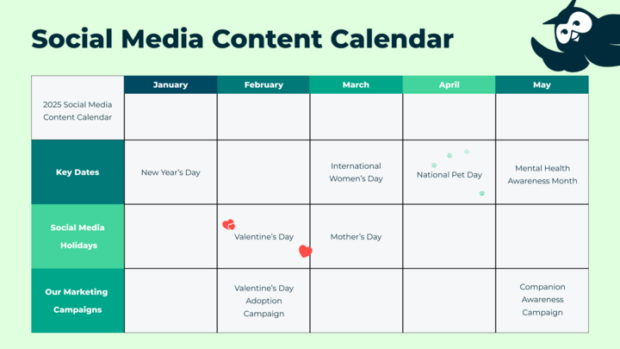
A social media calendar is a strategic plan of all upcoming content, including the date and time posts will go out and supporting information, such as links, hashtags, images or videos, mentions, Reels audio, or other platform-specific features.
A social media calendar can be a document, a spreadsheet (we have a free social media calendar template for you here!), or part of your project management app — whatever works for your team.
Does my team need a social media calendar?
Here are a few telltale signs your team is ready for a social media calendar:
- You post on multiple social platforms. This one’s obvious. Different platforms = different formats, audiences, and tones. A calendar keeps you organized and turns social media from a daily scramble into a predictable rhythm.
- You want your content to perform better. When you’re posting on the fly, it’s tough to know what’s working. With a calendar, you can nail your content mix (oops, five carousels in a row), spot gaps, and post when your audience is actually active.
- You post across different time zones. Creating content for a global audience? A calendar helps you plan and schedule posts for when your audience is actually awake (no late-night posting required).
- You have several team members creating or approving content. Things can slip through the cracks with multiple cooks in the kitchen. With a shared calendar, your team can easily track deadlines and approvals so everyone is on the same page.
- You manage multiple campaigns at once. When campaigns overlap, everything can start to blur. A calendar lays it all out on a single timeline so you can spot conflicts, space out messages, and keep your audience excited, not exhausted.
- You’ve ever forgotten to post (or posted twice by accident). It happens! A calendar helps you see what’s coming up, and with the right tool (like Hootsuite
 ), you can schedule posts in advance so you never forget to hit “publish.”
 - You plan content around seasons or events. Big dates sneak up faster than you think — but a calendar helps you stay ahead, prep content early, and hit every key moment right on schedule.
If you nodded along to a few of these, it’s probably time to level up with a social media calendar. Keep reading to see how it can make planning, posting, and reporting a whole lot easier.
What are the benefits of a social media calendar?
1. Organizes your work
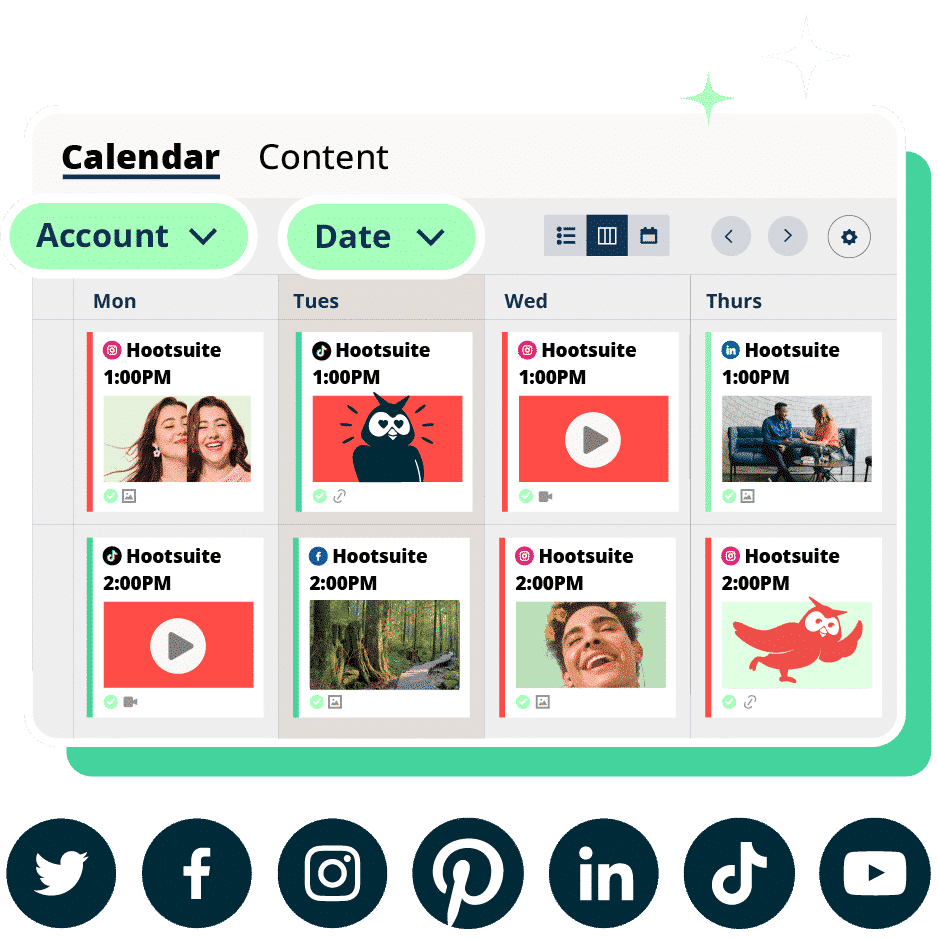
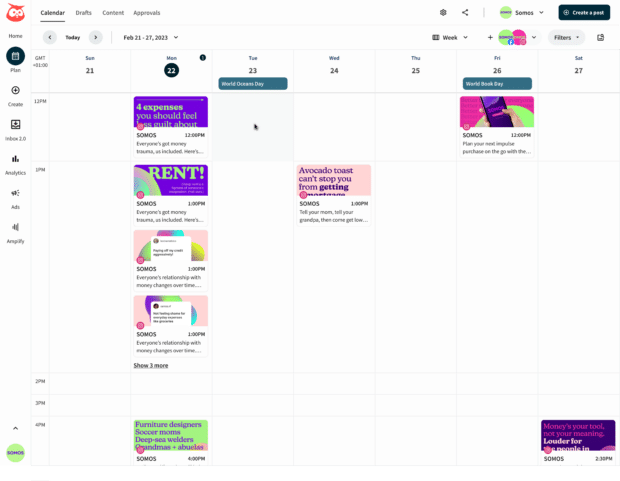
A social media calendar brings structure to your publishing schedule. Instead of jumping between spreadsheets or platforms, you can see every post in one place.
At a glance, you get a bird’s eye view to ensure you’re sticking to a consistent publishing schedule.
2. Aligns content with strategic goals
Once you have a calendar, it’s easier to zoom out and make sure every post has a purpose — whether it’s building awareness, driving engagement, or supporting a product launch.
Without one, you risk creating content last minute that may not align with your brand or your marketing strategy goals.
At Hootsuite, we’re not making content for the sake of making content. We’re making content that aligns with our strategy (but also has fluidity with different formats). We’re constantly leveling up to what the company is needing from our social media channels.
3. Identifies gaps
Having all your social media posts planned in one space allows you to easily spot where you’re either missing a post entirely, or just certain types of posts.
This also applies to each piece of content. Do scheduled posts have all the assets they need? Are we missing any graphics or captions for product launches?
Having a social media calendar means you aren’t running around at the last second begging the design team for an urgent graphic (or bribing them with iced coffee…). I’ll go into more detail on how we identify content gaps in the steps later.
4. Improves team collaboration
Between writers, designers, social managers, and approvers, it’s easy for communication to get messy. A shared calendar helps everyone stay aligned.
At Hootsuite, we take this to the next level with custom approval workflows. Assign posts, track progress, and get sign-off fast — because no one wants another “wait, who’s posting this?” moment.
5. Makes room for high-impact work
Scheduling content in advance means fewer last-minute scrambles. It frees up your team to focus on higher-impact work, like creative ideas, campaign strategy, and actually engaging with your audience.
And with a clear calendar, you can plan around design deadlines, approvals, and anything else that slows things down.
6. Gives you flexibility to adapt
Social moves fast. Even with the best plan, trends pop up, campaigns pivot, and algorithms do funky things.
A social media calendar keeps you flexible when things move a mile a minute. You can rearrange posts, slot in timely content, and keep your strategy on track.
7. Makes reporting easier
A social media calendar doubles as a record of what’s been published and why, making reporting faster. You’ll see how every post ties back to campaigns and goals, so your data actually means something.
With Hootsuite, you can track paid and organic posts side by side in one calendar — because who wants to bounce between different dashboards?
How to create a social media calendar
This is our social media calendar process here at Hootsuite. Feel free to copy it or adapt parts of it as needed to suit your own social media presence.
1. Start with a social media strategy
Before you can make a calendar, you need a strong social media strategy that withstands the changes of algorithms and trends.
And that means doing the less exciting things first — like pulling analytics using social media analytics tools, figuring out content pillars, and analyzing post performance — before you can do the fun things: post ideas, content creation and testing.
Your social media strategy should include:
- Clear goals: Use the S.M.A.R.T. framework to set goals that tie directly to your business or marketing goals.
- Key metrics: Define the specific metrics that will measure your progress in reaching those goals.
- Audience insights: Get to know your audience through personas and social listening.
- Competitive analysis: Study what works (and doesn’t) for others in your space.
- Platform selection: Choose which social platforms you’ll use, and set goals for each.
- Content pillars: Outline the themes and formats you’ll post about (e.g., educational videos, promos, or company culture).
- Posting frequency: Decide how often you’ll post on each platform to stay consistent without burning out.
- Approval workflowers: Set up clear approval workflows so everyone knows who reviews and signs off on content before it goes live.
- Reporting routine: Schedule regular check-ins to review analytics, report progress, and update your strategy.
Pro tip  : The North Star for many social media teams is cross-posting (sharing the same content across multiple platforms). However, we’ve learned over the last few years it’s not the best strategy.
Each social network is so different in the way it prioritizes content, and people use those networks differently. We learned a lot about this in our consumer trends report. How we show up on each network needs to be different to match the audience’s expectations.
Take the time to create or review your social strategy before jumping into creating a social content calendar. Get started or revamp your current one with our free social media strategy template.
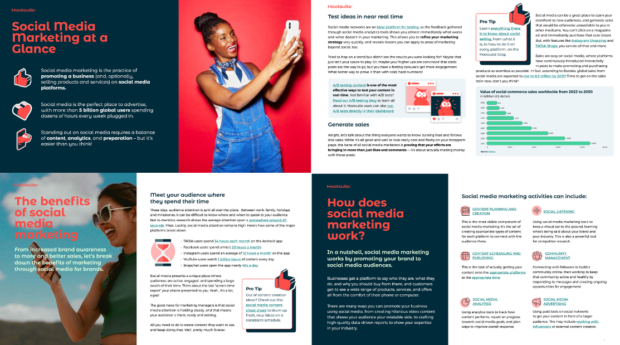
You can also get a primer from our free ebook on social media marketing basics — grab it below. No email required!
2. Plan your content schedule
Now it’s time to turn goals into a real posting schedule.
You might prefer monthly or biweekly planning, depending on your goals, team size, and content volume. The key is consistency. A predictable schedule keeps your team aligned and your content balanced.
At Hootsuite, we plan content weekly. It gives us enough structure to organize campaigns, but still lets us pivot quickly when a trend pops off.
For example, when Instagram launches a new feature, we can create a carousel post or video to educate our target audience.
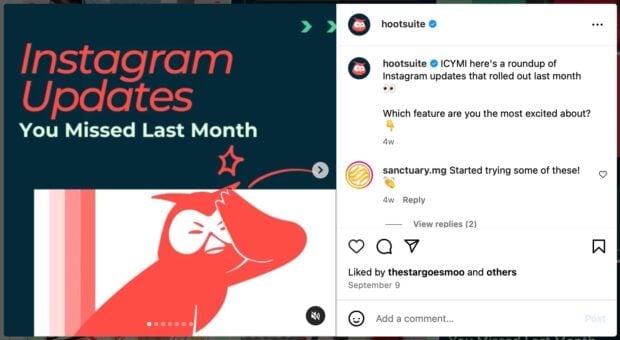
Sometimes we schedule posts months in advance if they’re part of a large campaign, such as our annual Social Trends report releases or promotional webinar content. But most of our regular content is planned week to week.
3. Research and brainstorm content
Once you know how many posts you need — and which content pillars they’ll tie into — it’s time to brainstorm ideas.
Here are a few ways to brainstorm social content:
- Start with social listening: See what your audience is talking about, what they love, and where they’re confused. This helps uncover gaps and opportunities.
- Use data and feedback: Look at comments, DMs, and post analytics to see what’s resonating and what needs tinkering.
- Write creative briefs: Once an idea sticks, outline what you need (think: visuals, captions, tone, and any platform-specific details).
- Repurpose what works: One high-performing idea can become multiple pieces of content across platforms.
At Hootsuite, we use Miro to store (and share) all our social content ideas Again, use whichever tool works best for your team. It can be as simple as a shared spreadsheet, document, or a note on your phone.
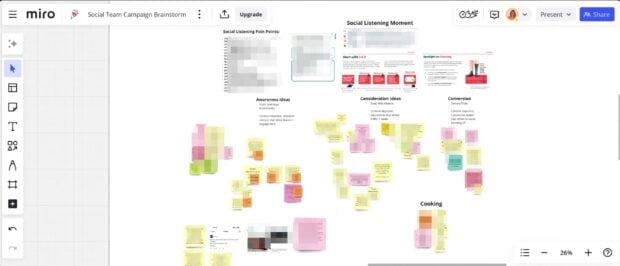
Social listening is especially valuable, and it’s a huge part of our brainstorming process. It helps us see how people talk about our brand, use Hootsuite, and how our content helps them manage social better.
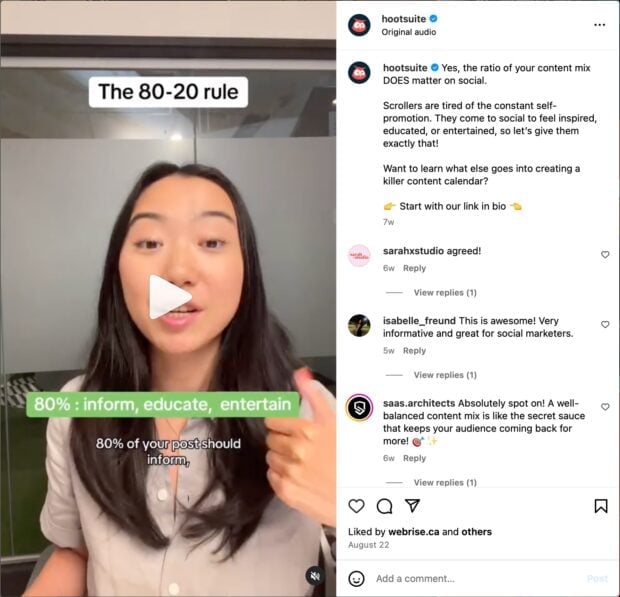
For example, our Reel about the 80/20 rule — creating content that’s 80% educational, 20% promotional — came straight from social listening. It’s not a new concept, but social listening told us some of our audience weren’t familiar with it, so we turned that insight into an educational post that performed well.
4. Make the content
Now it’s time for the fun part: making the actual content! Here’s how to approach it:
- Choose the right tools: Use whichever tools work for your team and the types of content you’re creating. Our team mainly uses CapCut and Canva to create high-quality content.
- Create in batches: Producing multiple posts at once saves time and helps you stay consistent. At Hootsuite, we create content months in advance for large campaigns or special initiatives, like our free educational webinars.
- But leave room for trends: Keep space in your schedule for more reactive content. Sometimes we create and post content within the same day to take advantage of a social media trend.
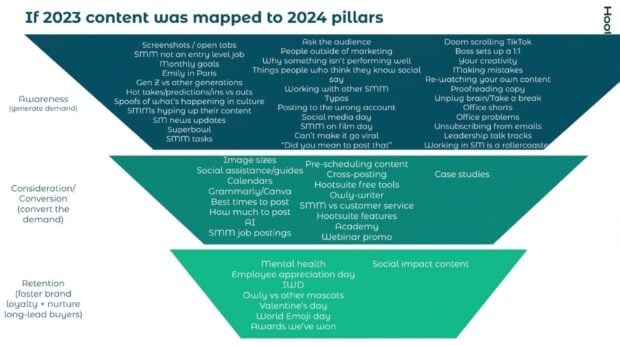
- Align to your pillars: Every post should ladder back to your content pillars. This keeps your messaging consistent from the first draft to the final post. Below, you can see what our content pillars looked like last year.
Pro tip : There was a myth circulating that Instagram Reels created with third-party tools like CapCut get less reach vs. if you create them in-app with Instagram’s native tools.
Not to worry—we experimented and found Instagram does not penalize Reels made with CapCut (or other apps).
5. Schedule content
Most teams schedule content weekly, biweekly, or monthly. The key is finding a rhythm that lets you stay organized and flexible.
For example, our team plans and schedules content every Friday. One perk of doing this weekly? If a hot trend pops up, we can shift things quickly and avoid any delays in posting due to approval or misalignment with ongoing marketing campaigns.
A big part of scheduling content is making sure you’re striking the right content mix. In other words, you have enough content to satisfy each pillar: awareness, consideration, and retention/conversion.
To manage this, we color-code posts by content pillar so we can easily see if we have a good mix of content for the upcoming week.
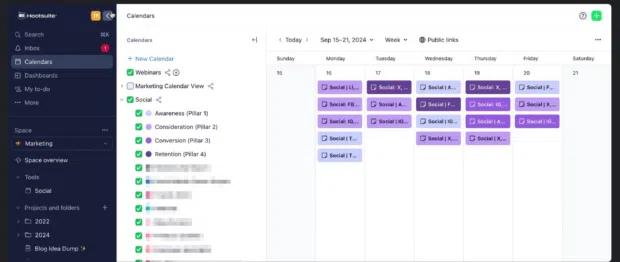
It’s also a good idea to look for gaps and opportunities. For example, we might notice we only have a few videos planned and choose to create more, or add something educational if we’re lacking in the consideration pillar.
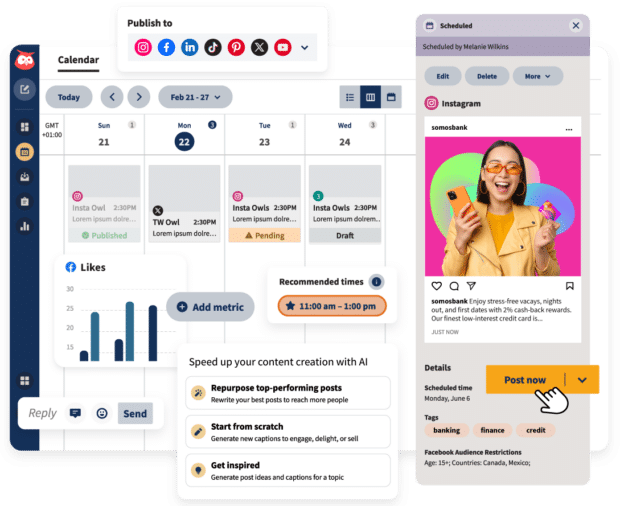
Once your content is finalized, scheduling it in a dedicated tool keeps everything running smoothly. We finish up any last details before we schedule each post in (obviously) Hootsuite!
Here’s are a few Hootsuite features we love:
- Smart scheduling: Automatically post at the best times for your audience to see your content.
- AI-powered creation: Save time with AI post creation and automations.
- Unified inbox: Reply to messages and comments in one inbox for all social media profiles.
- Performance tracking: See your social media ROI with easy-to-understand insights.
- Social listening: Monitor trends, keywords, and sentiment to understand how people are talking about your brand.
- Paid + organic management: Manage paid ad campaigns, plus employee advocacy programs, influencer management, approval workflows, and more.
Save over 130 hours per year with Hootsuite. Grab a free trial and try it for yourself.
6. Analyze performance
Start with the numbers that matter most: engagement rate, reach, click-through rate, and conversions. These tell you how people are interacting with your content across each platform.
From there, look for bigger patterns. Which post formats drive the most engagement? Which topics convert best? And which channels deliver the strongest reach?
For example, we recently experimented with videos on LinkedIn. We learned our LinkedIn audience loves educational videos, but most of our “TikTok-style” meme videos didn’t get much traction on the platform.
Without analytics reports, we may have guessed this info, but we wouldn’t have known for sure or been able to measure the difference trying new strategies made.
The easiest way to spot these trends is to label posts by campaign, content pillar, or format. My favorite feature in Hootsuite Analytics is the ability to tag each post with a custom label – helping us track performance by pillar and goal.
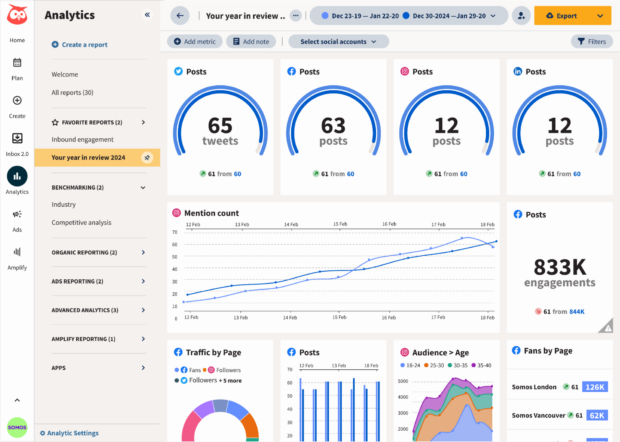
I keep track of our metrics in a spreadsheet so the entire team can easily see how new strategies are impacting results.
Want this spreadsheet? Download our free social media audit template.
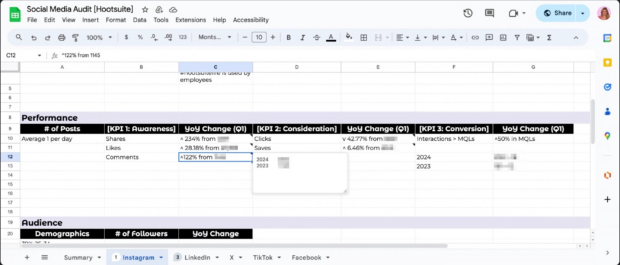
If you’re not seeing measurable results from social media planning yet, don’t worry. As my colleague Eileen Kwok points out:
Social media’s main purpose is as an awareness channel. Yes, we use it to bring in conversions but our larger goal is always making sure we’re spreading awareness of the company. We do that by being a community for social media managers first, and presenting our tool as a solution second.
– Eileen Kwok Social and Influencer Marketing Strategist at Hootsuite
Don’t be discouraged if your social media isn’t bringing in leads right away. That comes from potentially years of nurturing your audience.
7. Regularly update your content strategy
While this may sound like more of the “boring” stuff I mentioned earlier, regularly auditing your social media accounts is so crucial.
Here’s what to review during your audits:
- Top-performing content: Double down on what’s working by looking for posts that spark the most engagement, clicks, or conversions
- Underperforming content: Look for patterns in posts that didn’t land — timing, format, or message could all be factors.
- Platform-specific insights: Compare results across channels to see where your audience is most active and which networks drive the strongest results.
- Audience sentiment: Use social listening to monitor how people talk about your brand and what topics are gaining traction.
- Competitor benchmarks: Analyze how your performance stacks up in your industry.
I also recommend tracking key posts weekly or monthly rather than having to pull analytics for an entire year’s worth of content at once.
Last year, we completed a detailed, per-post review which was well worth the time spent. We learned what works and what doesn’t by sorting posts into low, mid, and high performing categories.
From there we were able to determine that for us animated infographics were a top performer, whereas animated product videos were not, among other insights.
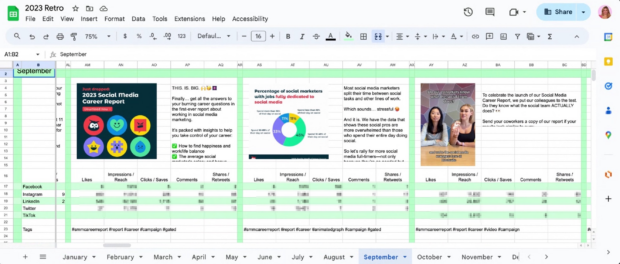
This deep dive helped us take a look at what we were doing last year and tweak our strategy for the year ahead.
It’s all a cycle: post content, see how it performs, test new ideas, analyze some more, tweak, and repeat.
Free social media content calendar template
Get your social calendar started today with our free template.
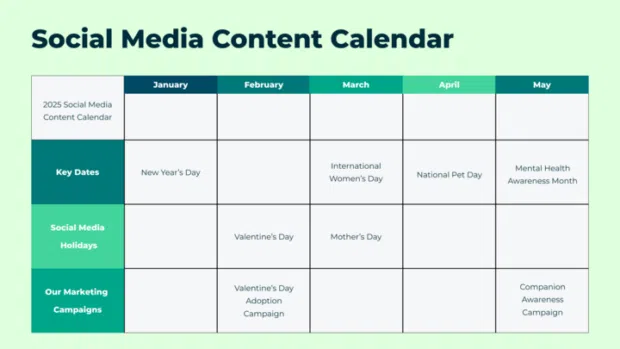
Bonus: Here’s how often you should post to each social network for best results:
- Instagram: Post 2 times per week.
- Instagram Stories: Post 2 times per day.
- Facebook: Post 2 times per week.
- X (Twitter): Post 2 times per week
- LinkedIn: Post 2 times per week.
- Threads: Post between 2 to 3 times per day.
- TikTok: Post 14 times per week.
- Pinterest: Post at least 1 time per week.
6 stats that will help you plan your social media calendar in 2025
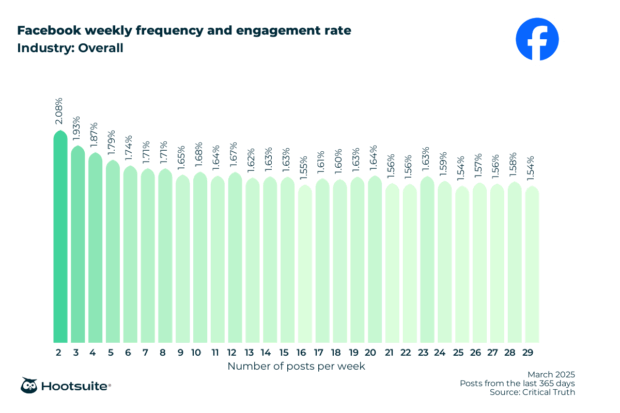
1. You should post at least twice per week
You don’t need to post every day. While engagement vs. frequency varies by industry, organizations who post twice weekly had the highest overall engagement rate (2.08%) on Facebook:
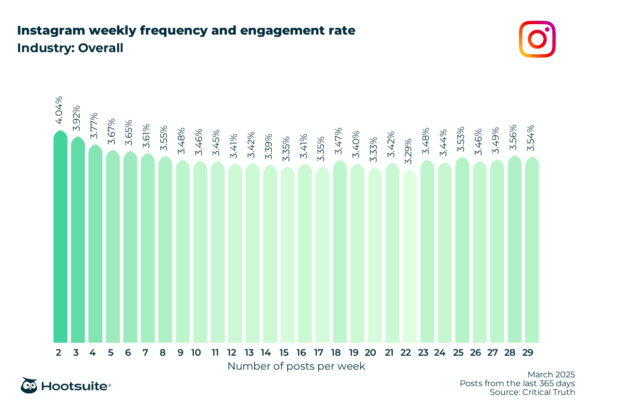
Our Instagram research had similar findings, with an engagement spike at two posts per week.
LinkedIn and X also showed the highest engagement with two posts per week.
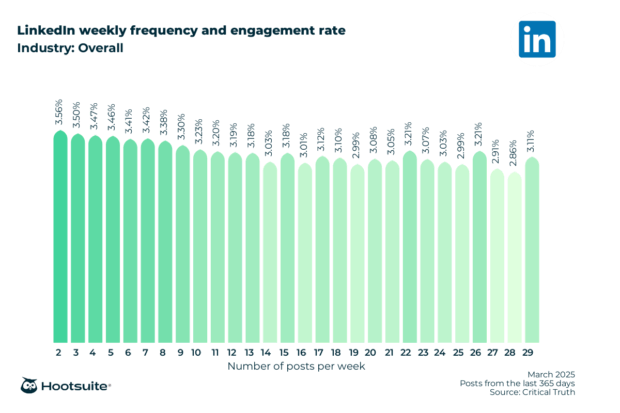
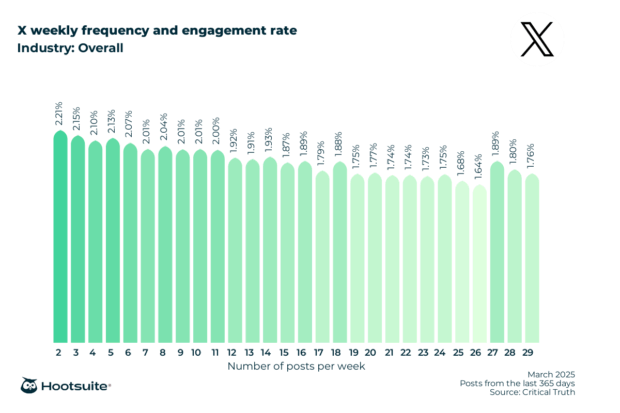
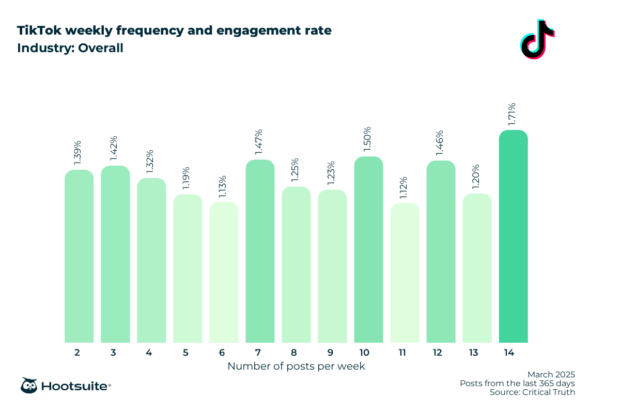
The outlier is TikTok where for the highest engagement rate, you should post 14 times per week.
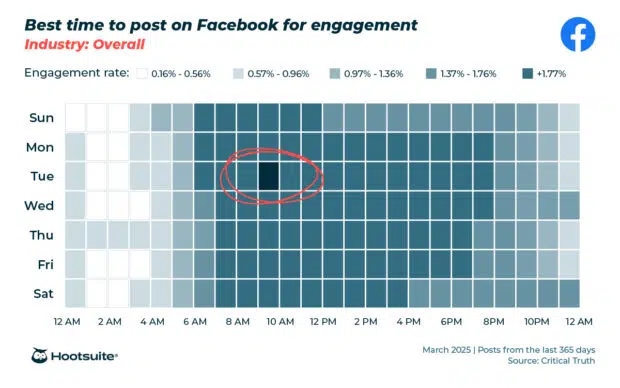
2. The best time to post on Facebook is 9 am
Our research shows that the optimal time to post on Facebook is 9 am Monday through Saturday.
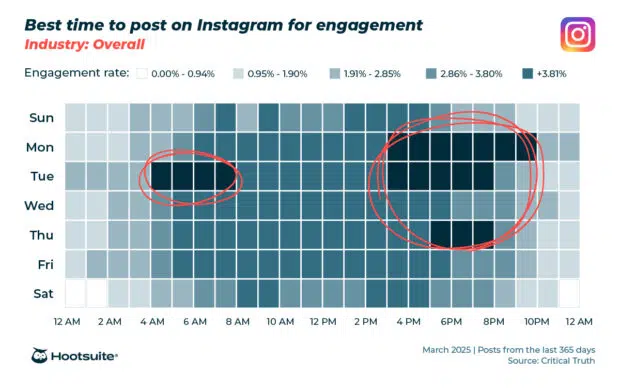
3. The best time to post on Instagram is 4 pm
For non-video posts, our research shows the best time to post on Instagram is 4 pm Tuesday through Saturday.
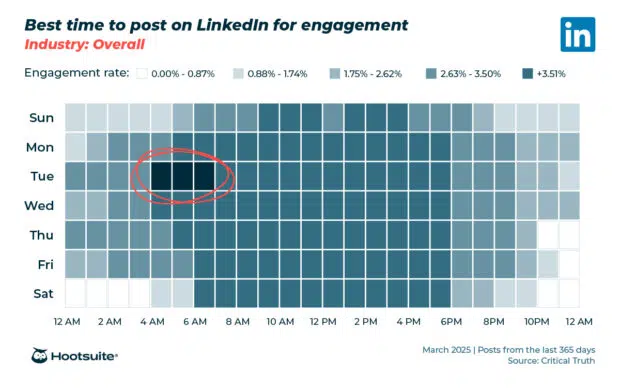
4. The best time to post on LinkedIn is 4-6 am
Our research shows the best time to post on LinkedIn is between 4-6 am on Tuesdays and 5-6 am on Fridays.
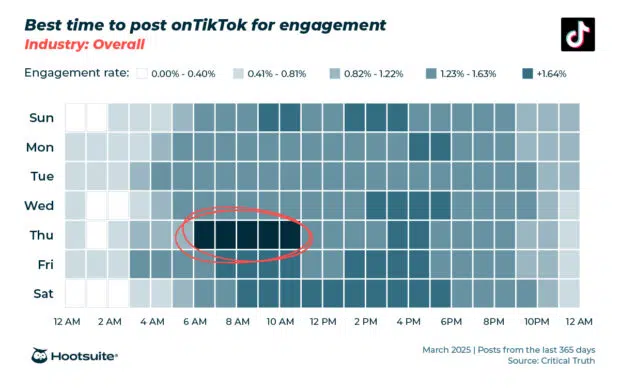
5. The best time to post on TikTok is 8 am
Our research has found the best time to post on TikTok is 8 am on Thursdays. Saturdays between 9 am-12 pm is the next best option.
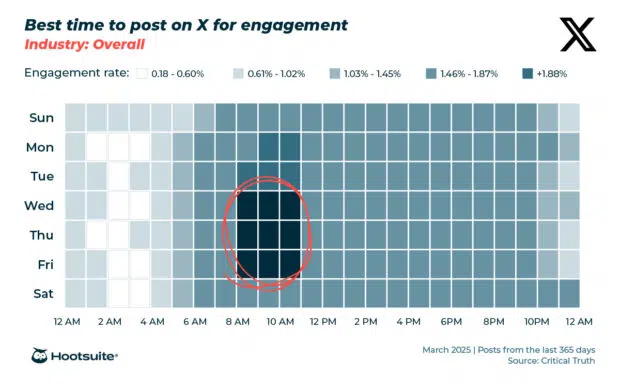
6. The best time to post on X (Twitter) is 9 am
Our research found X posts get the most engagement during business hours, with a peak between 9-11am on weekdays.
What are the best social media calendar tools for 2025?
The best social media calendar tools for 2025 help you plan, schedule, and analyze content across multiple platforms from one place. Copy our stack below, or check out other social media calendar tools we recommend.
Hootsuite
Yep, of course the Hootsuite team uses Hootsuite for social media management. I covered how we use it and what it can do for you above, but basically, you can do everything you need to do for social media marketing for all your platforms, including:
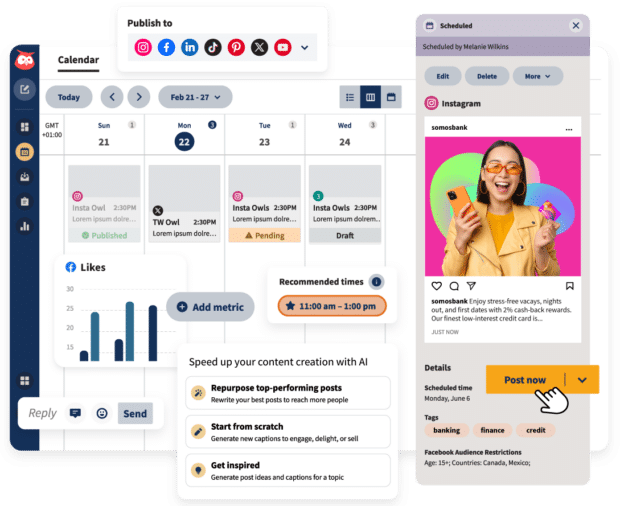
- Planning, creating, and scheduling social media content, with an easy calendar view that includes all your channels.
- Answering DMs and comments from one unified inbox for all your profiles.
- Detailed analytics that show your actual social ROI, including for paid and organic content together.
- The world’s best social listening tools built-in to all plans.
- AI automations to save time with post drafting, inspiration, and more.
- 100+ integrations with all your other favorite tools.
Google Sheets
We use Google Sheets to audit and track our performance.
Bonus: Many of our free social media templates are set up for you in Google Sheets!
Wrike
We plan our social media content calendar in Wrike before scheduling posts in Hootsuite. Using a dedicated project management tool for this is helpful if you already use one to manage other work in your organization.
Miro
I love Miro’s open canvases for brainstorming and being able to connect with my team from anywhere.
CapCut
In my opinion, CapCut is one of the best video editing apps. We use it for TikTok editing and all our other social video content.
Once you’re ready to implement your social calendar, use Hootsuite for social media scheduling, audience engagement, best-in-class social listening, and meaningful analytics. Get your free trial today.
FAQ: Social media calendars
How do you measure the success of a social media calendar?
You’ll know it’s working when your team is publishing consistently, hitting deadlines, and spending less time scrambling for last-minute posts
But the real measure of success comes from impact: Are your posts driving engagement, clicks, and conversions that tie back to your goals?
If your calendar helps you post with purpose, it’s doing its job.
What’s the leading social media content planner?
For large teams and growing brands, Hootsuite is hard to beat. Here’s why:
- Everything in one place: Plan, schedule, publish, and analyze posts across every major social platform, all from a single dashboard.
- Built for teamwork: Shared calendars, approval workflows, and custom permissions keep teams aligned (and ensures nothing slips through the cracks).
- Ready to scale: Global brands use Hootsuite to manage regional teams, campaigns, and complex publishing pipelines.
Click here to learn more about Hootsuite’s smart social media calendar and publisher.
How do you balance evergreen and real-time content in your social media calendar?
The trick is to plan ahead without locking yourself in. Build your calendar around consistent, evergreen content, but leave enough open space to jump on trends and join conversations as they happen.
With Hootsuite, it’s easy to drag, drop, and adjust your schedule in seconds, so you can stay strategic and spontaneous at the same time.
How do large brands align content calendars across multiple teams and regions?
For large brands, a centralized social media calendar gives every team a shared view of what’s planned, published, and performing.
Many global teams also build layered calendars: one for company-wide campaigns and another for regional content. That way, you stay consistent at the brand level while giving regional teams the flexibility to localize content for their audiences.
With Hootsuite, it’s easy to keep everyone in sync — shared views, approval workflows, and permissions mean every team stays coordinated (and no one accidentally double-posts).
What should a social media calendar include?
At a minimum, your calendar should capture the date, time, platform, and format of every post, so you always know what’s going live next. Tag each post with its content pillar to keep your mix balanced.
You’ll also want space for your copy, visuals, hashtags, and links. Keeping all your creative assets in one place saves time (and headaches) later.
Finally, note who owns each step — from writing to design to approval. That visibility keeps your team in sync and your workflow moving smoothly.
Save time managing your social media presence with Hootsuite. From a single dashboard you can publish and schedule posts, find relevant conversions, engage your audience, measure results, and more. Try it free today.
The post Social media calendar: Top tools and templates for 2025 appeared first on Social Media Marketing & Management Dashboard.
* This article was originally published here
Thursday, November 27, 2025
Wednesday, November 26, 2025
Tuesday, November 25, 2025
Instagram Stories: Tips, tricks, and new features for 2025
Are you a Feed-commitment-phobe? Do you love GIFs, stickers, and a little creative chaos? Then Instagram Stories are most definitely for you.
Instagram Stories have all kinds of built-in tools and functionalities. But they can be tricky to find and even trickier to use.
In this guide, we’ll walk through everything you need to know about how to use Instagram Stories, from basic navigation and features to creative tips for business users.
Let’s dive into the most valuable real estate on Instagram: the top of the app.
Key Takeaways
- Stories are where real attention lives. With 500M people watching daily, IG Stories remain one of the highest-visibility placements on the platform.
- They’re faster, easier, and way more interactive than the feed. Stickers, polls, GIFs, countdowns, links, and shopping tools turn quick updates into high-engagement moments.
- You don’t need to be a designer to make great Stories. Instagram’s built-in formats, effects, and editing features (plus tools like Canva inside Hootsuite) make polished, on-brand Stories effortless.
- The best Stories are planned, not rushed. Scheduling your Stories ensures consistency, helps you align with campaigns, and saves you from posting in real-time (i.e., the 7 a.m. “oops” story scramble).
What are Instagram Stories?
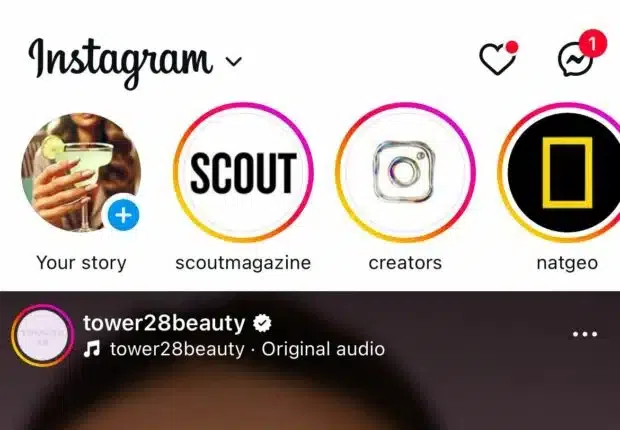
Instagram Stories are vertical photos and videos that disappear after 24 hours. They appear at the top of the Instagram app interface rather than in the news feed.
Why should I post on Instagram Stories?
The biggest reason to use IG Stories? Reach. Every day, approximately 500 million people watch Stories. That’s roughly ⅓ of Instagram’s total audience and a lot of potential eyeballs on your content.
Stories are especially valuable if your audience skews younger: Instagram is the most-used social media platform for Gen Z, and ranks among the top three for U.S. adults.
Beyond reach, stories can include interactive elements to make your content pop and turn casual viewers into engaged followers.
#1 for Instagram marketing
Schedule posts, Reels, and Stories. Answer comments and DMs, and build beautiful reports. It’s so easy.
Start free 30-day trialHow to post an Instagram Story
Step 1: Open the Story camera
- Tap the “+” icon in the top-left corner of your feed, or…
- Swipe right from anywhere in your feed.
Step 2: Capture or upload content
- Tap the white circle at the bottom of the screen to take a picture, or…
- Press and hold the white circle to record a video, or…
- Swipe up to use pre-existing photos or videos.
Step 3: Choose a format (optional)
If you want to share a standard photo or video, you can skip this step. But if you want to experiment with different formats, you’ll find a menu of options on the left side of the screen, including:
- Boomerang: Create a short, looping video that plays forward and backward.
- Layout: Combine multiple photos into a single collage-style Story.
- AI images: Enter a short text prompt, and Instagram will generate several images that you can share directly to your Story.
- Hands-free: Record a video without holding down the capture button.

Step 4: Edit your Story
- Add stickers, music, links, or text.
- Apply filters.
- Use the pen tool to doodle, highlight, or add personal touches.

Step 5: Share it
- Tap “Your Story” to post it, or choose “Close Friends” to share it with a select group of friends.
Before you start flexing your new Story skills, find out how many IG stories per day are ideal.
How to check your Instagram Story views
If your Instagram Story is still live (within 24 hours of posting), just tap your Story at the top of your feed and swipe up to see who’s viewed it, along with any likes it got.
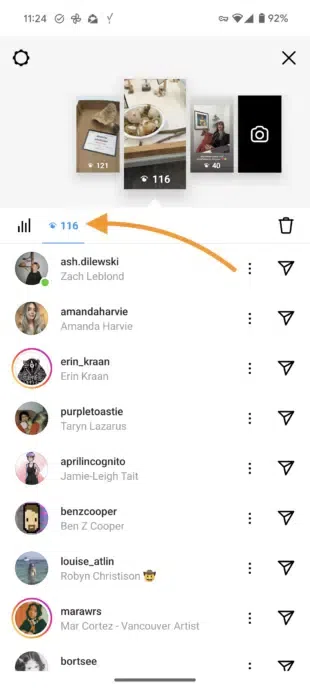
Pro tip : You can also access your Story stats in this view. Just hit the graph icon beside the eye icon.
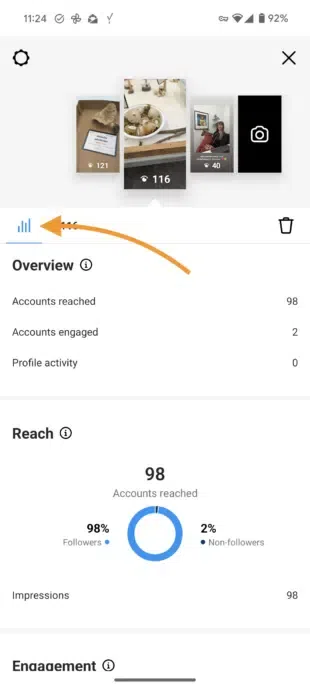
After 24 hours, Stories disappear from your profile. The good news? You can still access insights, including reach (unique viewers), impressions (total views, including repeats), link clicks, and more.
How to access Story insights:
Ready to geek out on your Story performance? Here’s where to find your insights in the app (psst: you’ll need a Professional or Creator account for this part).
- Tap your profile photo at the bottom right of the screen.
- Click the menu icon (three horizontal lines) in the top right, then select Insights.
- In the top right corner, tap Last 7 Days to adjust your reporting window. Choose from 7, 14, 30, or 90 days, or set a custom range.
- Scroll to Content You Shared and tap on Stories.
- Tap the Sort & filter icon to choose your metric and sorting options.
- Click on any of your Stories for more details.
Not sure which metrics to track? Fear not: this guide shows you how to zero in on the numbers that actually matter.
How to schedule Instagram Stories
You can schedule Instagram Stories using a social media management tool (like Hootsuite ). That way, you can plan your content in advance, set it to publish automatically, and move on to the rest of your (always overflowing) to-do list.
It also gives you the chance to line up Stories that complement your other social posts and support your bigger campaigns.
To schedule an Instagram Story using Hootsuite:
1. Head to your Hootsuite dashboard and select Create → Post from the left-hand menu.
2. In the Composer window, select the account you want to post your Story to.
3. In the Content section, switch to the Story editor using the dropdown menu on the right side.
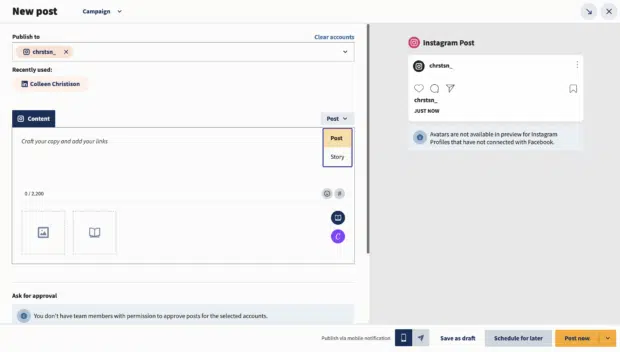
4. Click the upload icon to add your image or video. Or, click on the library icon to choose assets from your media library.
Videos must be between 1 second and 60 minutes long, and images must be less than 30MB. Both have a recommended aspect ratio of 9:16.
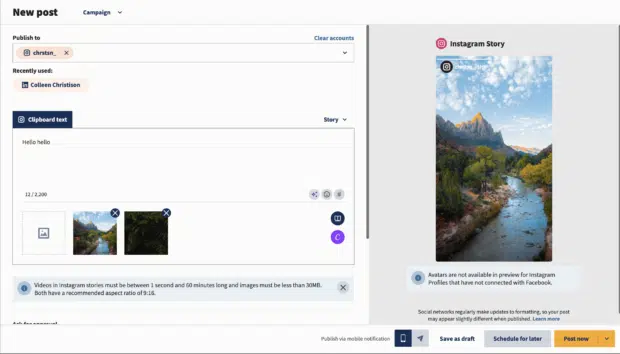
Note: If you want to add text or stickers to your Story, make sure they’re part of your image or video file. Text included in the caption field of Composer will not be included in your Story.
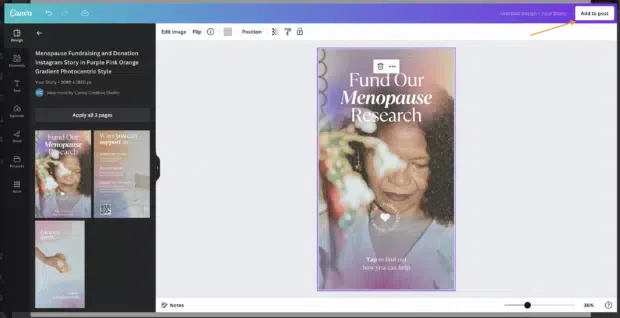
You can easily edit your images using Canva without leaving your Hootsuite dashboard. Click the Canva icon in the bottom right, select Instagram Story, and design away.
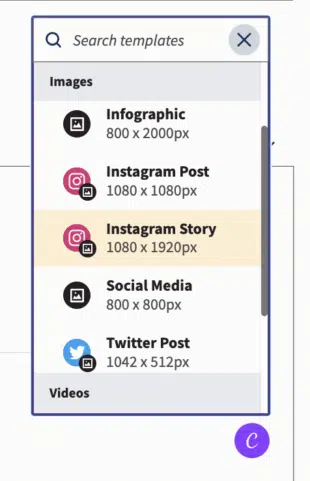
Once you’re happy with your Story, click Add to post in the top right corner to attach it to your draft.
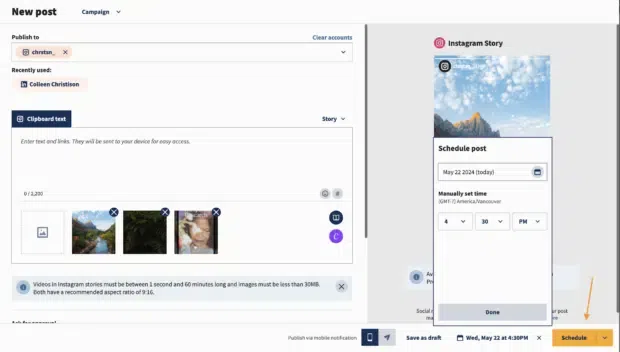
5. Preview your Story and click Schedule for later to select a time for it to go public. Then, click the yellow Schedule button, and you’re done!
Now, onto the juicy stuff: Here’s how to make an Instagram Story really pop using features.
26 cool Instagram Story features you should be using
If you want to sit with the cool kids at Instagram’s lunch table, then you need to be using cool Instagram Story features.
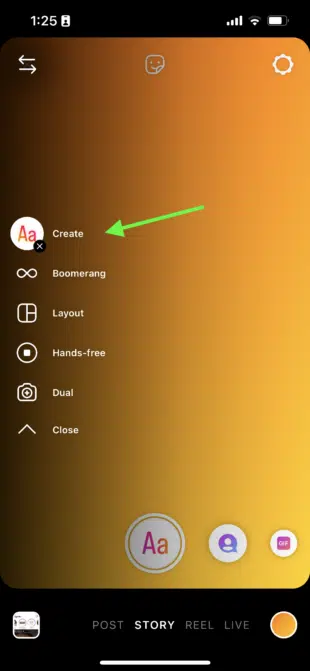
1. Create mode
With Create Mode, you can create an Instagram Story without any photos or videos. Add text, stickers, or GIFs on a plain background – perfect for quick updates or announcements.
2. Stickers
We could write an entire blog on Instagram Story stickers alone. There are so many different things you can do with them!
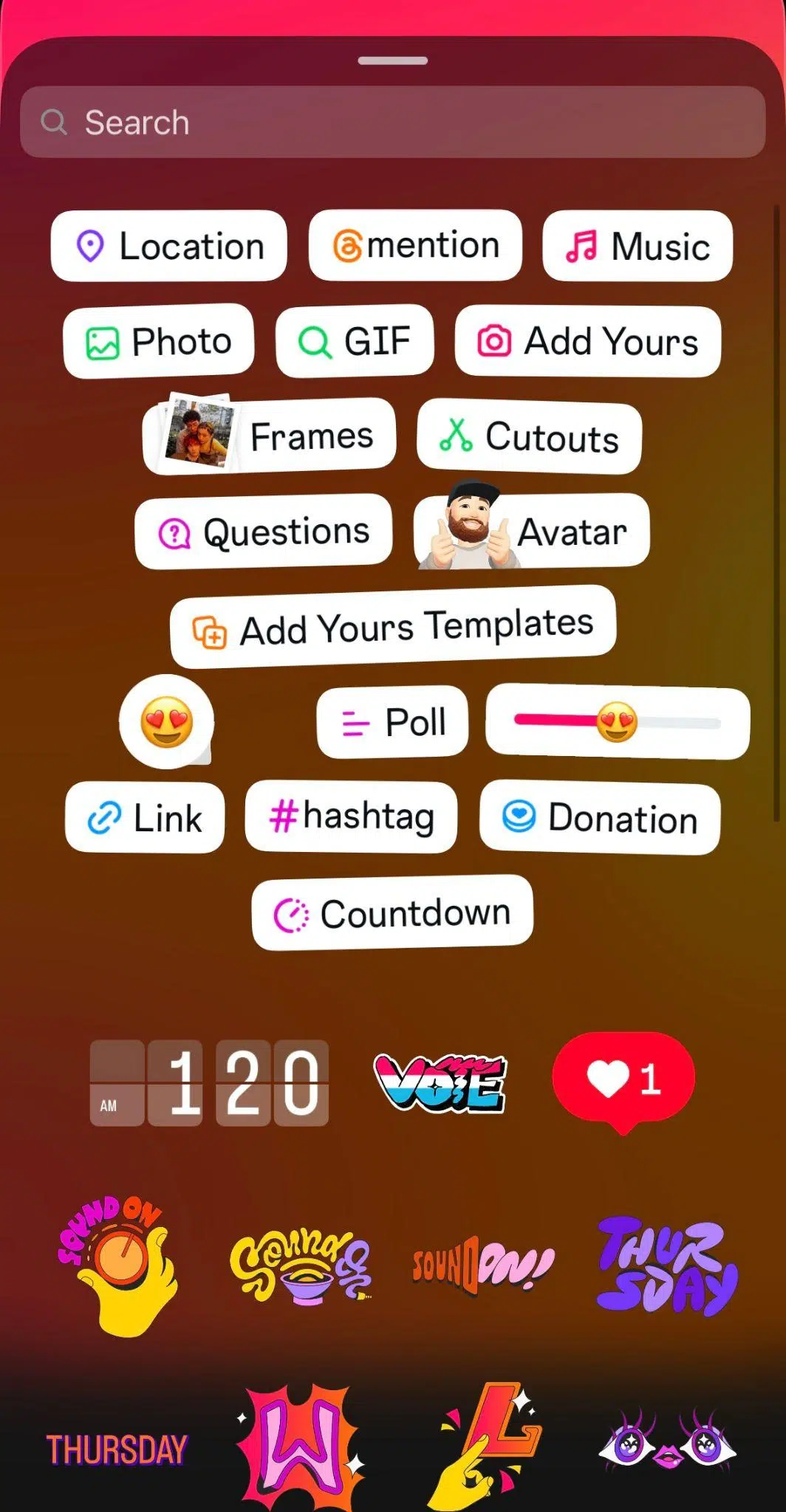
We’ll highlight a few notable ones below, but we wanted to point out that there are tons of options when it comes to stickers.
3. Countdown
Launching a product? Hosting an event? The countdown sticker lets you build hype by setting a timer that your audience can see.
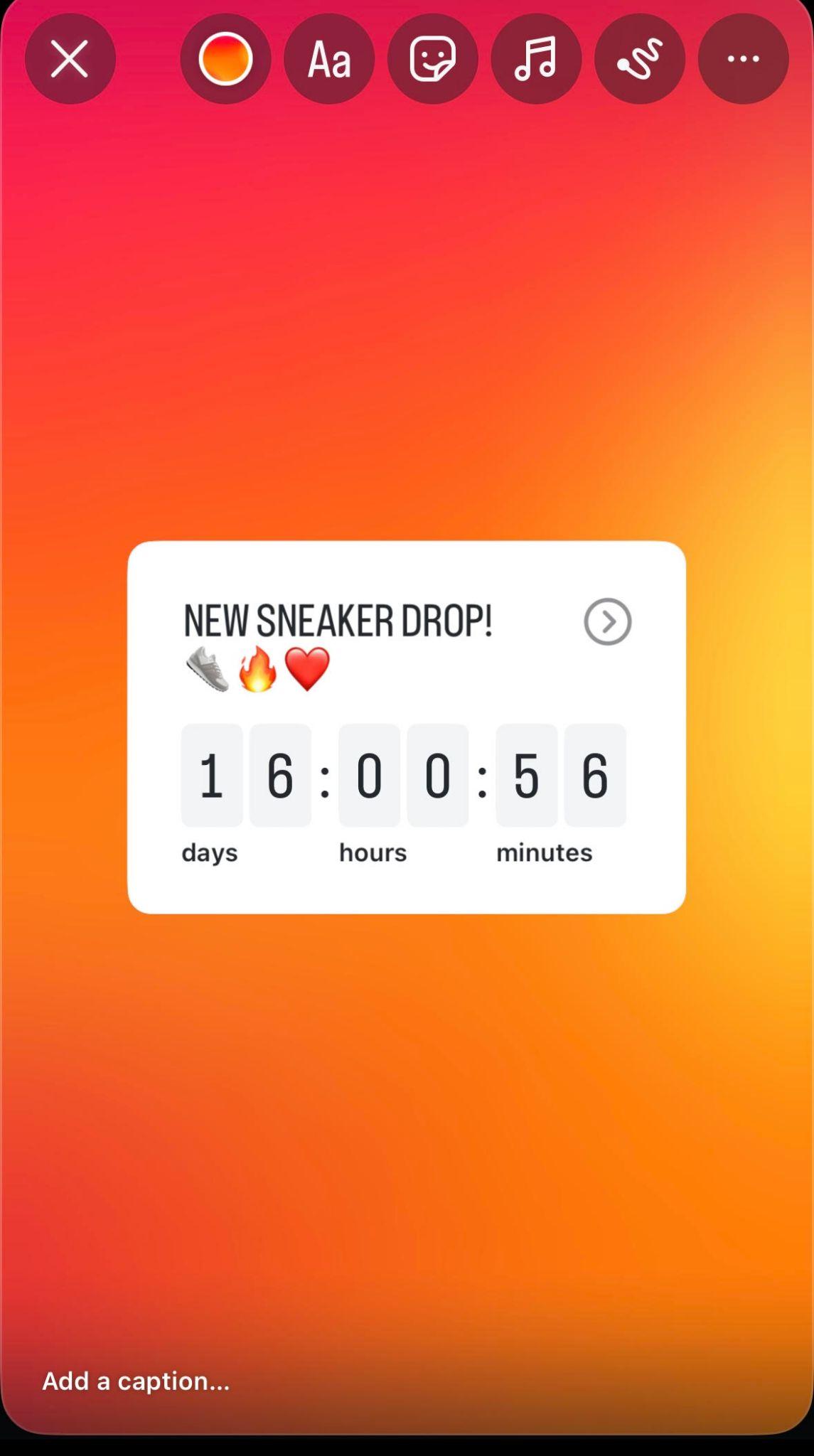
It doesn’t stop there: your followers can tap to get reminders when the countdown ends, making it one of the most powerful stickers for campaigns with a “big moment.”
4. Notify
The Notify sticker is an awesome tool for content creators and marketers.
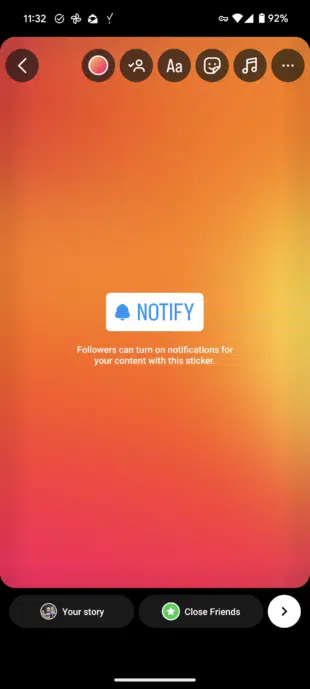
Viewers can click on it to sign up to be notified of your content. This way, eager followers will be among the first to know when you post something new.
5. Pen tool
Want a quick way to make your Story stand out? Use the pen tool to turn any background into a solid color.
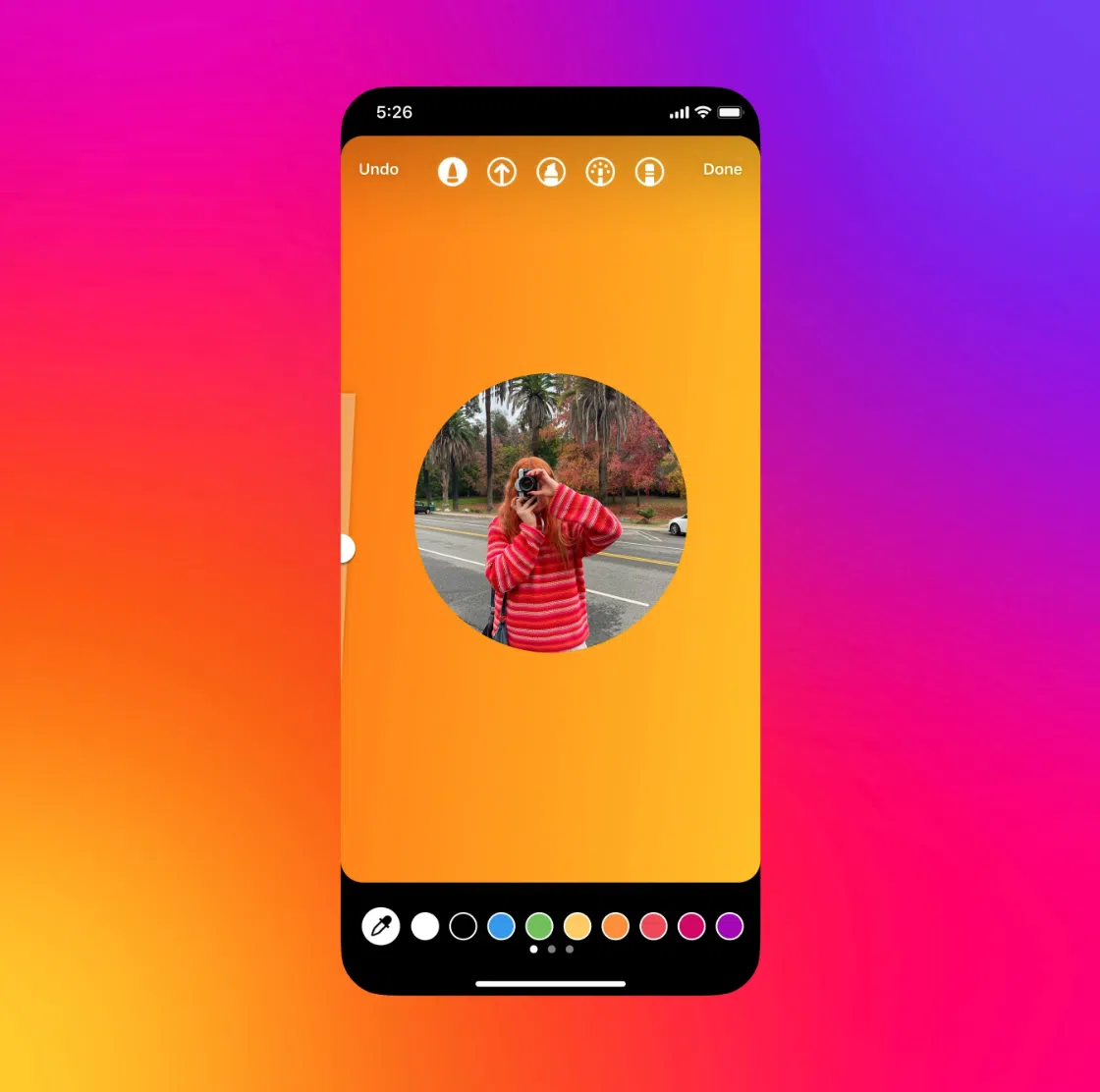
Source: Instagram
Just snap a photo, tap the pen icon, pick a color, and press-and-hold on the screen to fill. It’s perfect for creating a clean slate for text, stickers, or doodles.
6. Get orders
Turn your Stories into a mini storefront with the Get Orders sticker.
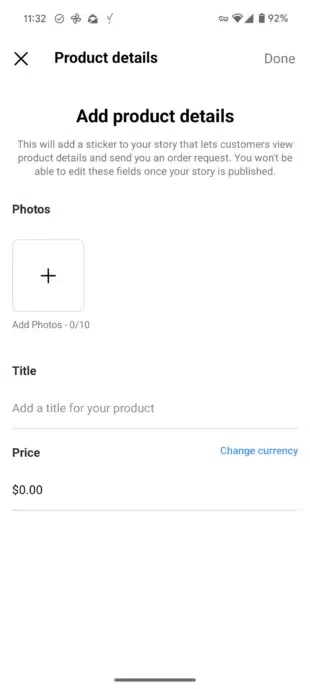
Add a link and give followers a seamless way to check out product details, ask questions, or place an order — all without ever leaving Instagram. It’s a fast track from Story view to sale.
7. Food orders
If you’re a restaurant, a catering company, a grocery store, a bakery, or any business that sells food, you’ll want to know about this one.

Add this sticker so hungry followers can place orders instantly (and you can skip answering endless DMs).
8. AI Label
Instagram Stories are encouraging people to label realistic content that’s made with AI with an AI Label.
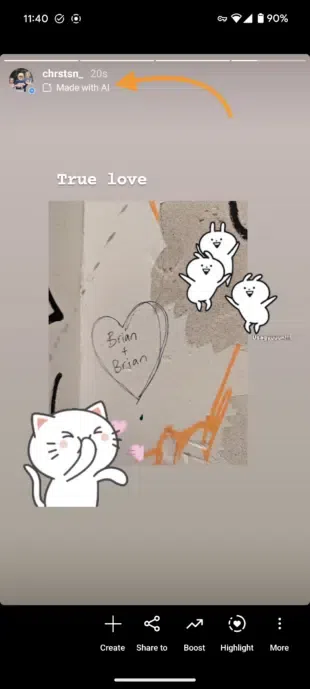
This can help combat the spread of misinformation and lets your viewers know if what they’re looking at is real or not.
9. Stories captions sticker
Making your content more accessible? That’s always a win in our books. The captions sticker auto-transcribes your Story so viewers can read along in real time.
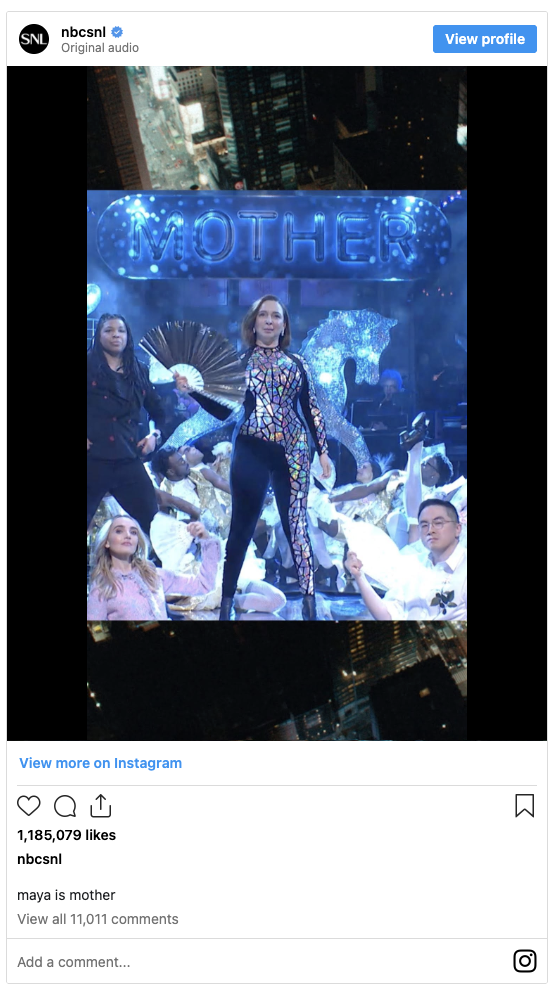
Captions are available for Reels AND Stories, and they can make a huge difference for Deaf and hard-of-hearing folks, plus anyone scrolling with their sound off.
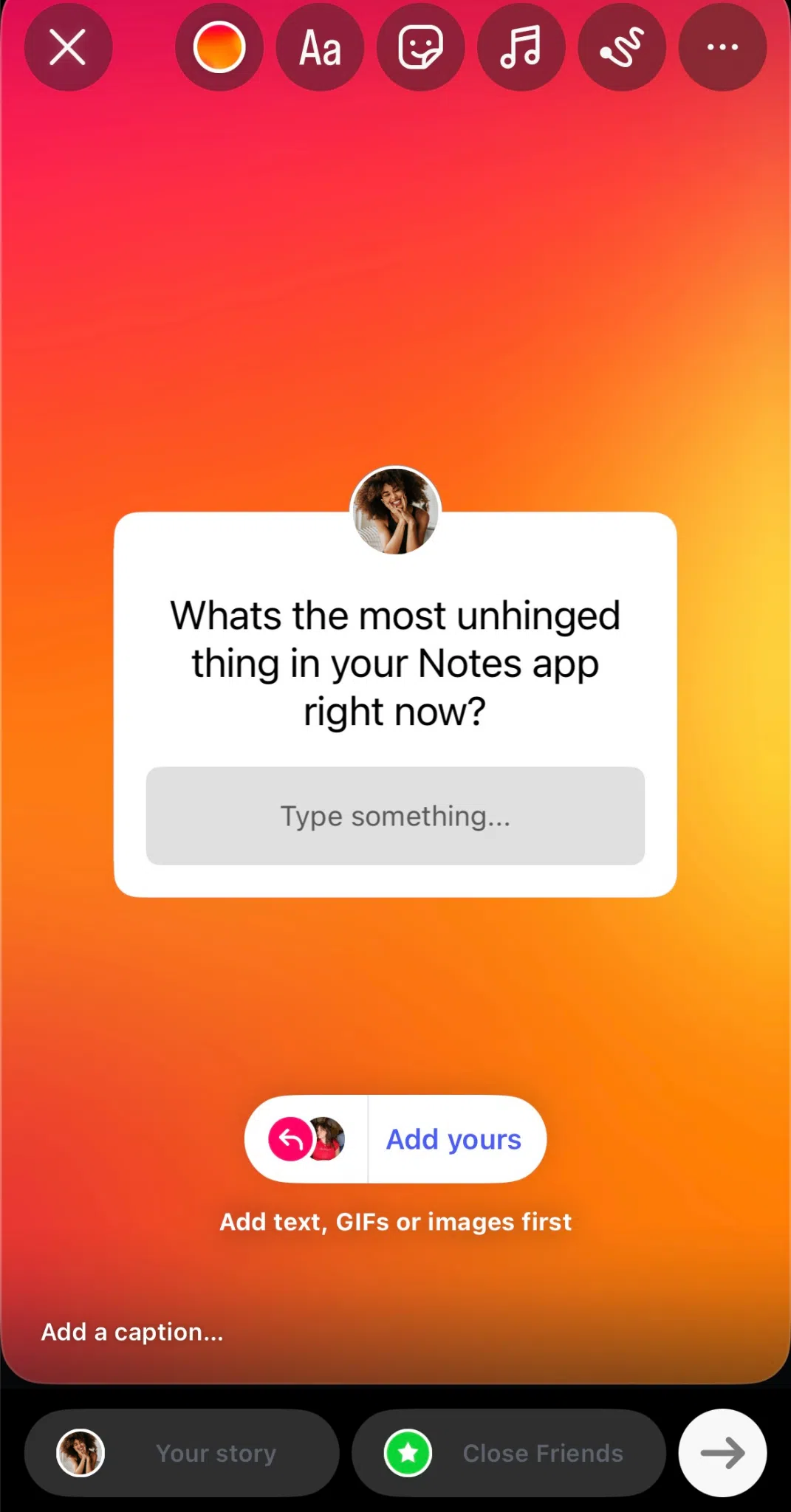
10. Polls, quizzes, and questions
This trio of stickers should be your go-to engagement boosters. Polls and quizzes invite quick responses, while the question sticker is perfect for starting conversations.
11. Gifs
Sometimes a GIF is the only way to communicate a vibe. Whether it’s the perfect eye-roll, a dramatic mic drop, or pure chaos energy, GIFs add personality to your Stories in a way plain text can’t.

12. Saved audio
If you find the perfect song or audio clip, don’t risk losing it!
Just tap on the song title at the top of the Story, then tap the bookmark icon to save the audio clip for next time.

That way, when you want to make your next Story, you can find the audio again in a snap.
13. Filters
Remember when everyone’s Stories were full of selfies with the dog-with-its-tongue-out filter overtop? Those were the days.

Now, you can superimpose your mouth over a Renaissance painting, turn yourself into Bluey, or give yourself several sets of eyes (unsettling).
14. Layout
Want to share multiple photos at once? The Layout feature allows you to post a collage of three, four, or six images, depending on your grid of choice.

15. Highlights
Stories don’t have to disappear after 24 hours. Highlighting keeps them pinned to your profile until you choose to delete them. This is a great way to showcase your best, brand-defining content.
Each highlight can contain as many Stories as you like, and you can keep adding to them as you post new content.
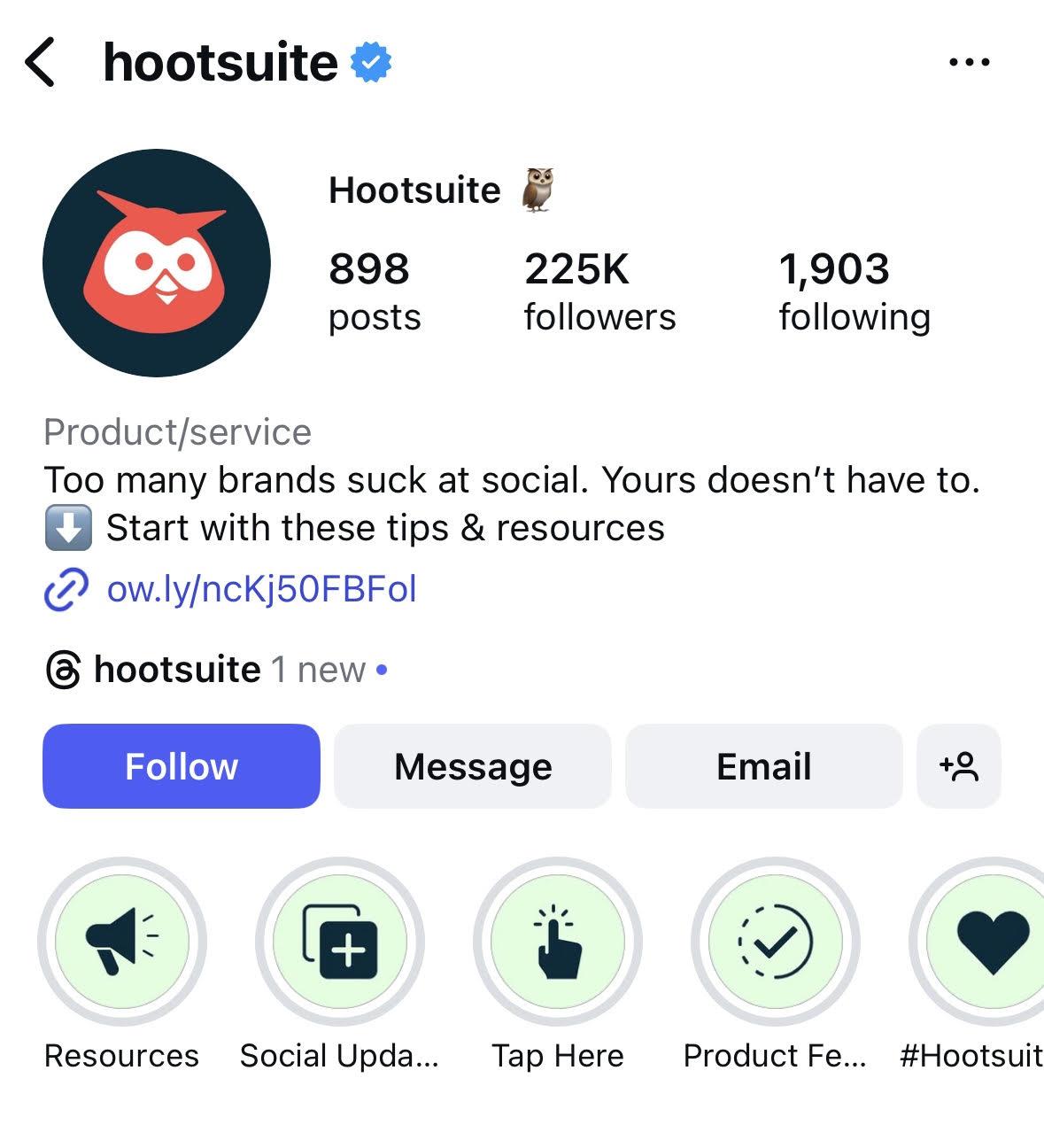
Bonus tip: Use cover photos for your Instagram Story highlights to keep your profile looking  aesthetic .
16. Story analytics
Okay, it’s not the flashiest feature, but it’s easily one of the most popular. (And psst: We actually have a whole article about Instagram Story analytics!)
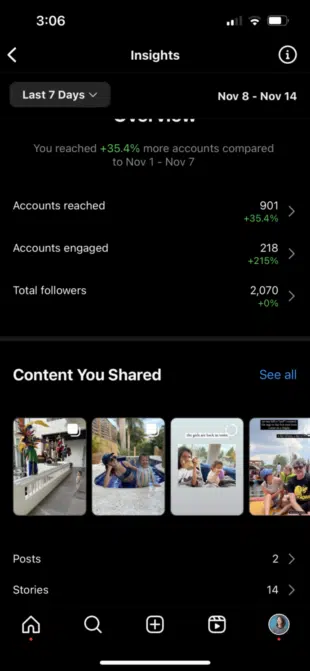
Story analytics show you who’s watching, how they’re engaging, and whether your content is hitting the mark. By analyzing metrics like views, replies, and swipe-ups, you can take a data-driven approach to your Story strategy.
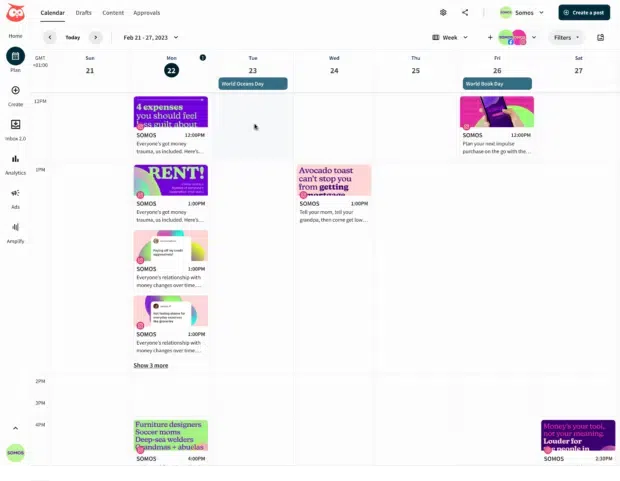
17. Scheduling Stories
You know what’s the worst? Waking up on your day off to publish a Story. You know what’s the best? Lying in bed (or doing literally anything else) and knowing your Stories are being published without you having to lift a finger.
Use tools like Hootsuite Composer to schedule your Stories in advance, and then sit back, relax, and enjoy your newfound freedom.
18. Control who can reply to your Story
Getting relentless messages from bots, trolls who bring you down, or spammy partnership offers? Then you may want to control who can reply to your Story.
You’ll find the controls for who can reply to your Story in More options, found on your profile screen. Then, look under How others can interact with you…
Then Story replies.
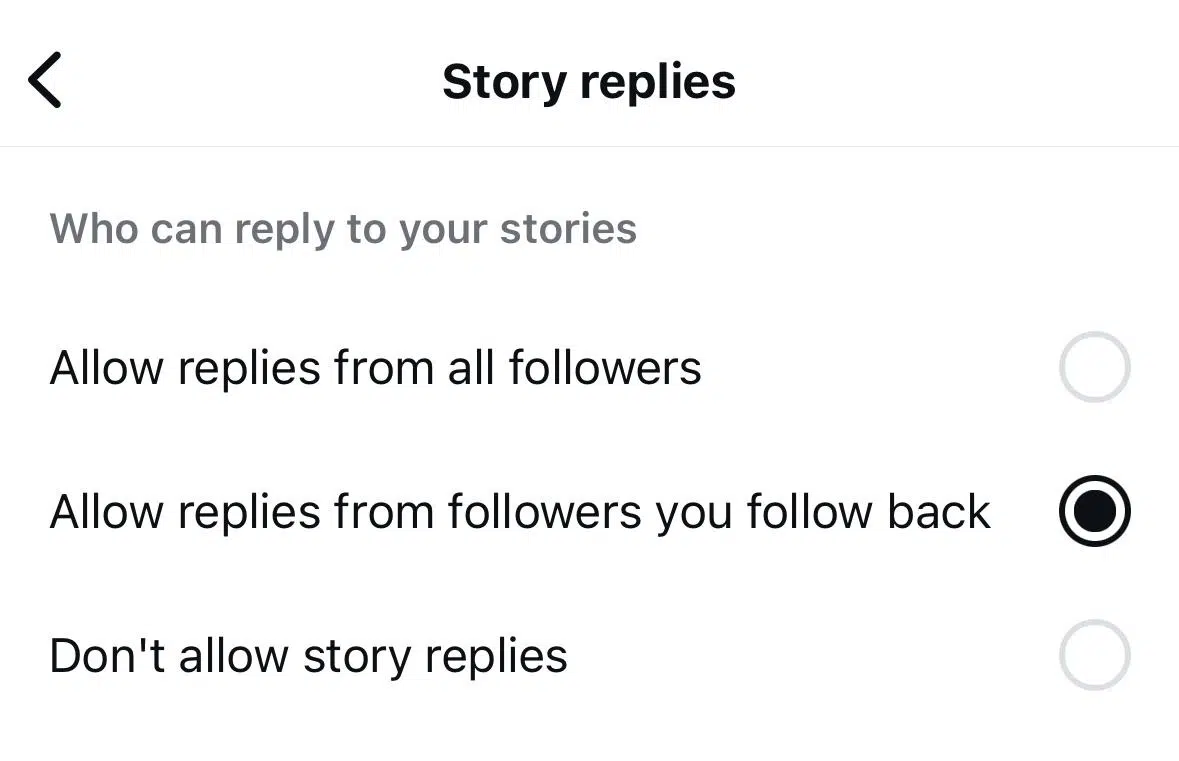
If you don’t want to allow replies from all followers, you can choose to turn off Story replies entirely or just limit them to followers you follow back.
19. Hide your Story
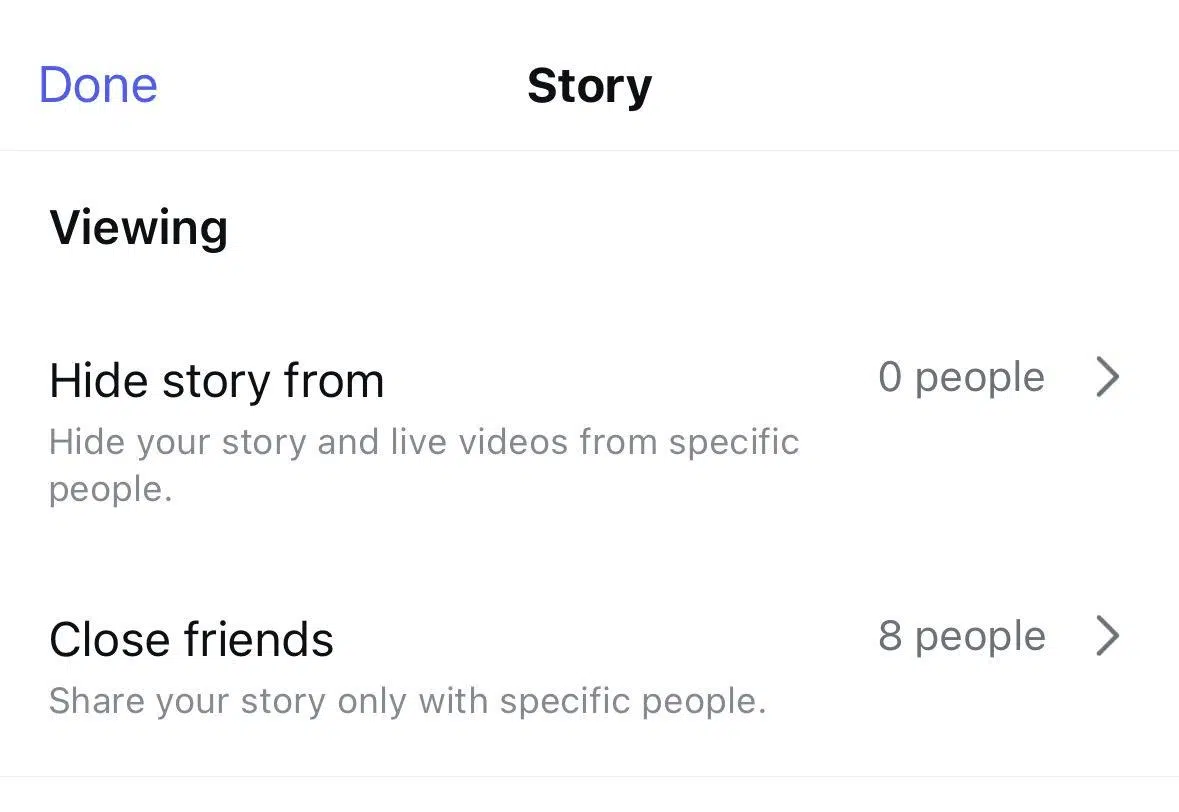
Posting a pic you don’t need your competitors to see? No problem. You can control who gets to see your Story.
You’ll find this option under the More menu > Settings and activity, and then click Hide story and live. Here, you can choose the accounts to hide your Story from.
20. Save your Story to your camera roll
If you’ve taken a particularly fire selfie or just need to keep your content handy, you can save your Instagram Story content to your camera roll.
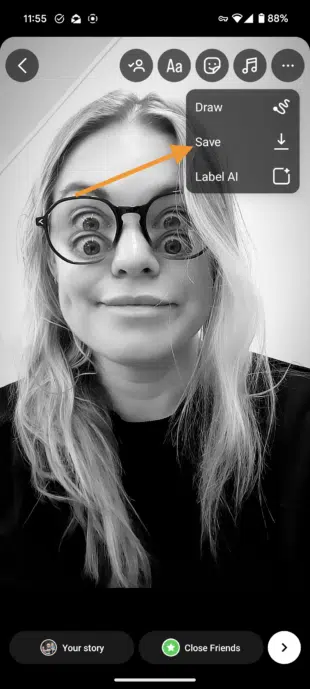
Before you hit share on your Story, tap the pointing down arrow icon at the top of your screen to save it to your phone.
21. Mention someone after you post a Story
Ever post a Story only to realize you forgot to tag someone? Having to go back, delete, and repost it makes you look a little, erm, unprofessional. Thankfully that’s all a part of the past now.
Now, you just have to hit the three dots above More…
and then Add Mention to tag someone in your Story retroactively.

22. Add Yours
Add Yours is a great way to start or join in on a trend. This sticker lets you post a prompt you want others to respond to, like “Add your last picture of your pet.”
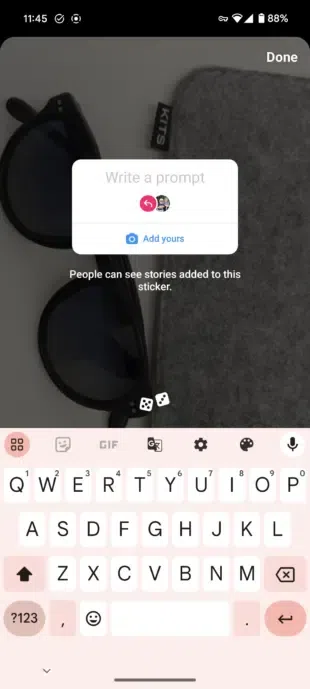
Then, other users can jump on the bandwagon and add photos of their pets or any other topic you choose.
23. Add Yours Music
The Add Yours Music sticker is just like the Add Yours sticker, but with music.

It’s perfect for creating collaborative playlists, sharing nostalgia, and sparking music-based convos.
24. Frames
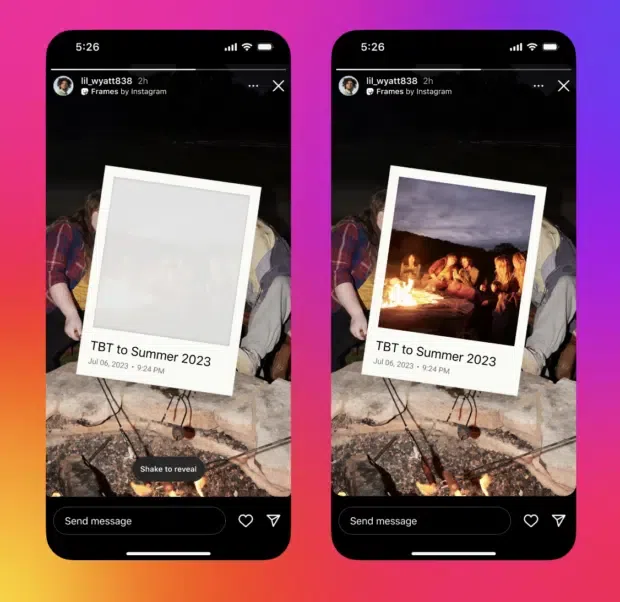
Turn your Story into a digital polaroid with the Frames sticker!
Source: Instagram
It shows up as an empty frame (with a date and timestamp), which your followers can reveal by shaking their phones. So fun!
25. Reveal
The Reveal sticker is a little like a treasure hunt. You can post hidden content that users have to DM you to uncover.

Source: Instagram
Once you select the Reveal sticker, type in a hint about the secret content. Followers will then send a DM and be shown the hidden content. You don’t need to approve the reveal. Talk about an engagement booster!
26. Cutouts
The Cutouts sticker lets you create your own sticker from your photos or videos. Once you choose the Cutout sticker, it will prompt you to choose a photo or video from your gallery.

Source: Instagram
The object for the cutout will either be automatically selected, or you can manually select it. Instagram will save your cutouts for you to reuse in the future!
Think you’ve tried every Story trick in the book? Think again: here are dozens of Story ideas guaranteed to drive engagement in 2025.
That’s not all we can do for you, either. Try these top-secret Instagram Story hacks and these time-saving Instagram Story templates.
Instagram Stories FAQ
Can you see who viewed your Instagram Story?
Yes! If your Story is still live (within 24 hours), just tap your Story and swipe up to see the full list of viewers. After 24 hours, you’ll only see insights like views and engagement, not individual names.
How long do Instagram Stories last?
Stories vanish after 24 hours unless you save them to Highlights, where they can live on your profile as long as you like.
Can you schedule Instagram Stories?
Yes! With tools like Hootsuite, you can plan, design, and schedule Instagram Stories in advance.
Who can see my Instagram Story?
If your account is public, all of your followers can see your Stories by default. You can also hide Stories from specific accounts manually.
How can I save my Instagram Story to my camera roll?
Before posting, just tap the downward arrow icon at the top of the screen to download your Story to your phone. You can also turn on automatic saving in your settings so every Story gets backed up to your camera roll or archive.
Save time managing Instagram with Hootsuite. From a single dashboard, you can create, schedule, and publish Stories, engage with your audience, measure performance, and manage all your social channels. Try it free today.
The post Instagram Stories: Tips, tricks, and new features for 2025 appeared first on Social Media Marketing & Management Dashboard.
* This article was originally published here
Subscribe to:
Comments (Atom)
-
You could spend your days trying to outsmart Instagram’s ever-changing algorithm. Or, you can take the direct route with Instagram ads. ...
-
Social Media Advertising Market Worth $262.62 Billion by 2028 - Million Insights 69News WFMZ-TV * This article was originally published ...
-
Wondering if you should invest your time and energy in creating content for Facebook Stories ? Facebook Stories are short user-generated vid...

