This-Party Ad Measurement Partners Announce New Snap Attention Measurement Social Media Today
* This article was originally published here
Monday, June 30, 2025

Sunday, June 29, 2025
Brand monitoring: The 2025 guide for real business impact
You’ve worked hard to build a focused message that tells the story of your brand. But your brand is not the only force driving that story. Every conversation about your brand shapes how people see you — whether you’re a participant in the conversation or not.
Brand monitoring ensures you know where those conversations are happening and what’s being said. It’s more than a simple tally of mentions or engagements. Brand monitoring is a process that includes discovering, analyzing, and acting on rich data from across the web and beyond.
Key takeaways
- Brand monitoring is more than just counting mentions. It’s the ongoing process of discovering, analyzing, and acting on what people are saying about your brand across all types of media, not just social.
- Brand monitoring pulls from a wide range of sources to give you a full picture of brand sentiment, competitive positioning, and consumer trends. This may include podcasts, forums, blogs, and news sites.
- A strong brand monitoring strategy helps you spot PR crises early, track product feedback, benchmark against competitors, and surface UGC and influencer opportunities.
What is brand monitoring?
Brand monitoring is the process of finding, following, analyzing, and acting on mentions and discussions of your brand. That goes for all forms of media, from social platforms to podcasts to traditional media outlets.
In other words, brand monitoring is a holistic look at what is being said out there in the world about you. Smart brands follow that data-gathering up with analysis and action. Rather than just cataloguing the conversation, use the information to guide your strategy in both the short and long term.
How is brand monitoring different from social listening?
Social listening is part of brand monitoring—but it only focuses on social media coverage.
Social listening provides a chance to track valuable social metrics, measure brand awareness, and understand the overall online mood.
This info is super helpful to track ROI or test social marketing strategies, but you can also use this key data to pinpoint trends and insights. From there you can develop an action plan and social strategy.
Brand monitoring incorporates all of this work but also includes many more data sources. You’ll get the bigger picture of what people are saying about your brand beyond social media channels. This can expand the demographic breadth of your dataset, too.
Why marketers need brand monitoring
Understand your brand sentiment
You don’t just want to know how much people are talking about you: you want to know how they’re talking about you. Beyond measuring mention volume, you want to understand the feelings and intent behind the conversations.
You also want to know what kinds of topics are creating positive or negative sentiment about your brand, so you can figure out a strategy to amplify positive topics and mitigate negative ones.
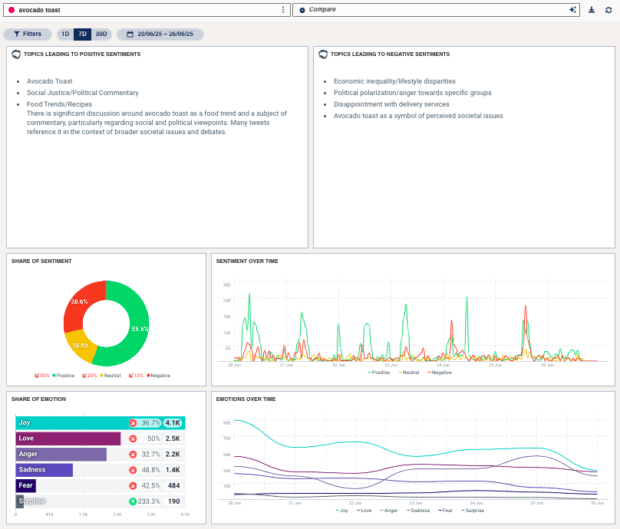
We don’t want to call out any specific brand here, but we do want to show you what this looks like. So, here’s a basic sentiment analysis for the topic of avocado toast. You can see that if avocado toast was a brand, they would want to lean into recipes but maybe stay away from talking about millennial financial habits (or at least tread carefully on that front).
Source: Hootsuite Listening
In particular, watch for sudden dives or peaks in people’s affection and affinity for your brand, and make sure you figure out their source. For example, the avocado toast people would want to look into what happened toward the end of the week to cause a couple of spikes in negative sentiment.
If something you’ve posted has resulted in a sudden drop in brand sentiment, you may have a PR crisis on your hands.
Reputation management
A brand’s reputation is one of its greatest sources of value. That’s always been true, but it’s even more important now that consumers can share their experiences so widely. (And that people have to be so careful when purchasing from unknown brands.)
Think about the research a new customer might do before buying from your brand. They might check out review sites and forums, or seek out opinions posted by relevant bloggers or social content creators.
You need to understand what they’ll find when they start that search.
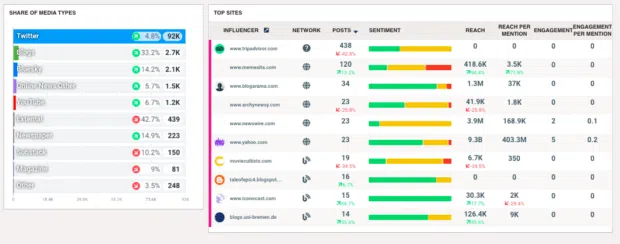
A good brand and social media monitoring tool can show you where the conversations are happening and what the sentiment is like on each platform.
Source: Hootsuite Listening
If there’s a negative conversation happening, you need to find ways to address it. If it’s glowing, look for ways to lean into and amplify the praise.
Learn how well your products and services work for your customers
When customers talk amongst themselves, they reveal all kinds of information you’d never get from a brand survey.
Keep an eye out for mentions of specific features or aspects of your products or services. This includes both existing features that are inspiring conversation as well as features consumers are expressing desire for. What’s working? What’s not? What new products or features are they hoping you’ll develop?
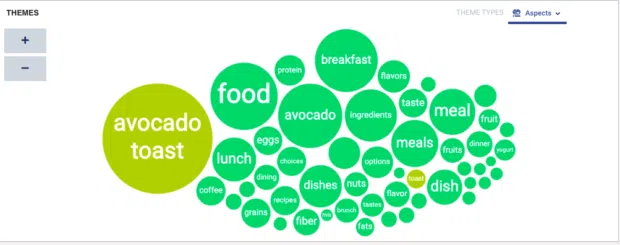
For example, here we can see that people are talking positively about the protein, fiber, and fats in avocado toast.
Source: Hootsuite Listening
If the avocado toast marketing team had previously focused on the flavor and taste of the dish, could inspire a new campaign based on nutritional benefits.
Understand the competitive landscape
Peeping on your competition to see what they’re doing right, and wrong, is part of holistic brand monitoring. You can incorporate this info into a competitive analysis and a SWOT analysis.
Take the chance to learn from others’ successes and misses. But also keep an eye out for upcoming product launches or other big moves that you might need to prepare for.
Also watch for new competitors as they emerge.
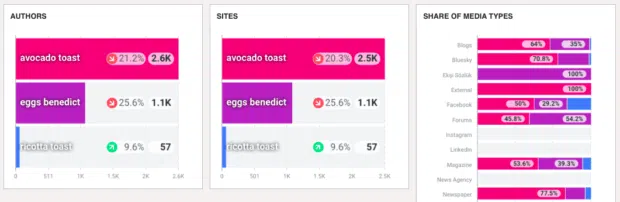
For example, in the breakfast category, avocado toast and eggs benedict should both be keeping an eye on ricotta toast. Sure, it’s a tiny upstart for now, but the conversation is picking up, especially on Facebook and in magazines.
Source: Hootsuite Listening
Set realistic benchmarks for awareness and sentiment
We talk a lot on this blog about setting SMART goals. That is, goals that are:
- Specific
- Measurable
- Achievable
- Relevant, and
- Time-bound
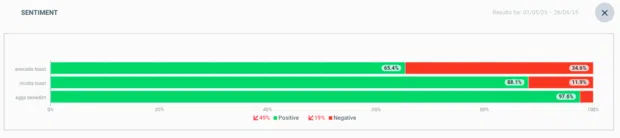
Brand monitoring is critical for knowing whether your goals are achievable. When you know what others in your industry are achieving, you see what’s really possible for your brand. You’ll be able to set goals that push your team to excel, but not to the point of unrealistic expectations.
For example, avocado toast is well behind both ricotta toast and eggs benedict when it comes to positive sentiment. The marketing team might want to adjust sentiment goals upward based on these competitive benchmarks.
Source: Hootsuite Listening
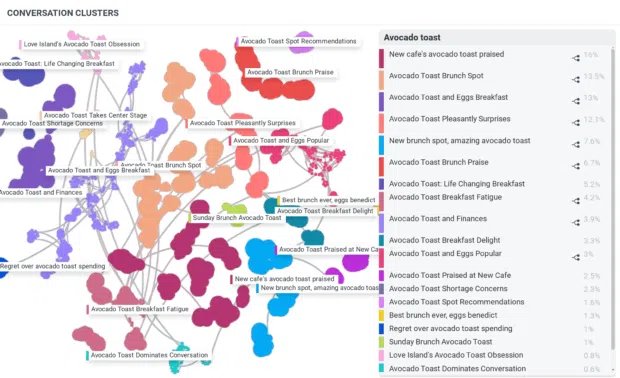
Spot consumer and industry trends
You don’t operate in a vacuum. A solid brand monitoring strategy keeps your online presence ahead of industry and consumer trends.
On the consumer side, look for changing preferences, new ways of talking about products in your niche, and shifting customer demographics.
Source: Talkwalker
On the industry side, brand monitoring ensures you’re up to date on any relevant policy changes, technical requirements, or other shifts that might impact your brand.
Source user-generated content and social proof
Whether people love your brand or hate your brand, if they feel strongly about you they are probably creating content about you.
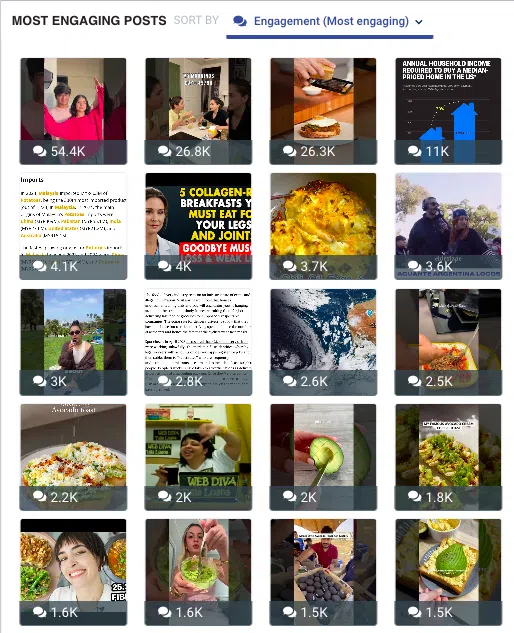
We’ve already talked a little bit about some of the ways to address negative opinions. Positive content, on the other hand, can help fill your content calendar and build your online reputation through social proof.
We’ve got a whole blog post on how to incorporate user-generated content into your social strategy. Brand monitoring tools can help you find the UGC that’s generating the most buzz and engagement.
Source: Hootsuite Listening
Connect with relevant influencers and journalists
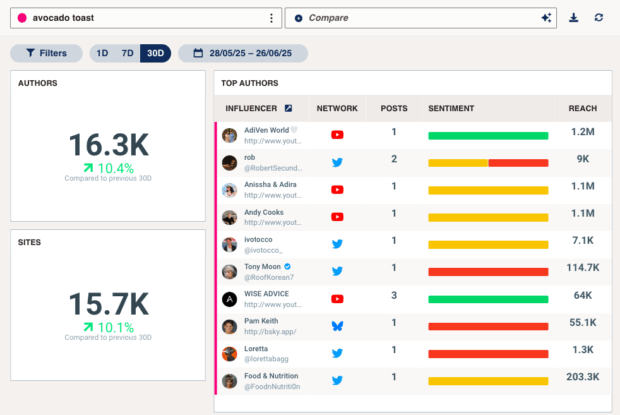
On social platforms, influencer partnerships are a key way to get your brand in front of new audiences. Beyond social networks, journalists covering your industry may be interested to know about newsworthy developments coming from your brand.
Source: Hootsuite Listening
Brand monitoring helps you identify and understand these opinion leaders. Brand monitoring tools can also give you key insights to inform your initial message when you reach out to connect.
What can you monitor?
You’re probably already tracking and responding to direct messages and tagged social mentions of your brand. (If you’re not, please, start doing this right away!) But the conversation about your brand online extends well beyond those direct mentions that trigger notifications from the social media platforms themselves.
Here are some important areas to monitor with your brand monitoring tools.
Brand mentions
This is the most obvious and most important element to keep watch for. But, as we just said, it’s important to look beyond direct @mentions and tags of your brand name or products. Monitor all of the following, including common variations and misspellings:
- Your brand name
- Product names
- Mascot names
- Taglines of slogans
- Branded hashtags
- Executive/C-suite names
You can use keyword combinations to monitor different aspects of your brand health and public perception, like customer service, product quality, and campaign messaging.
Competitor keywords
You can learn a lot from your competitors. You can determine how deep to go on your competitor monitoring depending on how many competitors you have, and how closely their target audience mirrors yours.
For example, Coke and Pepsi would keep very close watch of each other. But they’re probably less concerned about what smaller craft cola brands are doing. They wouldn’t ignore these brands entirely, but they’d focus less of their attention on monitoring their every move.
For your top competitors, you might want to monitor all the same types of mentions and keywords listed above. The key will be to use more complex searches to see when they take action that could impact your brand, like releasing a new product, opening a new store, or launching a new campaign (especially with an industry influencer or spokesperson).
Industry keywords
Here you’re looking for terms that apply to your industry as a whole. These may be more general, but they give you a bird’s-eye view of what’s happening:
- Industry buzzwords
- Industry hashtags
- Names of new policies or regulations that apply to your industry (or relevant keywords)
- Activists/advocates/thought leaders in your industry
Brand ambassadors and partners
Aligning your brand with any outside person or company comes with an element of risk, since you can’t control what they say and do. Brand monitoring helps ensure you’re aware of any challenges that could impact your own brand reputation. Here are a few things to monitor:
- Names of influencers and spokespeople
- Names of suppliers, vendors, and distributors
- Names of your shipping companies
What channels should you monitor for brand mentions?
The simple answer is that you should monitor conversations about your brand anywhere they are happening. Of course, when you first start your brand monitoring program, you might not know where brand conversations are happening.
It’s always best to cast a wide net. A good brand monitoring tool will comb through millions of data sources for you. If you’re monitoring manually, you’ll need to be far more selective. Here are some key channels to keep an eye on:
- Social media: Facebook, Instagram, LinkedIn, TikTok, Bluesky, etc.
- Forums: Reddit, Quora, niche forums for your industry
- News sites: News articles from CNN, the BBC, etc., as well as more niche news sites for your industry and press release sites
- Print and broadcast media: Local and national newspapers, magazines, columnists, TV, and radio
- Blogs, newsletters, and podcasts: Hosted/written by relevant thought leaders in your industry
- Review sites: G2, Glassdoor,Trustpilot, etc.
7 tips for a smart brand monitoring workflow
1. Structure your alerts
You don’t need to (and realistically can’t) take action on all of your brand monitoring findings every day. However, some things do require your immediate attention. Structure your alerts so you get the information when you really need it. Here’s a suggested system:
- Real-time alerts: For major dips in sentiment and emerging crises.
- Daily digests: Daily summaries of the conversation about your brand, industry, and competitors.
- Weekly or monthly roundups: Trends in sentiment, conversation volume, and emerging themes for more detailed analysis and strategy building.
2. Use Boolean operators (or AI) to target your search while filtering out noise and false positives
Boolean operators are the “ANDs,” “ORs,” and “NOTs” that allow you to make your monitoring searches much more specific.
AND helps you narrow your search by including more variables. OR broadens by including a number of different possibilities. And NOT excludes terms that could create false positives.
A couple of classic examples here are brands like Apple and Amazon, whose names are real words with their own meanings. NOT Boolean operators can help exclude results about orchards and rainforests.
Tip: Look for a brand monitoring tool that includes an AI-powered query builder. This allows you to state what you’re looking for in natural language rather than typing a long string of Boolean operators.
3. Use segment monitoring
If you only monitor your brand as a monolith, you can miss important pockets of data that highlight specific threats and opportunities.
For example, maybe people absolutely love one product, but they have some concerns about another. Your overall customer sentiment may still be firmly positive, so you could glaze over the problem. Monitoring at a more segmented level helps you spot more specific opportunities for action.
Try breaking things down by:
- Geography
- Product line
- Target demographic
Boolean operators can help here, or use a brand monitoring tool that can help you automate this.
4. Have a plan for what to do with your data
Sure, it’s called brand monitoring. But monitoring is actually only half the job. For brand monitoring to be useful, you need to actually do something with the insights. Rather than gathering data for data’s sake, make a plan for how you’ll put your findings into action.
For example:
- Use customer feedback to guide development and new features
- Use areas of confusion to steer the creation of new help docs or explainers
- Create a marketing campaign based on positive online conversations happening in niche groups
5. Have crisis management plans in place
You’ll eventually uncover something that requires higher-ups or other teams to step in. It could be an emerging PR crisis, reputational damage, or a product that’s not living up to your brand promise.
Brand monitoring allows you to spot these issues quickly. But to address them quickly, you need a plan in place before they happen. Create very clear guidelines about what kind of findings require escalation and who to notify.
6. Engage with opinions
Some people will love you. Some will … not. Either way, if people are expressing opinions about your brand, you may want to join the conversation.
Yes, it can be a good idea to engage with even those negative opinions. However, it’s important to remember never to feed the trolls. If you make an honest effort to resolve a negative experience but someone clearly just wants to trash you, it’s okay to back away. Others will see you’ve attempted to resolve the issue in good faith. The key is to show the public that you’re listening.
For positive opinions, engaging is of course a lot more fun. Thank people for their support and start to build relationships. This could lead to a new influencer partnership!
3 brand monitoring tools (from least to most advanced)
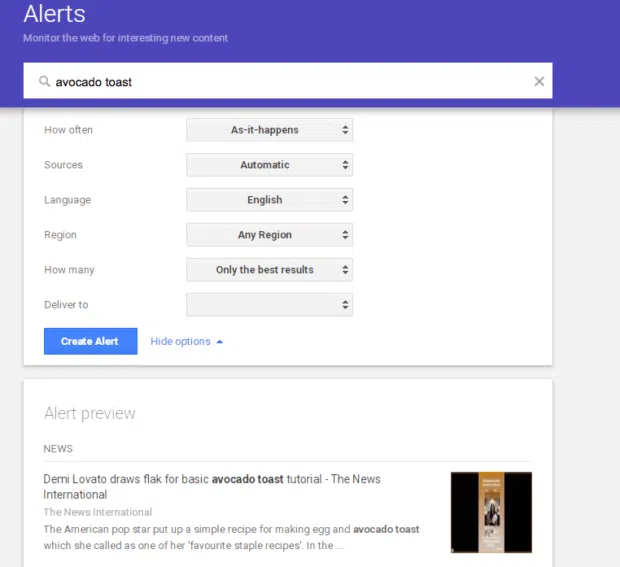
1. Google Alerts
Source: Google Alerts
Google Alerts is a free, basic brand monitoring tool that alerts you whenever a new result for your search query appears in Google search results.
You can set a few parameters here, including language and geography. You can also specify what kinds of sites you want to see results from:
- Blogs
- News
- Web
- Video
- Books
- Discussion
- Finance
Note that social media is not an option here. You’ll get results if a new account uses your keyword search in areas like the account name, but you won’t get alerts for social media posts.
There’s also no analysis: Just straight-up text alerts when new results appear.
That said, this is a very useful tool to get started with, and can have long-term value for very small brands or solopreneurs.
2. Hootsuite Listening
Source: Hootsuite Listening
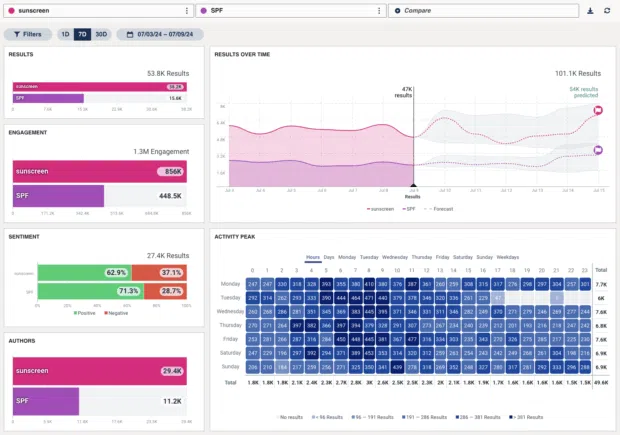
Every Hootsuite plan includes everything you need to get started with brand monitoring.
Use Quick Search to discover trending hashtags, brands and events anywhere in the world, or dive deeper for personalized insights on your brand.
You can track what people are saying about you, your top competitors, your products — up to two keywords tracking anything at all over the last 7 days.
Plus, you can use Quick Search to analyze things like:
- Key metrics. Are more people talking about your brand this week? What’s the vibe of their posts? Hootsuite Listening doesn’t just track what people are saying — it uses enhanced sentiment analysis to tell you how they really feel.
- Top themes. How are people talking about your brand? What are the most popular positive and negative posts about? Which other conversations are you showing up in?
- Results. Ready to get into specifics? The results tab will show you a selection of popular posts related to your search terms — you can filter by sentiment, channel, and more.
You also get access to the built-in AI query builder, which turns simple keywords into powerful brand monitoring queries so you can find sharper insights, faster. Just type what you’re looking for, and let Hootsuite’s AI handle the rest — no Boolean operators required!
3. Talkwalker
Source: Talkwalker
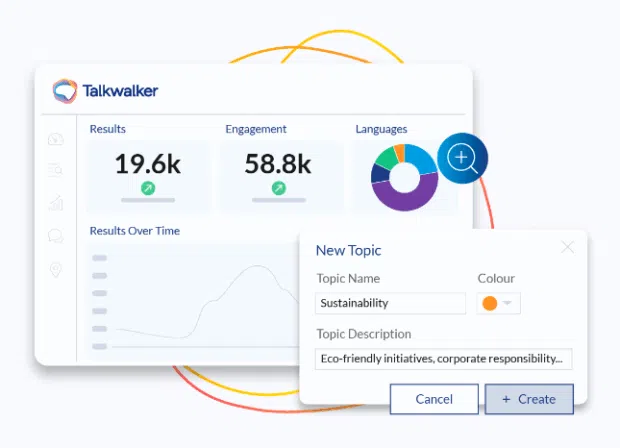
Talkwalker is a comprehensive brand monitoring tool that covers social media plus websites, forums, newsletters, videos, podcasts — more than 150 million sources in total. With more than 50 advanced filters, you can segment your data and identify exactly the right areas to monitor.
You can set up custom alerts and reports on your desired schedule. And you’ll find predefined dashboards to access quick and actionable insights.
Beyond telling you what’s already happened, Talkwalker also uses AI to forecast 90-day trends in conversation volume and engagement for any brand or topic, so you can build a strategic plan to get ahead of the competition.
Hootsuite makes it easy to monitor keywords and conversations on social media, so you can focus on taking action on the insights available. Try it free today.
The post Brand monitoring: The 2025 guide for real business impact appeared first on Social Media Marketing & Management Dashboard.
* This article was originally published here
Saturday, June 28, 2025
Friday, June 27, 2025
Thursday, June 26, 2025
2025 real estate social media marketing: Tips + free template
Real estate social media marketing is about much more than posting pretty pictures and enticing videos to show off your new listings. Social media helps build your personal brand so you can showcase the real, unique value you bring to the home-buying and -selling process. (Not just the properties you have for sale right now.)
Social media is the top tech tool for connecting real estate agents with quality leads. On this front, social far outpaces brokerage and realtor websites, MLS, and listing portals.
Nearly all real estate agents in the U.S. (91%) are using social media in their businesses, and 70% said it has an impact. That’s great for the majority of agents, but what about that 21% who are using social and not seeing results?
In this post, we’ll show you how to get strategic with your real estate social media use to drive real business results like:
- more leads and referrals
- stronger repeat client relationships
- and, yes, more activity on your listings, too.
Key Takeaways
- Social media is real estate’s #1 lead-gen tool. With 91% of U.S. agents using social platforms and 70% seeing results, social media outperforms MLS and listing portals for attracting quality leads—especially when it’s used to build a personal brand, not just promote listings.
- Different platforms serve different goals. Facebook is best for reaching older, financially established buyers and sellers, Instagram leads in engagement (especially with women), TikTok offers untapped potential among future buyers, and LinkedIn drives referrals through professional networking.
- Effective content goes beyond listings. Top-performing agents use tactics like video tours, market updates, local spotlights, client celebrations, and behind-the-scenes posts to build trust, grow relationships, and stand out. They also use DMs, collaboration, and targeted ads to generate real business results.
Which social networks are the best for real estate marketing?
The social network that will work best for you depends on what you’re trying to achieve. Looking strictly at engagement rates, Instagram comes out on top for the real estate industry.
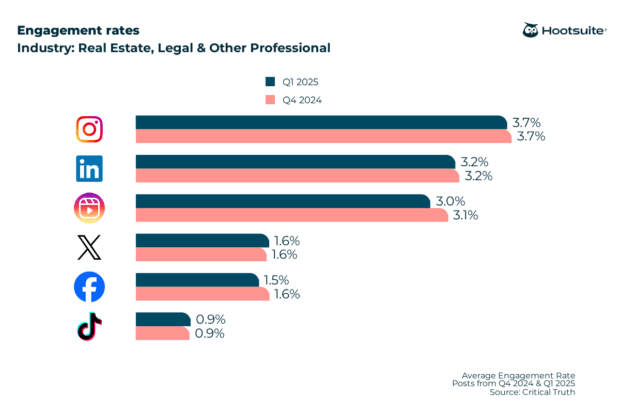
But you’re not using social media just to get engagement – you want it to help you win new potential clients and sell more homes. Here’s how each of the major social media platforms can help you reach those goals.
Facebook is best for
Showcasing current listings and reaching people actively thinking about buying or selling a home.
Why it works
The most recent data from the National Association of Realtors (NAR) shows that home buyers and sellers are firmly within the Facebook demographic.
The median age for a home buyer is 56 years old, and that of a home seller is 63. Pew Research data shows that 70% of Americans aged 50 to 64 use Facebook. It’s by far the most commonly used social network for people in this age group. The Facebook demographic is also financially well established: It’s the most commonly used platform for people with an income of $70K+ per year.
Benchmark data
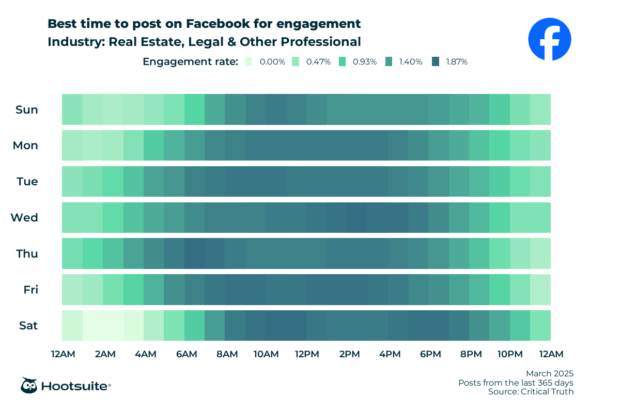
The best time to post on Facebook for engagement for real estate, legal, and other professionals is generally between 8 a.m. and noon.
The best type of content for realtors to post on Facebook is albums, with a 2.9% engagement rate. That’s not surprising, since albums give you the chance to show off a listing in great detail. Photos are next at 1.5%.
What’s interesting is that status updates actually get a slightly higher engagement rate than videos on this platform: 1.1% compared to 0.9%. A photo gallery looks like a better option for highlighting different areas of a listing than a video on Facebook.
Note that links get the lowest engagement at 0.6%. Rather than linking out to a listing, provide all the necessary information within the post itself and encourage viewers to connect.
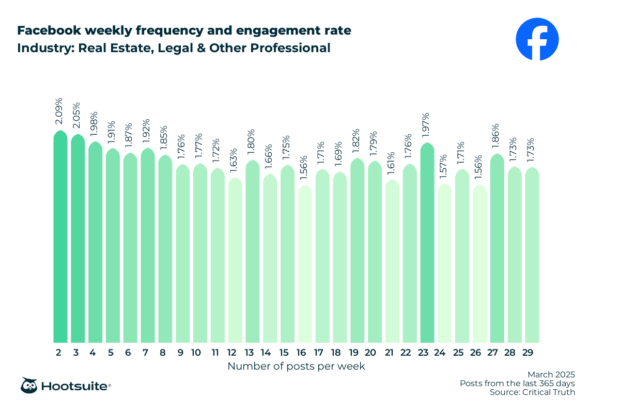
The average weekly follower growth rate for real estate, legal, and other professionals on Facebook is 1.6%, and the average weekly posting frequency is 11.6 posts. Real estate agents may actually be posting too often on Facebook. The highest engagement rates happen when these accounts post 2 to 4 times per week.
Instagram is best for
Driving engagement.
Why it works
Instagram has the highest engagement rates for real estate content. That makes it an effective tool for getting attention for current listings and building relationships by growing your follower base.
An interesting factor to note when planning your content calendar: NAR data shows that 20% of recent buyers were single women, compared to just 8% who were single men. Instagram’s U.S. user base also has more women (55.4%) than men (44.6%)
Benchmark data
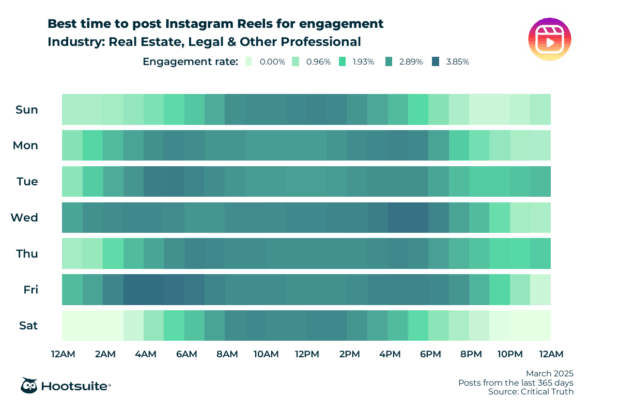
The best time to post for engagement for real estate, legal, and other professionals is generally very early in the morning (before 7 a.m.!) or in the late afternoon.
The best type of content for real estate agents to post on Instagram is carousels, with a 4.1% engagement rate. Photos are next at 3.5%, followed by Reels at 3.0%.
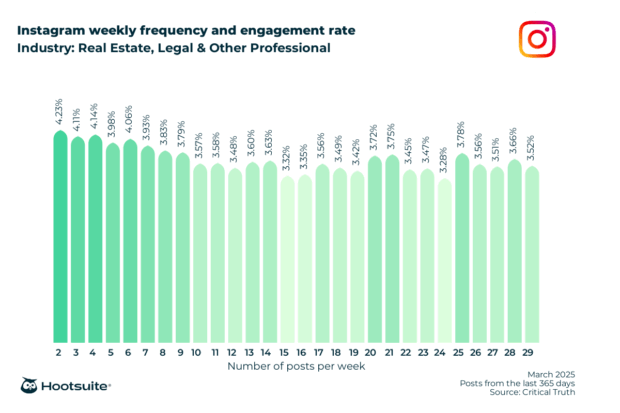
The average weekly follower growth rate for real estate, legal, and other professionals is 0.97%, and the average weekly posting frequency is 8.6 posts. Again, real estate agents may be posting too often, as the highest engagement happens when these accounts post 2 to 6 times per week.
TikTok
TikTok is best for
Reaching first-time buyers and future buyers.
Why it works
TikTok is most popular among those aged 18 to 29, followed by those aged 30 to 49.
For now, Gen Z makes up just 3% of buyers and 2% of sellers, but they are building their real estate knowledge. Young millennials already make up 12% of home buyers. And the average first-time home buyer is 38.
Only 15% of U.S. real estate agents currently use TikTok in their business. (Compare that to the 87% who use Facebook and 62% who use Instagram.) That gives you a chance to get established on this platform with very little competition – if you start now.
Benchmark data
Fridays are the best day for engagement for real estate, legal, and other professionals on TikTok.
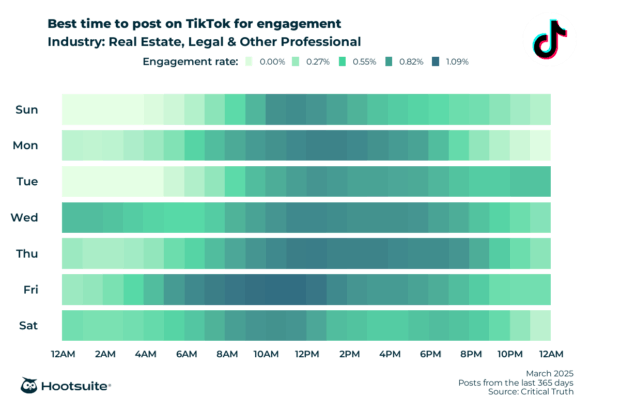
TikToks in the real estate, legal, and other professional industries get an average 0.9% engagement rate.
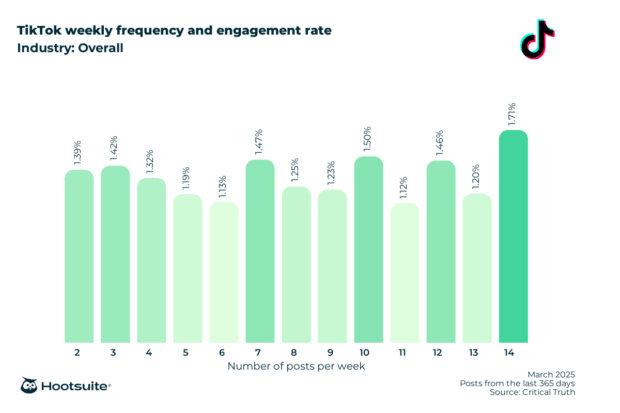
The average weekly follower growth rate for real estate, legal, and other professionals is 1.62%, and the average weekly posting frequency is 3.1 TikToks. We don’t have specific data for the real estate industry on the correlation between posting frequency and engagement rate on TikTok, but overall, the optimum number of posts is 13.
So, unlike on Facebook and Instagram, real estate agents may want to increase their posting frequency on TikTok to maximize engagement.
LinkedIn is best for
Building (and maintaining) professional networks that drive referrals.
Why it works
The stronger your professional network, the more chances you have to get a referral. This is a big deal: 40% of all buyers and 51% of first-time buyers found their real estate agent through a referral. For sellers, 66% used an agent that was referred to them or that they had used before.
Benchmark data
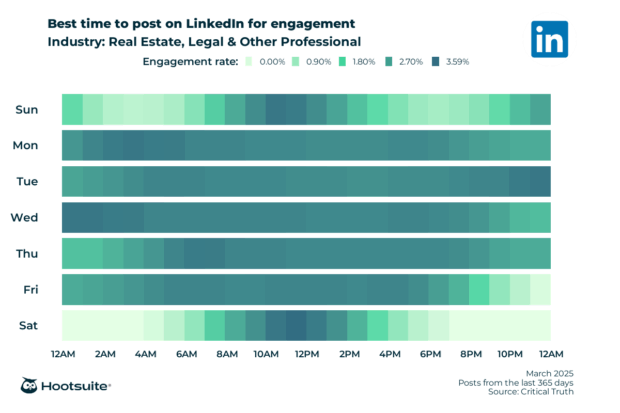
Real estate, legal, and other professional posts see most of their engagement on weekdays, with spikes of high activity around lunchtime on the weekends.
The best type of content for realtors to post on LinkedIn is videos, with a 4.0% engagement rate. Photos are next at 3.3%.
Status updates don’t get a lot of engagement for realtors on LinkedIn: Just a 1.6% engagement rate. Links actually get higher engagement at 2.1%.
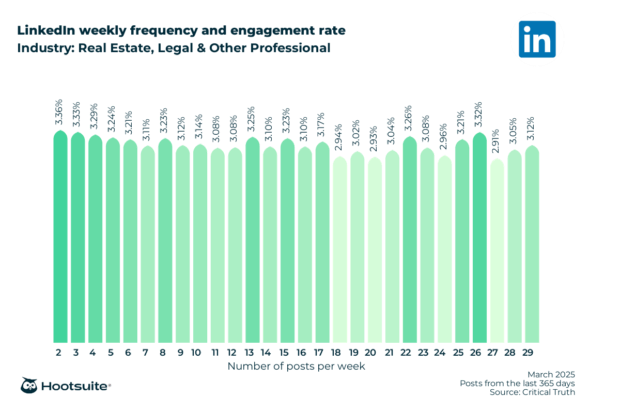
The average weekly follower growth rate for real estate, legal, and other professionals is 0.9%, and the average weekly posting frequency is 5.4 posts. Posting frequency does not have a clear effect on engagement rate for LinkedIn, as the rate moves up and down in a way that makes it tricky to make a call about what’s best.
14 social media marketing tactics for real estate agents and firms
We’re pretty sure you’re already posting your current listings on social media, so we’re not going to include that as a tactic here. Instead, we’ll look at more strategic ways to use your online presence to support your real estate business, grow your client list, and sell more homes.
1. Build a consistent brand
Brand awareness is important in any industry, but especially in real estate, where client–agent relationships are built on trust. But branding isn’t just about your logo, font, or colors. It’s about knowing your values and exuding them online.
Oakwyn Realty uses their motto of “work hard, stay humble” as a consistent theme in their social posts. When the firm’s agents participated in a softball tournament, the motto was on their jerseys. Showing the agents having fun as a team was a great way to drive the motto home while highlighting the real people behind the brand, too.
2. Prioritize relationships and community
The primary goal of real estate social media should always be relationship building. Engage with your followers. Respond promptly and courteously to comments and messages.
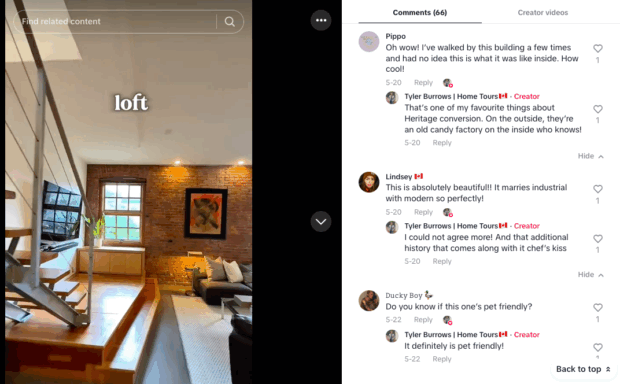
Vancouver realtor Tyler Burrows has built a full TikTok channel of high-quality video home tours that get thousands of views – and plenty of comments. He’s fully engaged with his audience, responding to every one.
Source: @thetylerburrows
What’s interesting is that Tyler is not the listing agent on many of the homes he showcases, but of course, he can still help anyone who’s interested in buying these homes. Every video helps build his relationship with his followers, too.
Tip: Hootsuite Inbox can help you stay on top of all your social media comments and DMs, all in one place.
3. Lean into video
You saw above that carousels have higher engagement rates than videos on Facebook and Instagram. But in real estate, engagement is not necessarily the most important metric. If you’re looking to extend your reach and visibility, short-form video (like TikToks and Instagram Reels) is tough to beat.
Tampa-based realtor Breanna Banaciski takes a very unconventional approach to real estate social media, but it makes her 125,000 followers love her. Her videos regularly get hundreds of thousands to a million-plus views, and thousands of comments.
Like Tyler in the example above, Breanna creates videos for many homes where she is not the listing agent. She’s developing a personal brand so she’s the first person her followers call (or, more realistically, DM) when they are ready to buy or sell.
4. Highlight your local area expertise
Home purchases often come with a move to a new neighborhood. They may even mean moving to a whole new city, state, or country! In this case, it’s particularly important for real estate agents to understand the areas they represent.
Consider posting about local events, neighborhood hangouts, new restaurant openings, festivals, museums, sporting events, and more. Your audience will appreciate social media content that has a personal touch and gives them insights into their new hometown.
Arlington, VA, real estate advisor Gabrielle Witkin regularly shares her favorite things about her city, and even created a local’s summer bucket list guide.
5. Show your work behind the scenes
Not everyone knows exactly what real estate agents do – or why they’re such an important part of the home-selling process. Letting followers in on some of the work you do behind the scenes helps show the value of hiring an agent. It’s also an opportunity for some comedic relief.
6. Celebrate your clients’ success
Buying or selling a home can feel like a major challenge for people who are already dealing with the stress of a move. Showing happy clients who have successfully navigated the process makes it all seem a little more manageable.
Vancouver realtor Lindsie Tomlinson shares “possession day” posts showing featuring clients on the day they get the keys to their new home.
In the captions, she often includes details about how she helped her clients find their dream home, whether that’s simply looking at a lot of listings to find the right one, or helping clients avoid a purchase in a building with potential issues.
7. Collect testimonials
While brands in other industries can share user-generated content to create social proof, that’s a little trickier for real estate agents. That makes testimonials a powerful asset for agents to build their reputation on social platforms.
Always be sure to ask your clients for permission before posting their testimonial. For more eye-catching visual appeal, give it a basic graphic design treatment rather than using simple text.
8. Tell great stories
Here we’re talking about telling stories, not posting Instagram Stories. That is, we’re suggesting you look for ways to incorporate storytelling principles into your social posts.
This won’t work for every listing. (A new-build condo, for example, may not have a compelling story to tell.) But when there is something interesting about a property, take the time to get that story out there.
For example, this small, pie-shaped house in Seattle might not immediately seem like a hot property. But the home’s history as a “spite house” gained plenty of attention on both social media and conventional news channels, and the home sold in just two weeks.
9. Provide market updates and context
For many people, real estate is a black box. It can be intimidating if you don’t really understand the process or the market.
Agents and brokers can use social media to demystify real estate with educational content. Talk about market trends, or offer advice on how to get ready for a home purchase or sale. This will help build trust, and can also be a useful way to set expectations when talking about pricing, listing, and bidding strategies.
10. Highlight home decor and DIY trends
Home decor is a popular topic on many social media platforms, and it’s a logical trend for real estate professionals to hop on. From home staging ideas to DIY projects that improve the value of a home, there’s plenty of ground here to provide content that entertains and keeps your followers engaged.
Toronto-based real estate sales rep Miranda Caldwell has built a TikTok audience of more than 400,000 by combining her real estate expertise with her love of design.

Source: TikTok
11. Build your email list
Social media followers are great, but your own subscribers are even better. Try creating a resource like a checklist, guide, or detailed market report that you use for lead generation. Tip: Automated DMs are a great way to put this into practice on Instagram!
Spokane, WA, realtor Alyssa Curnutt uses automated DMs on Instagram to collect leads with resources like her guide to Spokane’s best brunch spots.
12. Post your weekly open houses on a set schedule
Consistent posting trains your followers to expect content from you on a specific schedule, and even to seek it out if the algorithm doesn’t deliver it to their feed. Open houses are definitely a topic of interest for those thinking about buying a home.
Next Move Property in SIngleton, Australia, posts a list of their open houses every Friday. This is a great resource for potential buyers looking to plan their weekend real estate viewing.
13. Collaborate with relevant professionals
You’ve already seen one form of collaboration in this post: Realtors creating video tours highlighting properties for which they are not the listing agent.
But given the number of professionals required to complete a real estate transaction, there’s lots of room to collaborate with other relevant people in your local area, too. Think about staging companies, mortgage brokers, appraisers, photographers, and videographers. Also consider service providers that can help make the move itself easier for your clients, like movers and cleaners.
These connections can make life simpler for your clients. Showcasing them on social media shows your commitment to the whole process of moving homes, not just making the sale. Partnering on social media is also a good way to expand the audience for both you and your collaborators!
14. Test targeted social ads
One of the biggest benefits of having a digital marketing strategy for real estate is the ability to boost your efforts with paid social media. Not only can strategic investments get your content in front of more people, but you’ll be able to target your best customers directly.

Source: @danaharperrealestate via Meta Ad Library
Set targeting parameters by location, age, demographic, and interests to ensure everything you post is seen by the most qualified audience.
Hootsuite Ads lets you manage paid campaigns across networks with ease. Plus, build comprehensive reports that show you what’s working, what’s not, and where you should target next.
Free real estate social media strategy template
Bonus: Get a free social media strategy template designed specifically for real estate agents, brokers, and marketers. Use it to easily plan your own strategy, track results, and keep your team in the loop.
Ready to level up your social presence to bring in new leads on autopilot? Use Hootsuite to schedule, publish, and analyze your content and stay on top of DMs across all your platforms—from one dashboard. Try it free today.
The post 2025 real estate social media marketing: Tips + free template appeared first on Social Media Marketing & Management Dashboard.
* This article was originally published here
Subscribe to:
Comments (Atom)